

Have you ever had a conversation that left you emotionally exhausted?
Maybe someone you barely knew suddenly shared deeply personal details about their trauma. Or perhaps you’ve caught yourself unloading everything onto a friend because the emotions felt too big to hold alone.
This is often called trauma dumping.
The tricky part is that trauma dumping and healthy emotional sharing can look similar on the surface. Both involve talking about difficult experiences. The difference is in how, when, and why those experiences are shared.
Understanding trauma can help you build healthier relationships, communicate more effectively, and protect your emotional well-being without shutting down vulnerability.
Readers who struggle with social situations take the Social Anxiety Test for more targeted insights.What Is Trauma Dumping? (Quick Answer)
Trauma dumping is the act of sharing intense emotional experiences, traumatic events, or personal struggles without considering the other person’s emotional capacity, consent, or readiness to receive them.
Common signs include:
- Oversharing deeply personal experiences with strangers or acquaintances.
- Sharing without checking if the listener is emotionally available.
- Repeatedly unloading emotional pain without seeking solutions.
- Using conversations primarily as an emotional release.
- Leaving others feeling overwhelmed or emotionally drained.
Trauma dumping is usually not done with bad intentions. Often, it comes from pain, loneliness, or a need to feel understood.
💬 Feeling emotionally overwhelmed and not sure where to put your thoughts? Talk to Soululu a private, judgment-free space to process emotions safely.
What Does Trauma Dumping Mean?
The trauma dumping meaning is often misunderstood.
Many people assume any conversation about trauma is trauma dumping.
That is not true.
Talking about difficult experiences is healthy. Opening up to trusted people is important. Therapy, support groups, and meaningful conversations all involve discussing painful experiences.
Emotional dumping happens when emotional sharing becomes overwhelming for the listener because boundaries, timing, or emotional readiness are not considered.
A simple way to think about it:
| Healthy Sharing | Trauma Dumping |
| Mutual conversation | One-sided emotional unloading |
| Consent is considered | No emotional check-in |
| Builds connection | Creates overwhelm |
| Space for both people | Focus remains on one person |
| Support and processing | Immediate emotional release |
Trauma Dumping Examples
Understanding trauma dumping examples can make the difference clearer.
Example 1
You meet someone at a party.
Within ten minutes, they tell you detailed stories about childhood abuse, family trauma, and past relationships without any context or emotional check-in.
This may be emotional dumping.
Example 2
A friend asks:
“Do you have the energy for me to vent for a few minutes?”
You agree, and they share something difficult. This is healthy emotional communication.
Example 3
Someone repeatedly messages you every day with long emotional crises, but never asks how you’re doing.
This may be emotional dumping rather than mutual support. If you’re struggling with anxious thoughts, take our Anxiety Test to better understand your symptoms.
Signs of Trauma Dumping
Here are common signs of trauma dumping:
- Sharing highly personal trauma with people you barely know.
- Ignoring emotional boundaries.
- Dominating conversations with personal pain.
- Expecting others to act as therapists.
- Becoming upset when others cannot provide support.
- Repeating the same traumatic stories without processing them.
- Using emotional sharing as the only coping strategy.
Sometimes people who vent are not trying to be selfish.
They simply have not learned healthier ways to process difficult emotions.
Why Do People Trauma Dump?
Most emotional dumping comes from unmet emotional needs.
Common reasons include:
Loneliness
People often carry emotional pain alone for years before it spills out unexpectedly.
Lack of Support
If someone has never had a safe space to talk about their experiences, they may release everything at once.
Emotional Overwhelm
Sometimes emotions build faster than a person can process them.
Unprocessed Trauma
Trauma that has never been acknowledged or worked through often seeks expression. This is why oversharing is usually more about pain than attention-seeking.
Am I Trauma Dumping?
This is one of the most searched questions online.
Ask yourself, do I:
- Check if someone is emotionally available before sharing?
- Leave space for the other person to speak?
- Am I sharing to connect or only to unload?
- Rely on one person for all emotional support?
- Do people often seem overwhelmed after conversations with me?
If you answered yes to several of these questions, you may be engaging in sadfishing without realising it.
The good news is that awareness is the first step toward healthier communication.
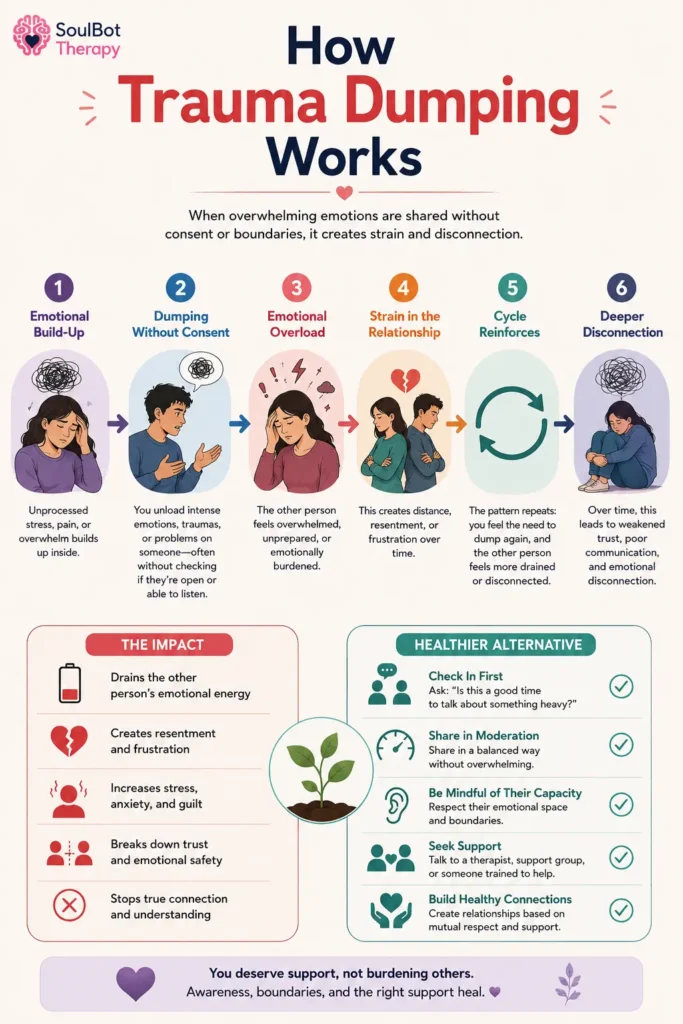
How to Respond to Trauma Dumping?
Knowing how to respond to trauma dumping can feel uncomfortable.
You want to be compassionate without becoming emotionally overwhelmed.
Try:
Set gentle boundaries
“I care about what you’re going through, but I don’t have the emotional energy for this conversation right now.”
Redirect toward support
“That sounds really difficult. Have you considered talking to a therapist or support group?”
Be honest
“I want to support you, but I feel overwhelmed and need a break from this conversation.”
Healthy boundaries protect both people.
How to Stop Trauma Dumping?
If you recognise these patterns in yourself:
Pause before sharing
Ask:
“Is this person emotionally available right now?”
Build multiple support systems.
Do not rely on a single person to meet all your emotional needs.
Journal first
Writing down your thoughts can help you understand what you actually need from a conversation.
Consider therapy
Therapy provides a safe place to process emotional feelings without worrying about overwhelming loved ones.
💬 If you need somewhere to process difficult emotions before bringing them into a relationship, talk to Soululu anytime.
Trauma Dumping vs Venting
Many people search for trauma dumping vs venting.
Here is the simplest difference:
| Venting | Trauma Dumping |
| Temporary emotional release | Repeated emotional unloading |
| Respects boundaries | Ignores emotional capacity |
| Includes mutual conversation | One-sided sharing |
| Helps regulate emotions | Often leaves people overwhelmed |
Venting can be healthy. Oversharing often signals that deeper support or processing may be needed.
In a Nutshell
Trauma dumping is not the same as being vulnerable.
Healthy vulnerability creates connection.
Oversharing happens when emotional pain is shared without considering the other person’s emotional capacity or boundaries.
Most people who overshare are not trying to hurt anyone. They are often carrying more pain than they know how to handle.
The goal is to share them in ways that create support, understanding, and healing for everyone involved.