

You want to speak up in class, at work, or during a conversation.
But you hesitate.
Maybe you stay quiet around new people. Or you replay conversations in your head afterwards. Social situations make you nervous, and you wonder:
“Am I just shy, or do I have social anxiety?”
It is a common question because shyness and social anxiety can look similar from the outside. Both can make you quieter, more reserved, or uncomfortable in social situations.
But they do not feel the same on the inside.
Understanding the difference can help you figure out whether what you’re experiencing is a personality trait or something that may need extra support.
Social Anxiety vs Shyness (Quick Answer)
The biggest difference between social anxiety vs shyness is intensity.
| Shyness | Social Anxiety |
| Temporary discomfort | Persistent fear |
| You can usually warm up over time | Anxiety often stays even after repeated exposure |
| May feel awkward | Fear of embarrassment or judgment |
| Doesn’t usually affect daily life | Can interfere with relationships, work, or school |
| Personality trait | Mental health condition |
A shy person may feel nervous meeting new people.
Someone with social anxiety often fears being judged, embarrassed, rejected, or humiliated in social situations.
Still wondering, "Am I just shy, or is it something more?" Knowing the difference is the first step toward feeling comfortable in your own skin. Take our quick, free Social Anxiety Test to better understand your anxiety patterns, identify your social triggers, and see how much it’s holding you back.What Is Shyness?
Shyness is a personality trait.
Shy people may:
- Take longer to open up
- Prefer smaller groups
- Feel nervous around strangers
- Need time to feel comfortable
But once they feel safe, many shy people enjoy conversations, friendships, and social activities.
Being shy is not a mental health problem. It is simply one way people experience social situations.
What Is Social Anxiety?
Social anxiety goes beyond being quiet or introverted.
Social anxiety involves intense fear of being judged, criticised, embarrassed, or rejected by others. People with social anxiety often experience:
- Extreme self-consciousness
- Fear of making mistakes in public
- Worry before social events
- Overthinking interactions afterward
- Physical anxiety symptoms
In severe cases, social anxiety can lead people to avoid situations they actually want to participate in.
Signs of Social Anxiety
Here are some common signs of social anxiety:
Before Social Situations
- Worrying for days or weeks beforehand
- Imagining worst-case scenarios
- Fear of saying something wrong
During Social Situations
- Racing heart
- Sweating
- Shaking
- Difficulty speaking
- Feeling frozen
After Social Situations
- Replaying conversations repeatedly
- Criticizing yourself
- Assuming others judged you negatively
These social anxiety symptoms often feel exhausting because the anxiety continues long after the event is over.
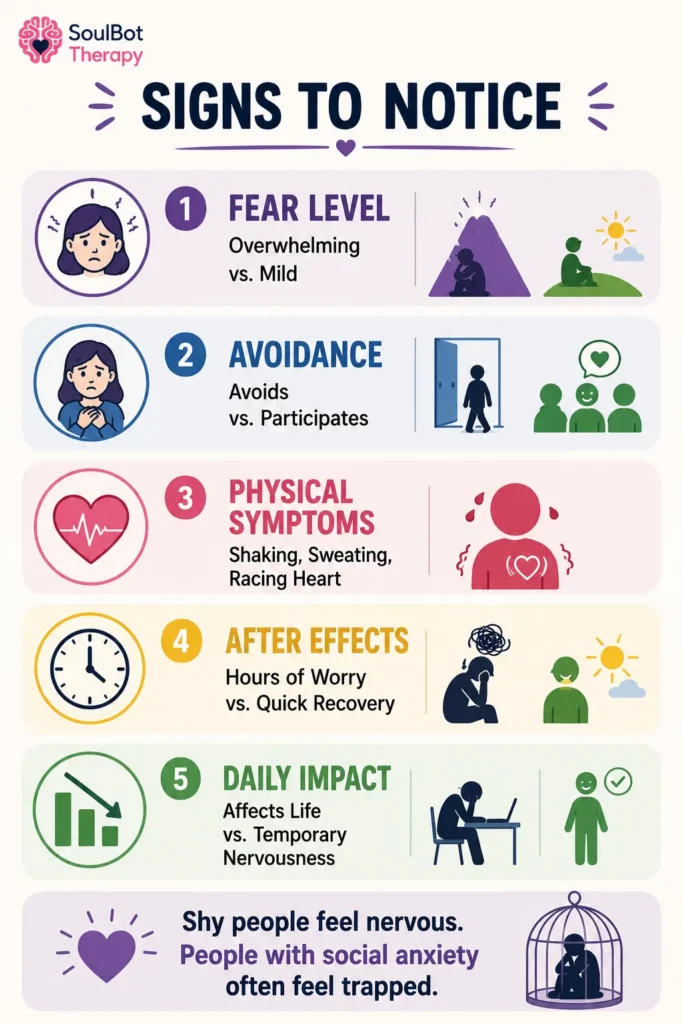
Am I Shy or Do I Have Social Anxiety?
Ask yourself these questions:
Do I avoid things I actually want to do?
A shy person may feel nervous but still participate.
Someone with social anxiety may avoid:
- Presentations
- Social events
- Meeting new people
- Dating
- Speaking in groups
Does my fear feel overwhelming?
Feeling nervous is normal. But if the fear feels intense enough to stop you from doing things, it may be more than shyness.
Do I constantly worry about being judged?
One of the biggest social anxiety disorder signs is excessive concern about what other people think. You may worry that:
- You sounded ignorant
- People noticed your anxiety
- You embarrassed yourself
Even when nobody else noticed anything.
Does it affect my daily life?
This is often the biggest clue.
If your anxiety affects:
- relationships
- work
- school
- opportunities
- confidence
It may be worth looking deeper.
Why Social Anxiety Feels So Real?
Social anxiety is not simply “being too sensitive.” Your brain is trying to protect you from perceived social threats. The problem is that the threat often feels much bigger than it actually is.
A simple conversation can feel like a performance. A small mistake can feel like a disaster.
That is why people with social anxiety often know their fears are irrational but still struggle to control them.
Can Shy People Also Have Social Anxiety?
Yes. Shyness and social anxiety are not opposites.
A person can be:
- shy without social anxiety
- socially anxious without being shy
- both shy and socially anxious
The difference comes down to how much fear, distress, and avoidance are involved.
How to Tell If You Have Social Anxiety?
If you are wondering how to tell if you have social anxiety, look for these patterns:
- ✅ Persistent fear of judgment
- ✅ Avoiding social situations
- ✅ Physical anxiety symptoms
- ✅ Overthinking conversations afterward
- ✅ Anxiety that affects your daily life
The more of these signs you experience, the more likely it is that social anxiety may be playing a role.
What Helps With Social Anxiety?
The good news is that social anxiety is highly treatable.
Things that often help include:
- Cognitive Behavioral Therapy (CBT)
- Gradual exposure to social situations
- Mindfulness techniques
- Self-compassion practices
- Professional support when needed
Small steps matter.
The goal is not to become the most outgoing person in the room.
💬 If social situations leave you exhausted, overwhelmed, or constantly second-guessing yourself, talk to Soululu and explore what might be driving those feelings.
Take the Social Anxiety Test
Still asking: “Do I have social anxiety or am I just shy?”
The easiest next step is to take our free Social Anxiety Test. It can help you understand:
- Your anxiety patterns
- Social triggers
- How much social anxiety may be affecting your life
💜 SoulTip: Being quiet does not automatically mean something is wrong with you. Some people simply need more time to feel comfortable.
In a Nutshell
When comparing social anxiety vs shyness, remember this:
Shyness is usually a personality trait. Social anxiety is a persistent fear of judgment that can affect daily life. If your nervousness stays manageable and fades with comfort, it may simply be shyness. If fear, avoidance, and overthinking are controlling your choices, social anxiety may be worth exploring further.
And understanding the difference is often the first step toward feeling more confident in social situations.