
Your heart races before a meeting that has not even started yet. You lie awake replaying a conversation from three days ago. You feel a low hum of dread that has no clear source, just always there.
Anxiety is the body’s natural response to a perceived threat. It becomes a problem when the response is excessive, difficult to control, and negatively affects daily activities such as work, school, or relationships.
The good news? Anxiety is one of the most treatable mental health conditions. Here is what actually works.
How to Deal With Anxiety: Quick Answer
- Breathe slowly: it signals your nervous system that you are safe.
- Move your body: even 5 minutes helps.
- Name what you are feeling: labelling reduces intensity.
- Challenge the thought: is it fact or fear?.
- Reduce what feeds it: caffeine, scrolling, avoidance.
- Get consistent support: therapy, community, tools like Soululu.
💬 Feeling anxious right now? Talk to Soululu, available anytime, judgment-free.What Anxiety Actually Feels Like?
Common symptoms include racing thoughts, excessive worry, difficulty concentrating, physical tension, and a sense of dread that feels disproportionate to the situation.
Anxiety is not weakness. It is your nervous system doing its job, just doing it too much, too often, in the wrong contexts.
According to the National Institute of Mental Health, anxiety disorders affect approximately 19.1% of adults in the United States each year, making them the most common class of mental health conditions. Source:
8 Proven Techniques to Deal With Anxiety
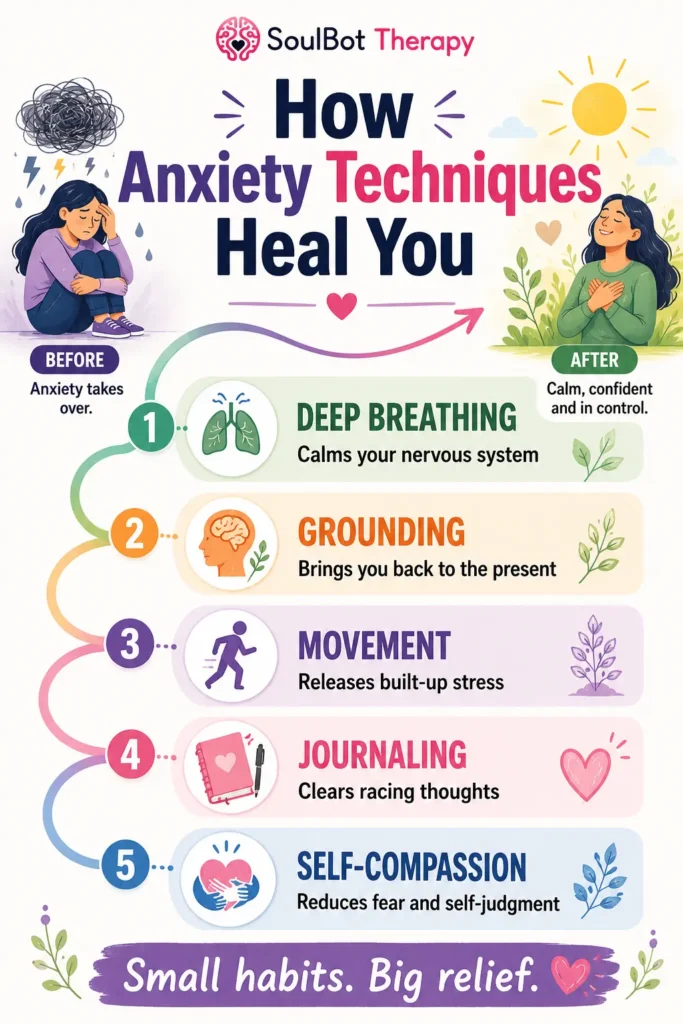
1. Breathe deliberately
Deep breathing slows your heart rate and signals calm. The 4-7-8 technique works well: inhale for 4 counts, hold for 7, exhale for 8. Even breathing in for 4 counts and out for 4 counts for 5 minutes can make a measurable difference.
2. Move your body
Physical activity has both immediate and long-term benefits for anxiety. Even brief activities like 30 to 60 seconds of squats, push-ups, or jumping jacks can help boost mood and calm the mind. You do not need a gym. You need movement.
3. Name what you are feeling
Saying or writing “I feel anxious right now” is not giving in to it. Journaling helps identify anxiety triggers and record what coping strategies work, with research showing that regular emotion-led journaling may reduce anxiety, depression, and distress.
4. Challenge the thought
Most anxiety is future-focused: a prediction of something bad happening. Ask yourself: Is this a fact or a fear? What is the actual evidence? What would I tell a friend thinking this?
Cognitive Behavioural Therapy tools help you reframe negative thought patterns, and CBT apps like WorryWatch and MindShift make these techniques accessible daily.
5. Use the 333 rule
The 333 rule is a grounding technique recommended for immediate anxiety relief: name 3 things you can see, 3 sounds you can hear, and move 3 parts of your body. It pulls your nervous system out of the future and into the present.
6. Reduce what feeds it
Caffeine and nicotine both exacerbate anxiety and disrupt sleep. Doom-scrolling before bed, skipping meals, and avoiding the things that make you anxious all make it worse over time. Small lifestyle changes compound.
7. Stop avoiding, start approaching
Avoidance is anxiety’s best friend. Every time you avoid something that makes you anxious, the anxiety grows. Gradual exposure to feared situations in small, manageable steps is one of the most evidence-based ways to reduce long-term anxiety.
8. Get consistent support
Therapy remains the most effective long-term treatment for anxiety, particularly CBT, which targets both the thoughts and behaviours that maintain it. If therapy feels out of reach right now, start somewhere, with a trusted person, a support community, or a tool like Soululu.
🧠 SoulTip: You do not have to eliminate anxiety. You just need to reduce it enough that it stops running your life. That is a realistic, achievable goal, and it starts with one small step today.
When to Seek Professional Help?
If anxiety is consistently affecting your sleep, relationships, or ability to function, it is worth speaking to a professional. You do not need to be in crisis to deserve support.
🧠 SoulFact: According to the World Health Organization, anxiety disorders affect 301 million people worldwide making them the most prevalent mental health condition on the planet. Yet fewer than 25% of those affected receive treatment.
Read more:
Why Do I Feel Overwhelmed All the Time?
How SoulBot Can Help?
Anxiety spikes at 2 a.m. In the middle of a workday. Before a hard conversation. Soululu is available in those moments as a private, calm space to process what you are feeling and access grounding tools when you need them most.
Here is what makes it different from a generic wellness app or a Google search:
It responds to you specifically. Not a pre-recorded meditation. Not a generic breathing timer. Soululu reads what you share and responds to your actual emotional state the way a calm, present person would.
It is available when anxiety peaks. Anxiety does not wait for office hours. Soululu is there at 2 am, before a hard conversation, mid-panic, and in the quiet dread of a Sunday evening.
It holds space without judgment. Many people with anxiety avoid talking about it because they fear being seen as weak, difficult, or “too much.” Soululu removes that barrier entirely.
It helps you apply what you know. You can use the 333 rule, breathing techniques, or thought challenges with Soululu guiding you through, not just reading about them.
Unlike static mental health content that exists the same for every reader, Soululu adapts. It tracks emotional patterns over time and reflects them, helping you understand not just that you feel anxious, but why, when, and what specifically triggers it.
💬 Start a conversation with Soululu whenever anxiety gets loud.🧠 Take the free Emotional Intelligence Test to understand how you process and respond to stress.