

Taking a break in a relationship can sound scary.
It can feel like a breakup waiting to happen. One person says, “I need space,” and suddenly your brain starts asking every painful question at once.
- Are we still together?
- Are they losing feelings?
- Is this a healthy space or emotional distancing?
If you are trying to understand taking a break in a relationship, this guide explains what it means, when it can help, what rules matter, and how to know whether the break is actually healthy.
Taking a Break in a Relationship: Quick Answer
Taking a break in a relationship means both partners agree to pause the regular dynamics of the relationship for a specific period while they reflect.
It does not automatically mean a breakup.
A healthy relationship break usually includes:
| Rule | Why It Matters |
| Clear time limit | Prevents confusion |
| Communication rules | Reduces anxiety |
| Dating boundaries | Avoids betrayal |
| Purpose of the break | Gives direction |
| Check-in plan | Prevents emotional limbo |
A break only works when both people understand what it means.
What Does Taking a Break in a Relationship Mean?
Taking a break usually means creating a temporary space from the relationship to think clearly.
Couples may take a break to:
- Reduce constant conflict
- Understand personal feelings
- Work through emotional overwhelm
- Reflect on compatibility
- Decide whether the relationship can continue in a healthier way
But a break should not be used as punishment, for control, or to avoid. A healthy space creates clarity. Unclear space creates anxiety.
Is Taking a Break the Same as Breaking Up?
No, but it depends on the rules. A breakup means the relationship has ended. Means the relationship is paused while both people reflect.
Here is the difference:
| Taking a Break | Breaking Up |
| Temporary pause | Relationship ends |
| Rules are discussed | Commitment ends |
| Goal is clarity | Goal is separation |
| Check-in is planned | No required check-in |
| Relationship status may continue | Relationship status changes |
This is why communication matters so much. If one person thinks it is a pause and the other treats it like a breakup, someone will get hurt.
When Taking a Break Can Be Healthy
Taking a break in a relationship can help when both people need space to think rather than react emotionally.
It may be healthy if:
- Arguments keep repeating
- Both partners feel emotionally overwhelmed
- One or both need time to reflect
- There is still care and respect
- Both people agree on the rules
- The goal is clarity, not punishment
Sometimes distance helps people understand what they truly feel.
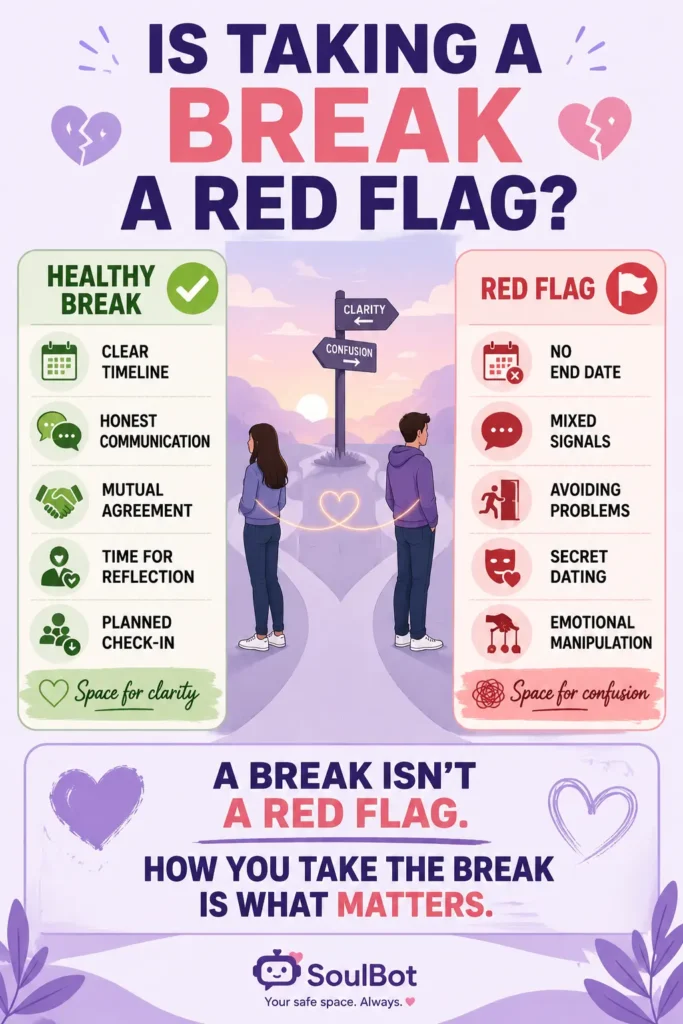
When Taking a Break Is a Red Flag
A break is not always healthy. It may be a red flag if:
- One person uses it to avoid accountability.
- The break has no timeline.
- Rules are unclear.
- One partner uses it to secretly date others.
- It becomes emotional manipulation.
- It happens every time conflict appears.
A break should not leave you confused, abandoned, or emotionally trapped. If the break feels like punishment, it probably is not a healthy space.
Rules for Taking a Break in a Relationship
If you decide to take a break, the rules are not optional. They protect both people.
1. Set a Clear Timeline
Do not leave the break open-ended.
Try:
“Let’s take two weeks and check in after that.”
Most healthy breaks have a defined time period, such as one week, two weeks, or one month.
2. Define Communication Boundaries
Decide whether you will:
- text occasionally
- avoid daily communication
- only talk for emergencies
- have one scheduled check-in
Without this, one person may feel ignored, while the other thinks they are respecting the other person’s space.
3. Discuss Dating and Physical Boundaries
This is important.
Ask directly:
“Are we allowed to date or be physically involved with other people during this break?”
Do not assume. Unspoken expectations create pain later.
4. Decide the Purpose of the Break
A break should have a reason.
Examples:
- “We need space to reflect on whether we can communicate better.”
- “Need time to understand if this relationship still feels healthy.”
- “Need emotional distance because we keep hurting each other.”
If there is no purpose, the break becomes emotional limbo.
5. Plan a Check-In
Before the break starts, decide when you will talk again.
At the check-in, discuss:
- What did you realise?
- Whether the relationship can continue.
- What needs to change?
- Whether more space is needed.
A break without a check-in is just uncertainty.
What Not to Do During a Relationship Break
Avoid these mistakes:
- Stalking their social media
- Testing whether they miss you
- Using the break to make them jealous
- Avoiding your own reflection
- Dating someone else without agreement
- Pretending everything is fine when it is not.
The point of a break is not to win control. The point is to understand what the relationship needs.
What Should You Think About During the Break?
Use the space honestly.
Ask yourself:
- I feel safer with or without this relationship?
- I miss the person or only the comfort?
- Are we both willing to change?
- Do I feel respected?
- Are the same problems repeating?
- Am I staying because of love or fear?
These questions can help you separate anxiety from clarity.
SoulTip: A break should not make you beg for basic communication. Even distance needs respect.
Can Taking a Break Save a Relationship?
Yes, sometimes.
A break can help if both people use the time to reflect, take responsibility, and communicate honestly afterwards.
But a break cannot save a relationship if:
- Only one person wants to fix things.
- Emotional harm keeps repeating.
- Boundaries are ignored.
- There is no accountability.
- The break is used to avoid hard conversations.
A break is not magic.
It only helps when both people are willing to do the emotional work.
Talk to Soululu
If taking a break has left you anxious, confused, or scared of losing someone, talk to Soululu.
Soululu gives you a private space to process what you are feeling before reacting in panic. Sometimes you do not need instant answers. You just need a calm place to untangle your thoughts.
Recommended Books and Tools for Relationship Clarity
Amazon affiliate options:
- Attached by Amir Levine and Rachel Heller
- Hold Me Tight by Dr Sue Johnson
- The Seven Principles for Making Marriage Work by John Gottman
- A guided relationship journal for couples
These tools can help with reflection, attachment patterns, communication, and emotional clarity. They are not a replacement for therapy.
SoulTip: Space is healthy when it brings clarity. Space is harmful when it creates confusion, fear, or a sense of control.
In a Nutshell
Taking a break in a relationship does not always mean breaking up.
It can be a healthy pause when both partners agree on the purpose, timeline, boundaries, and communication rules.
But if the break is vague, one-sided, or used to avoid accountability, it can create more emotional damage than clarity.
A healthy break should help you understand the relationship better. It should not leave you feeling abandoned in confusion.
Related SoulBot Reads
- Relationship Anxiety: Signs, Causes, and How to Deal With It
- What Is Monogamy in a Relationship? Explained Simply
- What Is Self-Sabotaging in Relationships?
- How to Respond to Gaslighting