
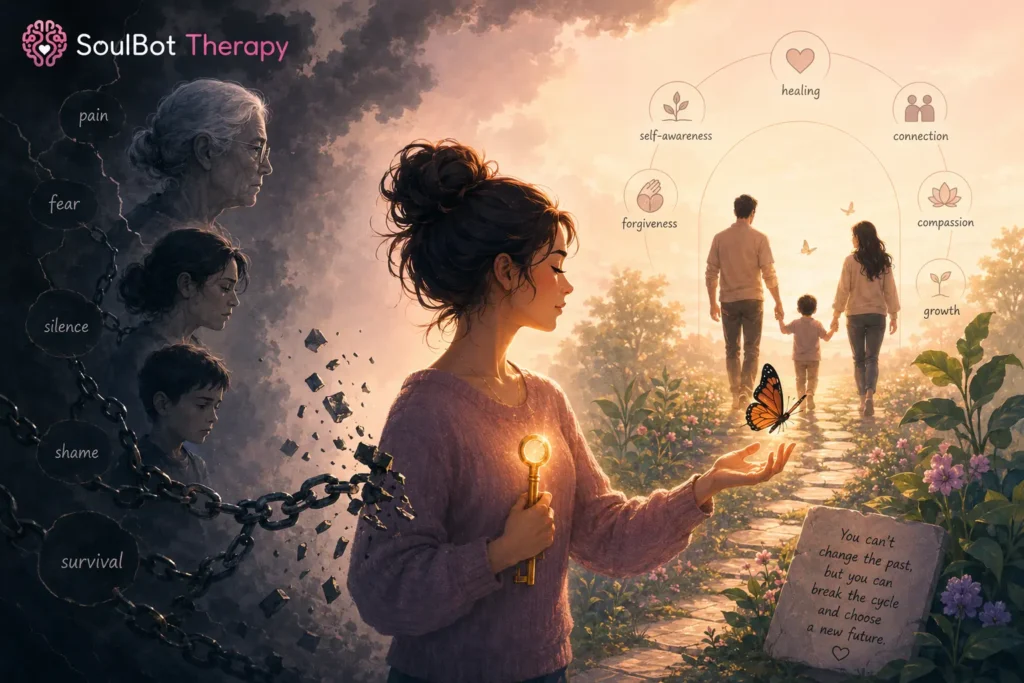
You shut down during conflict and panic when someone pulls away. Love feels unsafe even when nobody is hurting you. You behave the way your parents did during a fight.
And sometimes the hardest part is realising: These patterns may not have started with you.
This is often what generational trauma looks like.
Generational trauma can quietly shape the way people love, communicate, handle stress, and see themselves. Many people carry emotional survival patterns they never consciously chose but learned through family environments growing up.
The good news?
Patterns can be unlearned.
Cycles can be broken.
This guide explains:
- What generational trauma is
- Common signs and symptoms
- How trauma gets passed down
- How it affects relationships
- and how to begin healing
What Is Generational Trauma? (Quick Answer)
Generational trauma refers to emotional wounds, survival behaviours, unhealthy coping mechanisms, and stress patterns passed down through families across generations.
It may show up as:
- Anxiety
- Emotional unavailability
- People-pleasing
- Fear of conflict
- Attachment issues
- Toxic relationship patterns
- Difficulty expressing emotions
Generational trauma is not about blaming your family. It is about understanding how emotional pain and survival responses can repeat when they are never fully processed or healed.
💬 If family patterns are still affecting your mental health or relationships, talk to Soululu a private, judgment-free space to process your emotions safely.What Does Generational Trauma Look Like?
Generational trauma is not always obvious.
Sometimes it looks like:
- Parents who never talk about emotions
- Fear-based parenting
- Emotional neglect
- Explosive anger
- Constant criticism
- Silence after conflict
- Feeling unsafe expressing vulnerability
Children absorb emotional environments even when nobody explains them directly.
That is why many adults later struggle with:
- Anxiety
- Emotional shutdown
- Fear of abandonment
- People-pleasing
- Low self-worth
- Relationship insecurity
without fully understanding where those patterns came from.
Signs of Generational Trauma
Here are some of the most common signs of generational trauma:
| Family Pattern | How It May Show Up Later |
| Emotional neglect | Difficulty expressing emotions |
| Constant criticism | Low self-esteem |
| Anger in the household | Fear of conflict |
| Conditional love | People-pleasing |
| Emotional silence | Emotional suppression |
| Unpredictable parenting | Anxiety and hypervigilance |
| Unhealthy relationships | Attachment issues |
Other common symptoms include:
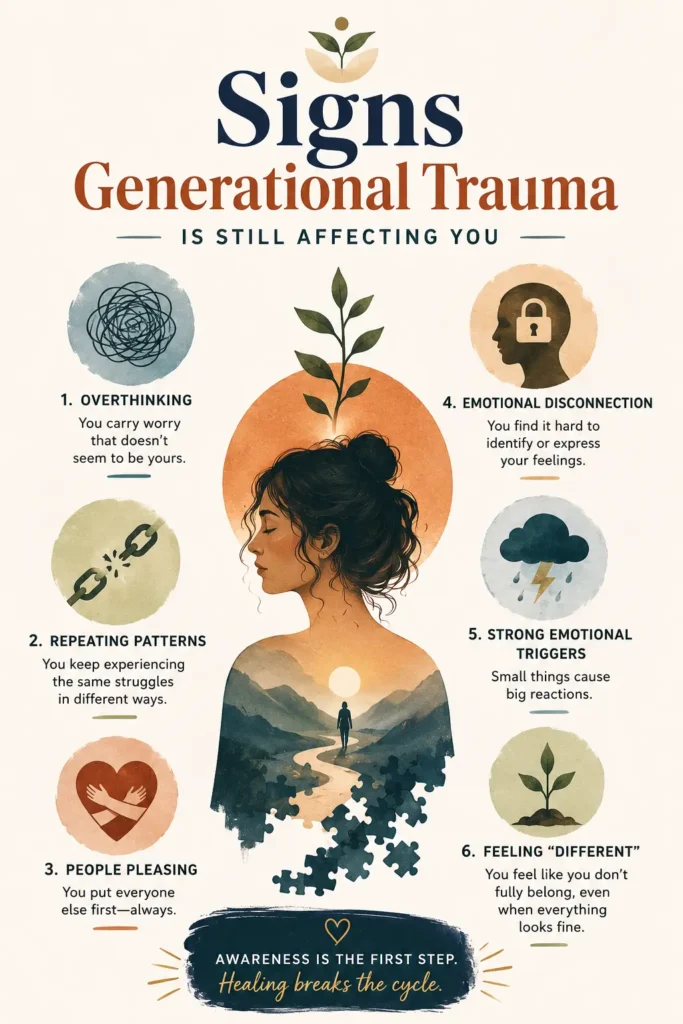
- Overreacting emotionally to certain situations
- Shutting down during difficult conversations
- Feeling responsible for everyone else’s emotions
- Difficulty trusting people
- Fear of vulnerability
- Self-sabotaging relationships
- Feeling emotionally “too much” or “not enough.”
Many people mistake these patterns for personality traits when they are actually learned survival responses.
🧠 SoulFact: Research in attachment psychology suggests that children often internalise the emotional coping patterns and stress responses they grow up around, especially during early development.
Can Trauma Be Passed Down?
One of the most searched questions today is:
“Can trauma be inherited?”
The answer is yes, emotionally and behaviorally. Children learn emotional survival patterns from the environments in which they grow up.
For example:
- A child raised in an emotionally unpredictable environment may become hypervigilant in relationships.
- A child raised in emotionally silent households may struggle to express vulnerability later in life.
- A child who grew up in a critical environment may develop deep shame and perfectionism.
Some researchers also study how chronic stress and trauma may influence biological stress responses across generations, though this research is still developing.
But the emotional side is clear: Pain that is never processed often gets repeated.
What Generational Trauma Can Look Like in Real Life?
Generational trauma does not always feel dramatic. Sometimes it looks like:
- Apologizing constantly
- Feeling guilty for resting
- Panicking when someone is upset with you
- Struggling to set boundaries
- Fearing rejection even in healthy relationships
- Avoiding emotional closeness
- Feeling emotionally numb during conflict
- Needing constant reassurance
These reactions often develop because your nervous system learned that emotional safety was unpredictable.
How Generational Trauma Affects Relationships?
Generational trauma often affects adult relationships the most.
It can create:
- Anxious attachment
- Emotional avoidance
- Fear of abandonment
- Trust issues
- Unhealthy conflict patterns
- Emotional dependency
- Fear of vulnerability
For example:
Someone who grew up around emotional instability may constantly expect rejection, even in loving relationships. Another person may avoid closeness completely because emotional intimacy was never felt safe growing up.
This is why relationship struggles are not always just about the relationship itself. Sometimes they are connected to emotional patterns learned much earlier.
Breaking Generational Trauma Starts With Awareness
Healing generational trauma does not mean hating your family. It means understanding what hurt you so the cycle does not continue through you.
Awareness changes everything.
You begin noticing:
- Why certain situations trigger intense reactions
- Why emotional closeness feels scary
- Why conflict feels unsafe
- Why do you repeat patterns you promised yourself you would avoid
And slowly, you realise:
Some behaviours that once protected you are now hurting you. That realisation is often the beginning of healing.
How to Break the Cycle of Generational Trauma?
1. Identify the patterns
You cannot heal what you do not recognise.
Pay attention to:
- Emotional triggers
- Relationship patterns
- Fear responses
- Communication habits
2. Learn emotional regulation
Grounding exercises, journaling, therapy, and nervous system work can help reduce survival-mode reactions.
3. Set healthier boundaries
Healing sometimes means changing unhealthy family dynamics rather than continuing them in silence.
4. Build healthier relationship patterns
Practice:
- Honest communication
- Emotional vulnerability
- Secure attachment behaviours
- Asking for support
5. Consider trauma-informed therapy
Approaches like CBT, EMDR, somatic therapy, and attachment-based therapy can help process deeply rooted emotional patterns safely.
💬 If inherited family patterns still affect how you love, react, or trust people today, talk to Soululu and process those emotions gently, one step at a time.Recommended Books for Generational Trauma
Helpful resources include:
- 📖 Adult Children of Emotionally Immature Parents
- 📖 It Didn’t Start With You
- 📖 The Body Keeps the Score
These books help explain how emotional patterns develop and how healing becomes possible.
In a Nutshell
If you are trying to understand what is generational trauma, here is the simplest answer:
It is emotional pain and survival patterns passed through families over time. But inherited patterns are not permanent patterns. Healing begins when you stop asking:
“What is wrong with me?”
and start asking: “What happened before me that shaped the way I learned to survive?”
Because sometimes breaking the cycle starts with realising: It did not begin with you.