

Things are going well. Really well.
Then something shifts. You start picking fights over nothing. Pull away when your partner gets close. You find flaws that were not there before. You do or say something that puts distance between you and a person you genuinely care about.
Afterwards, you wonder: Why do I keep doing this?
Self-sabotage in relationships happens when unconscious thoughts or actions hurt your romantic bond without you meaning to. It is a defensive habit that creates distance, breaks trust, and stops relationships from growing.
This comprehensive guide will help you recognise the hidden signs of sabotage, understand the psychological root causes, and learn actionable steps to break the cycle.
Self-Sabotage in Relationships: Quick Summary
- Definition: Unconscious behaviours that damage a connection you actually want.
- Common Signs: Picking fights, pulling away, avoiding commitment, and excessive jealousy.
- Root Causes: Fear of abandonment, low self-worth, past trauma, and insecure attachment styles.
- The Reality: The behaviour is not intentional, but it is your responsibility to address it.
- The Cure: Healing happens through self-awareness, vulnerable communication, and emotional regulation.
What Is Self-Sabotage in Relationships?
Self-sabotage is a set of destructive behaviours, conscious or unconscious, that frequently result in the breakdown of a relationship. It creates a painful paradox: you deeply want the relationship to work, but a part of your mind is convinced it will end badly. To protect yourself from that predicted pain, you unconsciously bring about the very ending you fear.
Psychological research shows this pattern often stems from past trauma or negative experiences. These events make it difficult to feel worthy of love or safe in a stable environment. It is not a lack of care; it is an excess of fear. If left unaddressed, these patterns repeat across multiple relationships over time.
8 Warning Signs of Relationship Self-Sabotage
Self-sabotage in a relationship is highly subtle. You may genuinely love your partner while actively pushing them away. Look out for these common behavioural signs:
- Pulling away during intimacy: Withdrawing or becoming highly critical the moment emotional closeness deepens.
- Picking unnecessary fights: Creating conflict over minor issues to mask deeper, underlying fears.
- Avoiding commitment: Keeping things casual, avoiding future plans, or finding arbitrary flaws to delay commitment.
- Testing your partner: Creating unfair scenarios to see if your partner will leave, attempting to prove your anxieties right.
- Excessive jealousy: Checking phones, demanding constant reassurance, and assuming infidelity without evidence.
- Withholding needs: Refusing to communicate your desires, holding silent grudges, and assuming your partner should read your mind.
- Blaming your partner entirely: Shifting all responsibility onto your partner to protect your own low self-esteem.
- Losing your identity: Over-accommodating your partner and erasing your own needs, which breeds deep resentment.
💬 Recognising a pattern in yourself takes courage. Talk to Soululu — a private space to process what is coming up, anytime.Why Do I Self-Sabotage? The Root Causes
Your nervous system gets stuck in sabotage loops because it misinterprets closeness as a threat. The most common psychological drivers include:
Insecure Attachment Styles
Attachment styles formed in early childhood shape adult romantic relationships. An avoidant attachment style drives you to maintain emotional distance to avoid rejection. An anxious attachment style creates a constant fear of abandonment, driving hypervigilance, testing, and conflict.
Fear of Vulnerability
True intimacy requires letting your guard down. If you subconsciously believe that vulnerability equals danger, your brain will trigger defensive, sabotaging behaviours to push your partner away and keep you safe.
Low Self-Worth
When you have low self-esteem, you do not believe you deserve a healthy relationship. When you find a good partner, your subconscious creates chaos because a stable, loving relationship feels unfamiliar and unearned.
Past Relationship Trauma
Experiencing betrayal, infidelity, or sudden abandonment teaches your body that love is unsafe. Your nervous system carries that survival data into new partnerships, treating your current partner as a future threat.
🧠 SoulTip: Self sabotage does not mean you are broken it means you are human. Most of us develop these patterns as a way to survive, not to destroy.
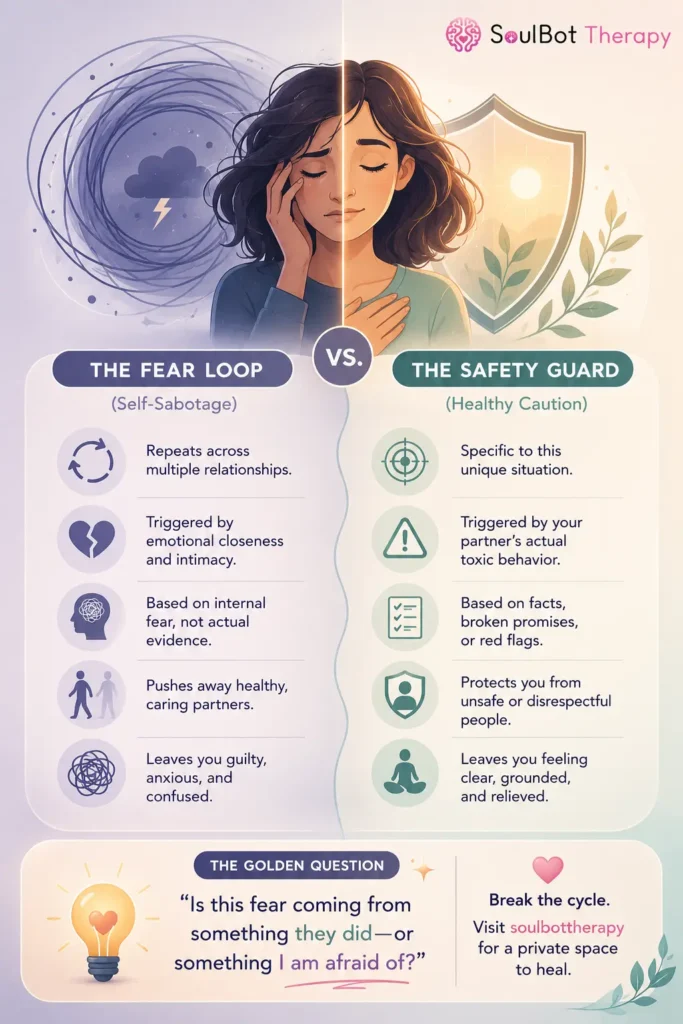
Self-Sabotage vs Healthy Caution
Not every doubt means you are sabotaging. Use this framework to differentiate fear from reality:
| Self-Sabotage | Healthy Caution |
| Leaves you feeling guilty, anxious, and confused. | The doubt is specific to this unique relationship. |
| Triggered by closeness and emotional intimacy. | Triggered by your partner’s actual, toxic behavior. |
| Based entirely on internal fear, not real evidence. | Based on objective facts, red flags, and broken trust. |
| The pattern repeats across multiple relationships. | Protects you from unsafe people who treat you poorly. |
| Leaves you feeling guilty, anxious, and confused . | Leaves you feeling guilty, anxious, and confused. |
📖 Want to go deeper? Susan Anderson's The Journey from Abandonment to Healing is one of the most insightful books on how fear of abandonment drives self-sabotage in relationships and how to heal it. How to Stop Self-Sabotaging Your Relationship?
Breaking a deep-seated psychological habit requires deliberate effort. Follow these four actionable steps to rewire your responses:
1. Recognise Your Triggers
Keep a mental or physical journal of your reactions to your relationship. Identify the exact moments you feel the urge to pull away or argue. Notice if the urge happens after a moment of deep intimacy, a compliment, or a discussion about the future. Spotting the pattern removes its unconscious power.
2. Pause Before You React
When a trigger occurs, your nervous system enters a fight-or-flight state. Do not act on your initial impulse to criticise or retreat. Take a 10-minute pause. Breathe deeply and ask yourself: “Is my partner actually doing something wrong right now, or am I just feeling afraid?”
3. Practice Vulnerable Communication
Replace defensive actions with honest words. Instead of picking a fight to create distance, share the underlying emotion with your partner. Try saying: “I am really enjoying how close we are getting, but it is making me feel a bit anxious and scared. I need a little reassurance.”
4. Separate Past Trauma From Present Reality
Remind yourself explicitly that your current partner is not the person who hurt you in your past. Actively look for evidence of your partner’s reliability, kindness, and consistency to help your brain build new, safe associations with love.
Give Yourself a Private Space to Heal
Recognising these patterns within yourself takes immense courage. If you are ready to unpack your relationship anxieties, share your fears, and actively break the cycle of self-sabotage, Soululu offers a private, safe space to process your emotions anytime. You do not have to navigate your healing journey alone.