
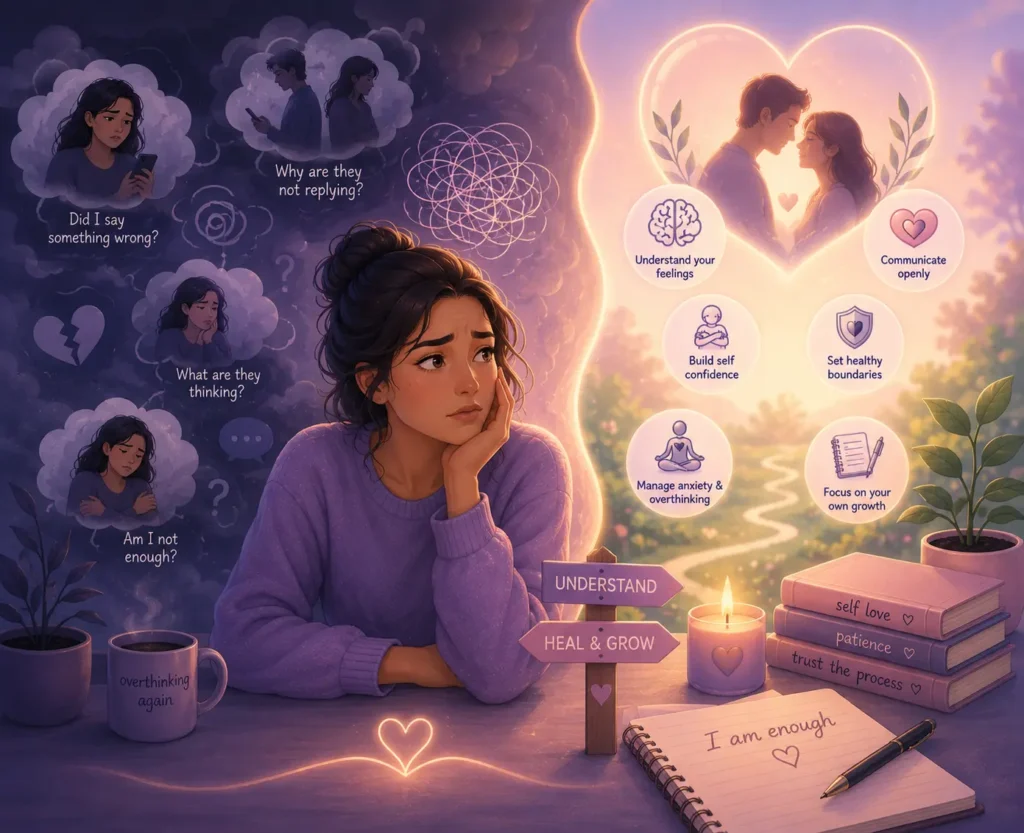
Your relationship is going fine. But your mind keeps asking:
- “What if they lose feelings?”
- “Why did they reply differently?”
- “What if I care more than they do?”
If this sounds familiar, you may be dealing with relationship anxiety. This does not automatically mean your relationship is unhealthy. This is common when fear, attachment wounds, low self-esteem, or past heartbreak affect your sense of safety.
This guide will clarify what relationship anxiety looks like, its main signs, its causes, and practical ways to address it.
What Is Relationship Anxiety?
Relationship anxiety is a persistent fear, doubt, or insecurity in a romantic connection, even when things are going well.
It often includes:
- Overthinking
- Fear of abandonment
- Reassurance-seeking
- Emotional spiraling
- Difficulty trusting love fully
It is not an official diagnosis, but it is a very real emotional experience.
💬 Feeling anxious about your relationship right now? Talk to Soululu, a private, judgment-free space to process what you are feeling calmly.Signs of Relationship Anxiety
Here are the most common signs:
| Sign | Replaying texts, conversations, and tone changes |
| Overthinking | Constant worry that they will leave |
| Fear of abandonment | Constant worry they will leave |
| Reassurance-seeking | Asking “Are we okay?” repeatedly |
| Emotional spiraling | Small issues feel emotionally huge |
| Difficulty relaxing | Waiting for something to go wrong |
| Self-sabotage | Pushing your partner away before they can hurt you |
Many people with relationship fears still deeply love their partner. The anxiety usually comes from insecurity, not lack of love.
What Causes Relationship Anxiety?
Relationship anxiety develops from emotional insecurity, not “neediness.”
Common causes include:
Anxious attachment
If love felt inconsistent growing up, your nervous system may stay alert in close relationships.
Past heartbreak or betrayal
Being cheated on, abandoned, or emotionally hurt before can make trust feel unsafe.
Low self-esteem
If you secretly fear “not being enough,” relationships can trigger constant self-doubt.
General anxiety or stress
Work stress, burnout, and emotional exhaustion often spill into relationships, too.
🧠 SoulFact: Studies on attachment theory show that people with anxious attachment styles are more likely to experience relationship anxiety, reassurance-seeking, and fear of rejection in romantic relationships.
Relationship Anxiety vs Intuition
This is one of the most searched relationship questions online. So how do you know whether it is anxiety or a real red flag?
| Relationship Anxiety | Intuition |
| Feels repetitive across relationships | Feels connected to specific behaviour |
| Based on fear and “what ifs” | Based on consistent patterns |
| Gets louder during stress | Feels calm and clear |
| Needs constant reassurance | Notices genuine concerns |
A simple question helps:
“Would I still feel this fear even if my partner changed nothing?” If yes, the anxiety may be coming more from within than from the relationship itself.
How Relationship Anxiety Affects Relationships?
Relationship anxiety affects both people.
For the anxious partner:
- constant stress
- emotional exhaustion
- overthinking
- insecurity
For the other partner:
- pressure to constantly reassure
- emotional burnout
- communication strain
This is why relationship anxiety should not be dismissed as just overthinking.
How to Deal With Relationship Anxiety?
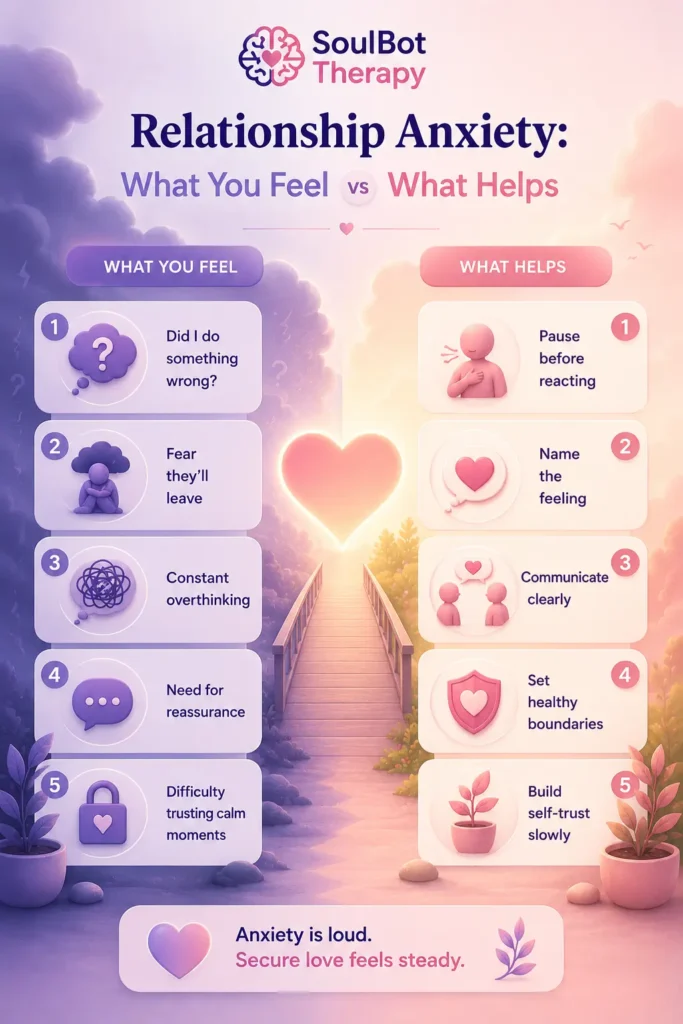
1. Stop reacting immediately
Pause before assuming the worst. Anxiety often creates stories, not facts.
2. Identify your triggers
Ask yourself:
- What specifically triggered me?
- Does this remind me of past experiences?
Awareness reduces emotional spiralling.
3. Communicate calmly
Instead of: “You’re pulling away.”
Try: “I’ve been feeling anxious lately and wanted to talk about it.”
Healthy communication matters more than perfect communication.
4. Reduce reassurance-seeking
Reassurance helps temporarily, but constant reassurance strengthens anxiety long-term.
5. Work on your self-worth outside the relationship
Your emotional stability should not rely entirely on one person’s validation.
6. Consider therapy or emotional support
Attachment-based therapy and CBT are highly effective for relationship + anxiety.
Journaling and emotional processing tools can help, too.
💬 If your mind keeps spiralling after small relationship moments, talk to Soululu and process your thoughts before anxiety takes over the whole relationship.Can Relationship Anxiety Go Away?
Yes. For many people, their connection improves when:
- Emotional safety increases
- Attachment wounds heal
- Communication improves
- Self-worth becomes stronger
The goal is not to eliminate anxiety completely. The goal is to stop anxiety from controlling the relationship.
Recommended Tools
Helpful resources include:
- Attachment theory books
- Guided journals
- CBT workbooks
📖 Attached by Amir Levine is one of the most recommended books for understanding anxious attachment and relationship anxiety.
In a Nutshell
Relationship anxiety is not proof that your connection is doomed. Most of the time, it is your nervous system trying to protect you from loss, rejection, or emotional pain. But relationships become healthier when fear no longer leads them. And healing starts when you understand what your anxiety is actually trying to say.