

You send a message and immediately start watching for the reply.
They seem a little distant today, and your mind starts running Did I say something wrong? Are they losing interest? Is this relationship okay?
You know, somewhere, that you are probably overthinking. But knowing that does not make the feeling go away.
If this sounds familiar, you might have an anxious attachment style. And the most important thing to understand about it is this: it is not a flaw. It is a pattern that made complete sense when it was formed, and one that can change.
Anxious Attachment Style: Quick Answer
- A pattern of craving closeness but constantly fearing loss
- Rooted in inconsistent caregiving in childhood
- Signs include fear of abandonment, need for reassurance, and hypervigilance in relationships.
- Triggered by distance, silence, or perceived rejection
- An anxious attachment is not permanent
🧠 Not sure what your attachment style is? Take the free Love Language Test to understand how you give and receive connection.What Is Anxious Attachment Style?
Anxious attachment style, also known as anxious-preoccupied attachment, is one of the four main adult attachment styles identified in attachment theory.
People who fall into this category typically score highly on measures of anxiety in relationships. Adults with anxious attachment styles tend to find it difficult to emotionally regulate and may be more impulsive than others, which can lead to a higher risk of symptoms of depression, generalised anxiety and relationship anxiety.
At its core, anxious attachment is a paradox: you long for closeness more than almost anything, but the moment you have it, you start to fear losing it.
People with anxious attachment style long for closeness and connection, but the moment they get it, they begin to fear it will not last. Their nervous system is on high alert, a pattern learned from unstable emotional environments in childhood.
The good news? What is learned can be unlearned.
Where Does Anxious Attachment Come From?
Anxious attachment almost always develops in childhood, specifically in response to caregiving that was inconsistent rather than absent.
For example, one time when you were angry as a child, your parent reassured you and talked you through your difficult feelings, but the next time it happened, they dismissed you and told you to get over it. The child may become confused about their relationship with a caregiver, sending mixed signals.
When love and attention felt unpredictable, sometimes warm and close, sometimes cold and distant, a child learns to stay hypervigilant. To watch constantly for signs of withdrawal. To seek reassurance often, because reassurance was never guaranteed.
That hypervigilance follows you into adult relationships. Research suggests that about 20 to 25% of adults in Western countries fit an anxious attachment pattern, so if you see yourself in this, you are not alone.
🧠 SoulFact: Anxious attachment is not a personality defect. It is a nervous system response, a learned survival strategy that protected you when you were young. Understanding where it came from is the first step toward changing it.
Signs of Anxious Attachment Style
Not all of these will apply to everyone. However, if several of these feelings consistently apply to you, anxious attachment may be part of your pattern.
You need frequent reassurance
You often need to hear that things are okay, that they still care, that you have not done anything wrong, that the relationship is solid. Not because you are needy, but because your nervous system genuinely does not feel safe without confirmation.
You read into small things
A shorter reply than usual. A slightly different tone. Taking longer to respond. These moments can bring back old memories of being ignored or left alone. Your brain may react to a late text as if it is a life-or-death situation, even if part of you knows that is not true.
You fear abandonment constantly
Fear of rejection or abandonment is never far from your mind. Even an ordinary aspect of relationships, such as an occasional argument, can send you spiralling into insecurity and worst-case scenarios.
You become preoccupied with the relationship
When something feels off, it is hard to think about anything else. Work, friends, and other areas of life fade into the background while you try to figure out what is happening between you and your partner.
You put your partner’s needs above your own
People with anxious attachment style are often highly attuned and sensitive to their partner’s needs, sometimes to the point of neglecting their own. You are very good at taking care of others. Taking care of yourself feels harder.
You struggle to express needs directly
You want closeness. You want reassurance. But asking for it directly feels risky. What if they pull away? So you hint, test, or wait and hope, which often leads to more frustration rather than less.
Your self-worth feels tied to the relationship
Deep down, someone with an anxious attachment style believes that as soon as their partner gets to know the real them, they will lose interest and reject them. Their low self-esteem causes them to think they are not good enough to retain a partner’s interest in the long run.
You feel relieved when they reach out, but only briefly
When they respond, call, or show affection, you feel better but only for a while. The reassurance fades quickly, and the anxiety creeps back in. This cycle is exhausting for everyone involved.
🧠 SoulTip: Recognising these signs in yourself is not something to be ashamed of. It takes real self-awareness to see your own patterns clearly. That awareness is where change begins.
Anxious Attachment Triggers: What Sets It Off
Anxious attachment triggers are rooted in early experiences and persist into adulthood. Individuals with an anxious attachment style often encounter several triggers in their daily lives that can evoke feelings of insecurity, anxiety, and fear of abandonment.
The most common triggers include:
- Inconsistent communication Receiving mixed signals or inconsistent responses from partners can trigger anxiety. Anxiously attached individuals may interpret delayed responses or changes in communication patterns as signs of potential rejection or abandonment.
- Perceived rejection or dismissal: Situations where they feel ignored, dismissed, or unimportant can be highly triggering, including moments when their partner seems disinterested, preoccupied, or emotionally distant.
- Conflict or arguments: Disagreements or tense discussions can set off anxious feelings, making it difficult to feel secure in the relationship. Even minor disagreements can feel like a threat to the entire relationship.
- Ambiguity and uncertainty: Situations where the status of the relationship is unclear, such as undefined relationship boundaries or a lack of commitment, can cause significant anxiety.
- Physical or emotional distance: Long periods of physical separation, such as long-distance relationships or frequent travel, can increase anxiety about the stability and security of the relationship.
- A partner who pulls away: A common pattern is when an anxious person gets together with someone who does not want to be too close and tends to shut down or pull away. This dynamic, known as the anxious-avoidant trap, is one of the most painful relationship cycles there is.
📖 Want to go deeper? Amir Levine and Rachel Heller's Attached: The New Science of Adult Attachment is the most widely recommended book on understanding your attachment style and finding the right relationship dynamic for you.Anxious Attachment in Relationships: What It Looks Like Day to Day
Understanding the signs is one thing. Seeing how anxious attachment actually plays out in a relationship is another.
The negative impacts of anxious attachment styles can cause relationships to suffer, even though they stem from your desire to bring your partner closer.
In practice, anxious attachment in relationships often looks like:
- Checking your phone constantly after sending a message
- Feeling a spike of anxiety when your partner seems quieter than usual
- Having arguments that escalate quickly because the fear underneath them is so big
- Apologising more than you need to, to keep the peace
- Feeling clingy but hating that you feel that way
- Needing more connection than your partner seems to want and feeling ashamed about that need
None of this makes you a bad partner. It makes you someone whose nervous system learned to survive in uncertainty and who is now applying that survival strategy to a context where it is no longer needed.
Anxious Attachment vs Secure Attachment -The Key Differences
| Needs frequent reassurance | Feels generally secure without constant confirmation |
| Fears abandonment regularly | Trusts that the relationship is stable |
| Hypervigilant to partner’s mood | Can tolerate partner’s distance without spiralling |
| Self-worth tied to relationship | Self-worth exists independently |
| Struggles to ask for needs directly | Can express needs clearly and calmly |
| Reassurance helps briefly, then fades | Feels settled for longer periods |
Secure attachment is not about never feeling anxious. It is about having a baseline sense of safety that does not collapse every time something feels uncertain.
Can You Heal Anxious Attachment?
Yes. Completely and genuinely yes.
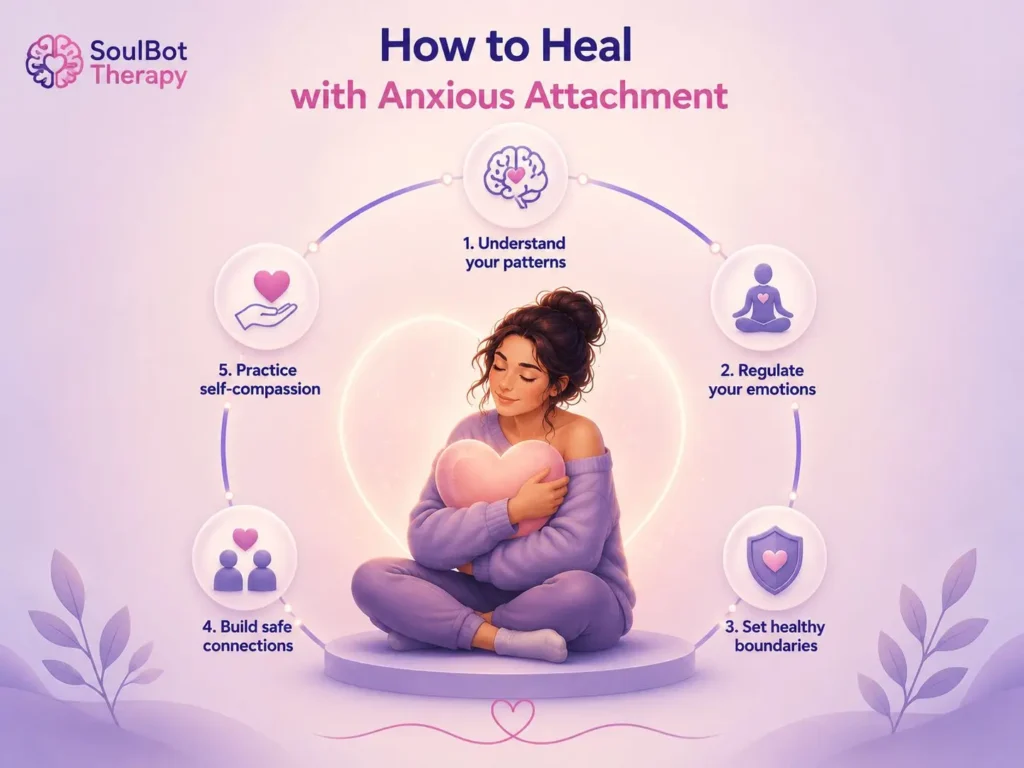
Anxious attachment typically does not emerge spontaneously; it often comes from having caregivers who were not always consistently available. But what is learned can be unlearned. Professional support is available to help people rewrite their templates for relationships.
Healing anxious attachment involves:
Therapy particularly approaches like attachment-focused therapy, schema therapy, or EMDR, which work with the root experiences that created the pattern in the first place.
Building self-worth involves independently learning that your value does not depend on whether someone chooses you, stays, or reassures you.
Learning to tolerate uncertainty, not eliminating anxiety, but building the capacity to sit with it without immediately acting on it.
Practising secure behaviour, spending time alone, building friendships with securely attached people, and practising expressing needs directly.
Choosing relationships that feel safe, not ones that recreate the push-pull dynamic your nervous system is used to.
🧠 SoulTip: Healing anxious attachment does not mean becoming someone who does not need connection. It means finding a way to hold your need for closeness without it consuming you.
How SoulBot Can Help?
Working through anxious attachment takes time, and having a safe, private space to process your feelings between therapy sessions or when emotions run high makes a real difference.
Soululu, SoulBot’s AI companion, is available whenever the anxiety spikes and you need somewhere to put it. No judgment. No reassurance that fades. Just a calm, consistent presence.
💬 Start a conversation with Soululu whenever you need it.
🧠 Understanding how you connect with people starts with knowing your love language. Take the free Love Language Test to learn more about yourself.