Home > Blog > Depression Symptoms You Should Never Ignore
Depression Symptoms You Should Never Ignore
Mental Health
Last Updated: April 23, 2026
Table of Contents
Depression doesn’t always look the way you’d expect.
It’s not always crying in bed. It’s not always “I can’t get up.” Sometimes it’s just… feeling nothing. Scrolling through your phone for hours. Saying “I’m fine” and almost meaning it.
That’s exactly why so many people miss the early signs because they don’t look serious enough to act on. If you’ve been wondering whether what you’re feeling is normal or if it’s something more like depression symptoms, this guide is for you.
Depression symptoms are changes in how you feel, think, and function, and they affect your emotional, physical, and mental health all at once.
The clinical definition from the American Psychiatric Association describes major depressive disorder as a condition involving at least five symptoms lasting two or more weeks, causing significant impairment in daily life.
But here’s what that actually means in real life:
You don’t feel sad exactly. You just feel off. Heavy. Like everything takes three times as much effort as it should. Like you’re watching your life happen through glass.
Depression can affect:
Your energy levels
Your sleep quality
Your appetite and digestion
Your ability to focus or make decisions
Your interest in people, hobbies, and life itself
And in most cases, it builds gradually, not overnight.
The Most Common Depression Symptoms (Explained Simply)
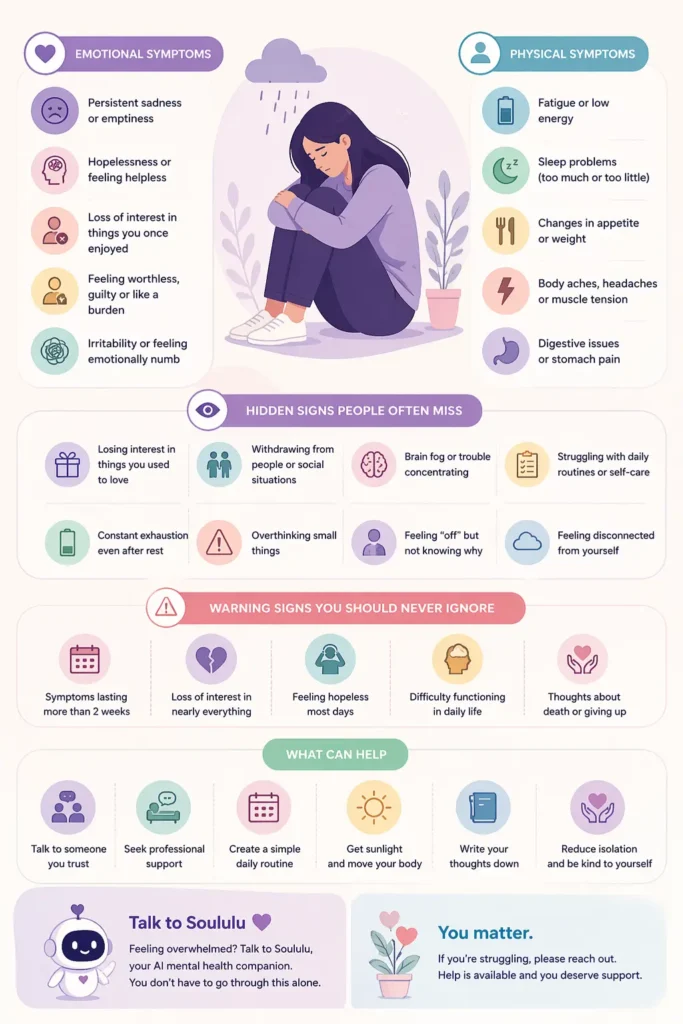
These are the core signs that mental health professionals look for when assessing depression:
1. Persistent Sadness or Emotional Emptiness
Not just “feeling down for a day.” This is a heaviness that stays, even when things in your life are objectively okay.
2. Loss of Interest (Anhedonia)
Things that used to make you happy just… don’t anymore. Your favourite show, your friends, and your hobbies you loved. This loss of pleasure is one of the most telling signs.
3. Constant Fatigue and Low Energy
You sleep eight hours and still wake up exhausted. Even small tasks feel like lifting heavy weights.
4. Sleep Disturbances
This can go either way: sleeping too much or lying awake at 3 am with a brain that won’t stop. Both are common.
5. Appetite Changes
Eating far less than usual, or eating more than you want to out of emotional numbness — both are depression symptoms.
6. Difficulty Concentrating
Reading the same sentence five times. Forgetting things you just said. That brain fog that makes even simple decisions feel impossible.
7. Feeling Worthless or Excessively Guilty
A persistent inner voice that tells you you’re a burden, you’re not doing enough, you’re the problem.
8. Irritability or Unexplained Anger
Often overlooked, especially in men. Depression doesn’t always feel like sadness. Sometimes it feels like a short fuse you can’t control.
9. Thoughts About Death or “Giving Up”
These don’t have to be active suicidal thoughts to matter. Passive thoughts like “I wish I could disappear” or “nothing would be different if I weren’t here” are serious and deserve attention.
⚠️ If you’re having thoughts of harming yourself or ending your life, please reach out to a mental health professional or crisis helpline immediately. You don’t have to figure this out alone.
Emotional Symptoms of Depression: What People Don’t Tell You
Most people expect to feel intensely sad if they’re depressed. But many describe it differently:
Numbness — not sad, not happy. Just nothing.
Disconnection — feeling like you’re watching your life from the outside.
Emotional flatness — laughing at jokes but not really feeling them.
Feeling like a burden — a sense that others would be better off without you around.
Losing interest in people — pulling away from friends and family, not out of anger, but out of exhaustion.
This emotional emptiness is actually more common than intense sadness and it’s the exact reason so many people dismiss what they’re going through as “just stress” or “just being tired.”
Physical Symptoms of Depression: Yes, Depression Lives in Your Body Too
This is where it gets confusing because depression doesn’t just affect your mind.
Common physical symptoms of depression include:
Symptom
What It Feels Like
Fatigue
Bone-deep tiredness that rest doesn’t fix
Body aches
Unexplained heaviness, muscle pain
Headaches
Frequent, tension-type headaches
Digestive issues
Nausea, stomach pain, constipation
Sleep problems
Insomnia or hypersomnia (sleeping too much)
Psychomotor changes
Moving or speaking more slowly than usual
This is important: if you’ve been to a doctor for unexplained physical symptoms and nothing shows up, your body may be expressing emotional pain.
Hidden Signs of Depression People Almost Always Miss
These are the subtle, easy-to-rationalise symptoms that often fly under the radar:
🔍 Losing interest in hobbies — You used to paint, cook, or go to the gym. Now you just… don’t. And you don’t even miss it.
🔍 Social withdrawal — Cancelling plans. Avoiding calls. Letting messages sit unread for days.
🔍 Mental fog — Not being able to follow a conversation, forgetting things, struggling with tasks that used to be easy.
🔍 Increased irritability — Snapping at people you love over small things.
🔍 Constant overthinking — Your brain running loops at night, replaying conversations, catastrophising futures.
🔍 Feeling “off” but not knowing why — That persistent sense that something’s wrong, even when you can’t name it.
🔍 Neglecting basic self-care — Skipping showers, not eating properly, letting your space get messier than usual.
These don’t look dramatic. But they accumulate and that’s exactly how depression works.
What Does Depression Actually Feel Like?
People who’ve experienced depression describe it in ways that go beyond any medical definition:
“It’s like being underwater. You can see everything happening above you, but you can’t quite reach it.”
“It’s not sadness exactly. It’s just… grey. Everything is grey.”
“I laughed at things. I went to work. On paper, I was fine. Inside, I felt nothing at all.”
Depression often feels like:
Heaviness- like every movement costs more than it should
Slowness-thoughts, words, decisions all feel sluggish.
Disconnection– from yourself, your relationships, your sense of purpose
Persistence– it’s not a bad week. It’s a state that just… stays.
Depression vs Burnout: How to Tell the Difference
This is one of the most Googled questions around mental health — and for good reason.
Burnout
Depression
Cause
Usually work/stress-related
Affects all areas of life
Recovery
Often improves with rest
Doesn’t lift with time off
Emotions
Exhausted, detached
Empty, hopeless, worthless
Motivation
Low due to overload
Low even in safe situations
Help needed
Rest, boundaries, recovery
Often requires professional support
The key test: If you took a two-week holiday and came back feeling genuinely better, that’s more likely to be burnout. If the heaviness stayed regardless of what you did or didn’t do, pay attention to that.
Depression Symptoms You Should Never Ignore
These are red flags. If you’re experiencing any of the following, it’s time to take it seriously:
✅ Symptoms lasting more than two weeks with no clear trigger
✅ Loss of interest in almost everything, not just one or two things
✅ Feeling hopeless most days, not just occasionally
✅ Withdrawing completely from friends, family, or activities
✅ Struggling to function at work, home, or in relationships
✅ Any thoughts about death, disappearing, or giving up
You don’t need to be at rock bottom to deserve support. Early intervention makes a significant difference.
🛒 Supportive Tools That Can Help
These can help you process your thoughts when things feel unclear:
These tools support reflection and emotional clarity. They are not a substitute for therapy.
When Should You Seek Help for Depression?
A common question, and one that people often delay too long to ask.
Seek support if:
Your symptoms have lasted two weeks or more.
They’re affecting your ability to work, maintain relationships, or function daily.
You feel like you’re getting worse, not better.
You’re using alcohol or substances to cope.
The people who know you have noticed a change
Seek immediate help if:
You’re having thoughts of harming yourself.
You feel unsafe
You feel like others would be better off without you.
You can talk to a mental health professional, your GP, or reach out to a crisis service. You can also start by simply talking to Soululu, who can help you with your emotions.
What Helps When Depression Symptoms Start Showing?
Professional help is the most effective route, but while you’re getting there, here are starting points that genuinely matter:
Talk about it — To a friend, a family member, a therapist, or even an AI companion like Soululu. Putting words to feelings reduces their weight.
Build micro-routines—not a full schedule. Just one anchor: wake up at the same time, eat one proper meal, step outside once.
Move your body — Not to lose weight. Not to “get fit.” Just 20 minutes of walking changes brain chemistry. Research consistently backs this.
Get sunlight exposure — especially in the morning. Light regulates melatonin and circadian rhythm, both of which are disrupted by depression.
Reduce isolation — Even low-effort social contact helps. A text. A coffee. Showing up without having to “be on.”
Write your thoughts — Journalling isn’t about being eloquent. It’s about externalising what’s stuck in your head.
💜 SoulTip: You don’t have to do all of this at once. Pick one. Do it tomorrow. That’s enough to start.
💜 A Note from Soululu
Depression doesn’t always feel like a crisis. Sometimes it feels like being quietly exhausted all the time. Like going through the motions. Like existing without really living.
If any of this felt familiar, you’re not dramatic. You’re not weak. You’re not “just stressed.”
You’re someone who deserves to understand what’s happening inside them.
And you don’t have to figure it out alone.
💬 Talk to Soululu
Feeling overwhelmed, numb, or unsure what you’re going through?
👉 Talk to Soululu without pressure, without judgment, whenever you’re ready.
Or if you want to understand your emotional patterns better:
The main symptoms of depression include persistent low mood or emotional emptiness, loss of interest in things you previously enjoyed (called anhedonia), fatigue, sleep changes (too much or too little), appetite shifts, difficulty concentrating, feelings of worthlessness or guilt, and, in severe cases, thoughts related to death or suicide.
Depression often feels less like intense sadness and more like a persistent heaviness, numbness, or disconnection from life. Many people describe feeling emotionally flat, mentally foggy, or as if they’re watching life unfold from a distance.
Yes. Depression frequently manifests physically. Common physical symptoms include unexplained fatigue, body aches, headaches, digestive problems, disrupted sleep, and slowed movement or speech. These physical symptoms are caused by the same neurological and physiological changes that drive the emotional aspects of depression.
Hidden signs of depression include increased irritability, social withdrawal (avoiding people without quite knowing why), brain fog, neglecting self-care like hygiene or eating, losing interest in hobbies without missing them.
Burnout is typically linked to prolonged stress or overwork and tends to improve meaningfully with rest, boundary-setting, and recovery time. Depression affects how you feel about life as a whole — not just your job and doesn’t lift reliably with rest alone.
Sonali Shastri is a Content Expert at SoulBot Therapy, where she creates mental health and self-discovery content that feels clear, relatable, and emotionally grounded. She specializes in translating psychology-informed ideas into simple, relatable blogs, test pages, and reflection-based resources. Her work helps readers understand themselves better while reducing stigma around mental health conversations.