

You have read about gaslighting. You have recognised the signs.
Now comes the harder part: what do you actually do in the moment when it is happening?
When someone tells you that you are imagining things, overreacting, or remembering it wrong, what do you say? How do you hold onto your reality when someone is actively trying to pull it away from you?
This blog covers exactly how to respond to gaslighting,
what to say, what not to say, and how to protect yourself over time.
💬 Feeling overwhelmed right now? Soululu is here to listen privately, judgment-free, anytime.How to Respond to Gaslighting (Quick Answer)
- Stay calm and do not react emotionally.
- State your reality clearly without arguing.
- Refuse to engage in circular conversations.
- Set a firm boundary and stick to it.
- Take physical space if needed.
- Document what happened afterwards
- Seek outside support from someone you trust
Learning how to respond to gaslighting takes practice, especially when the manipulation feels subtle or comes from someone you love. The goal is never to win the argument. It is to stay connected to your own reality.
Why You Cannot Just “Talk It Out.”
The first thing to understand about responding to gaslighting is this: you cannot reason your way out of it. If you are still unsure whether what you are experiencing is gaslighting, read our guide on the signs of gaslighting in a relationship first.
Gaslighting is not a misunderstanding. It is not a communication problem that can be solved by explaining yourself more clearly or finding the right words to make them see your point.
A gaslighter’s goal is to win, not to problem-solve. That is why engaging in the argument on their terms rarely works; the conversation is not designed to be resolved. It is designed to keep you doubting.
This does not mean you are helpless. It means the goal of responding to gaslighting is not to convince them but to stay connected to your own reality. That shift in goal changes everything about how you approach it.
🧠 Understanding your emotional patterns can help you heal. Take the free Emotional Availability Test to understand how you connect in relationships.How to Respond to Gaslighting Over Time- Beyond the Conversation?
1. Stay as calm as you can
Gaslighters often try to provoke emotional reactions to further their manipulation. Keeping your emotions in check makes it easier to respond clearly.
This is easier said than done, especially when the person doing this is someone you love. But an emotional reaction gives them something to redirect the conversation toward. Your feelings become the subject instead of their behaviour.
Take a breath. Slow down. You do not have to respond immediately.
2. State your reality simply and clearly
Some phrases that work:
- “I hear that you see it differently. This is my experience.”
- “I know what I heard. I am not going to debate that.”
- “I am certain of what happened. We can disagree, but I am not going to change my account of it.”
Asserting your reality without blaming or accusing disrupts the gaslighter’s attempt to control the narrative. By calmly stating your experience, you plant a seed of doubt in their manipulation and show you will not be easily swayed. Over time, gaslighting can contribute to anxiety symptoms, including chronic self-doubt, emotional exhaustion, and difficulty making decisions.
3. Refuse to engage in circular arguments
Gaslighting conversations go in circles by design. You explain. They deny. You re-explain. They dismiss. You try again. They escalate.
The way to break the loop is to step out of it.
- “I am not going to keep going around in circles on this.”
- “I have said what I needed to say. I am done with this conversation for now.”
- “I am not comfortable continuing this discussion if you keep dismissing what I say.”
Setting a boundary and repeating it calmly, becoming a broken record, helps ensure what you are saying resonates while putting a stop to further argument.
4. Give yourself physical space
A gaslighter relies on constant contact and quick reactions. Putting physical distance between you and stepping outside, going for a walk, or taking a break can weaken their hold on your thoughts and help you stay clear-headed.
You are allowed to say: “I need some space right now. We can come back to this later.”
If you feel emotionally overwhelmed after a gaslighting conversation, stepping away is not a weakness; it is self-protection.
5. Do not apologize just to end the conflict
Never take responsibility for a gaslighter’s behavior just to keep the peace. A gaslighter will take it seriously and use it against you.
It feels easier in the moment to say sorry and move on. But every time you apologize for something you did not do, you reinforce the gaslighter’s version of reality and make it harder to trust yourself next time.
🧠 SoulTip: You do not have to have the perfect response ready. Sometimes the most powerful thing you can do is say nothing, walk away, and come back to yourself. Silence is not defeat. It is self-protection.
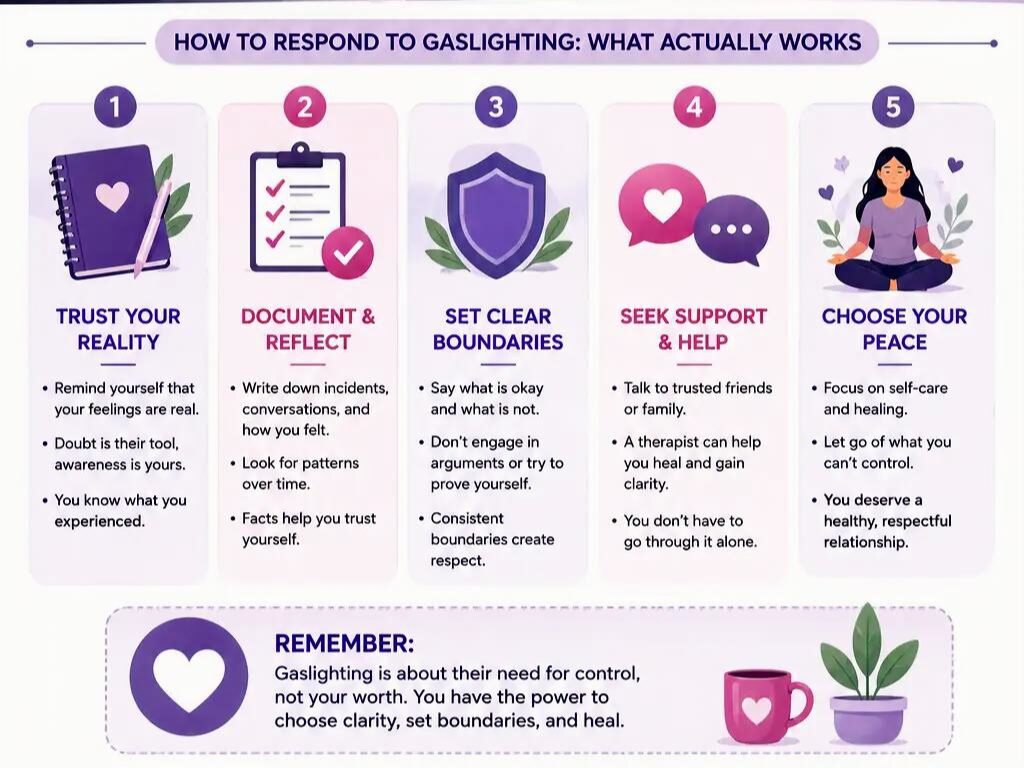
What to Say to a Gaslighter: Phrases That Work
Here are specific phrases organized by situation:
Deny something that happened:
- “I remember this clearly. We can see it differently without one of us being wrong.”
- “I know what was said. I am not going to argue about it.”
- “My memory of this is clear.”
Tell you that you are overreacting:
- “My feelings are my feelings. They are not up for debate.”
- “I get to decide how something made me feel.”
- “I am not overreacting. I am telling you how this affected me.”
Blame you for their behavior:
- “I am not responsible for how you chose to respond.”
- “My behavior does not justify what you said or did.”
- “We can talk about what I did separately. Right now, I am talking about what you did.”
Tell you that you are too sensitive:
- “Being sensitive to how I am treated is not a flaw.”
- “I would rather feel things deeply than not feel them at all.”
- “Calling me sensitive does not make what happened okay.”
When you need to end the conversation:
- “I am not able to continue this right now.”
- “I need some time before we talk about this again.”
- “I have said what I needed to say.”
What NOT to Say to a Gaslighter?
Equally important is what to avoid:
- Do not try to out-argue them with evidence.
They will find a way to discredit it, dismiss it, or use it against you. Evidence-based arguments rarely work with someone who is committed to their version of events. - Do not get drawn into defending your feelings.
Your feelings do not need a defense. The moment you start justifying why you felt hurt, you have accepted their premise that your feelings need justification. - Do not say things you do not mean to escalate the situatio
Avoid inflammatory statements that could cause the person to escalate to aggressive or explosive behavior. The goal is to protect yourself, not to win. - Do not apologize for their behavior
Even if it ends the argument faster. It costs more than it saves.
How to Deal With Gaslighting Over Time?
Responding in the moment is one part. The other part is protecting yourself consistently, over time.
Keep a private record
Document your interactions, save texts and emails, note dates and times of conversations, and summarise what was said with direct quotes where possible.
This is not about building a legal case. It is about having somewhere to turn when your memory is being questioned. When you doubt yourself, you can go back and see what actually happened.
Stay connected to people outside the relationship
Gaslighting works partly through isolation. Talking to people you trust gives you a vital outside perspective and emotional support, and it counters the isolation that gaslighting depends on.
If you have been pulling away from friends or family, reaching back out is one of the most important things you can do.
Take care of yourself deliberately
A gaslighter may try to make you feel undeserving of self-care or label your practices as lazy or indulgent. Maintaining self-care habits despite this keeps you stronger and better able to hold onto your reality.
Rest, movement, time with people who make you feel like yourself, these are not luxuries. They are part of how you stay grounded.
Work with a therapist
A therapist who understands emotional abuse can help you rebuild trust in your own perceptions, process what you have experienced, and make clear-headed decisions about what to do next.
🧠 SoulTip: Recovery from gaslighting is not linear. There will be days when you feel clear and days when you doubt yourself again. That is normal. The goal is not to feel certain every day; it is to keep coming back to yourself.
When Responding Is No Longer Enough: Knowing When to Leave
Sometimes the most honest answer is this: when gaslighting is consistent, intentional, and the person doing it has no interest in changing, no response strategy will fix it.
If you call out a gaslighter’s actions and they do not stop or they escalate, the only healthy response may be to leave the relationship.
This is not a failure. It is clarity.
If you are concerned about your safety while leaving, please reach out to a domestic violence support service in your country. Leaving a controlling relationship is safest with support, and help is available.
Recovering From Gaslighting
Recovery is not a straight line. But it is possible, and it starts with small, consistent steps back to yourself.
Rebuilding self-trust
Gaslighting erodes your ability to trust your own instincts. Start small. Notice what you want for dinner, how a conversation made you feel, and what your gut says in low-stakes situations. Trust is rebuilt through practice, not overnight.
📖 Want to go deeper? Stephanie Sarkis’s Gaslighting: Recognise Manipulative and Emotionally Abusive People and Break Free is one of the most practical books for anyone navigating this experience.Reconnecting with people
Isolation is part of how gaslighting works. Reaching back out to friends, family, or a support community is one of the most important steps in recovery. You do not have to explain everything. Just start showing up again.
Learning what healthy boundaries feel like
Many people coming out of gaslighting relationships have lost their sense of what normal feels like. Working with a therapist can help you relearn what respectful communication looks and feels like and rebuild confidence in your own judgment.
Grieving the relationship
Even when you know the relationship was harmful, loss is still loss. Allow yourself to feel it without guilt. Grief is not a sign that you made the wrong decision. It is a sign that you loved someone.
Giving yourself time
Recovery from gaslighting, especially long-term gaslighting, can take months or years. There will be days when you feel clear and days when you doubt yourself again. Both are part of the process.
🧠 SoulFact: Research shows that survivors who implement structured recovery strategies, such as journaling, therapy, and rebuilding support networks, report significant improvements in self-trust within 6 to 12 months of leaving abusive situations.
How SoulBot Can Help?
Processing all of this, the confusion, the self-doubt, the exhaustion of constantly defending your reality is a lot to carry alone.
Soululu, SoulBot’s AI companion, is available whenever you need a private, judgment-free space to talk through what you are feeling. No labels. No advice you did not ask for. Just a calm presence when things feel heavy.
💬 Start a conversation with Soululu whenever you are ready.