

Quick Answer: How Do You Deal With Anxiety?
When anxiety hits, don’t try to solve your entire life at once.
Start with three things:
- Body: slow your breathing and reconnect with your surroundings.
- Thoughts: separate what is happening from what your mind predicts will happen.
- Behaviour: take one useful action instead of automatically avoiding the situation.
For longer-term anxiety, regular sleep, physical activity, reducing triggers such as excess caffeine, and therapies such as CBT can help. Anxiety disorders are treatable, and professional support is worth considering when anxiety starts interfering with work, relationships, sleep, or everyday activities.
What Is Anxiety?
Anxiety is a feeling of worry, fear, or unease that can appear when your brain anticipates a threat.
Some anxiety is useful. It can make you prepare for an interview, pay attention before crossing a road, or respond quickly to danger.
The problem is when the alarm:
- Appears when there is little immediate danger;
- Feels much stronger than the situation;
- Continues after the threat has passed;
- Repeatedly changes what you do.
WHO estimates that 359 million people were living with an anxiety disorder in 2021, making anxiety disorders among the world’s most common mental-health conditions.
Anxiety vs Fear: What’s the Difference?
They overlap, but they are not exactly the same.
| Fear | Anxiety |
|---|---|
| Often responds to an immediate threat | Often focuses on what might happen |
| “That dog is running towards me.” | “What if a dog attacks me tomorrow?” |
| Usually tied to something happening now | Can continue without an immediate threat |
| Often settles when danger passes | Worry may continue after the situation ends |
You can experience both at the same time.
Understanding which one is happening helps you decide what to do next.
How to Calm Anxiety in the Moment
1. Slow Your Breathing, Don’t Force Huge Breaths
When anxiety rises, people may start breathing quickly or shallowly.
Try:
Breathe in gently through your nose.
Breathe out slowly.
Keep the breath comfortable rather than unusually deep.
Continue for a few minutes.
NHS guidance recommends gentle, regular breathing for stress, anxiety, and panic rather than forcing the breath.
If counting helps, try:
In: 1–2–3–4
Out: 1–2–3–4
You do not have to hold your breath.
2. Use the 5-4-3-2-1 Grounding Technique
If your attention is trapped inside anxious thoughts, deliberately reconnect with what is around you.
Name:
- 5 things you can see
- 4 things you can feel
- 3 things you can hear
- 2 things you can smell
- 1 thing you can taste
Grounding uses your senses to bring attention back to your present environment and can be useful when anxiety or panic makes you feel out of control.
3. Separate the Fact From the Fear
Anxiety often takes a possibility and turns it into a prediction.
Try this:
Fact:
“My manager asked to speak with me tomorrow.”
Fear:
“I am definitely getting fired.”
Balanced response:
“I don’t know why they want to talk yet. I can prepare for the conversation without deciding the outcome in advance.”
You are not forcing yourself to think positively.
You are removing certainty from something you cannot yet know.
The SoulBot Anxiety Loop
Many anxious patterns follow this cycle:
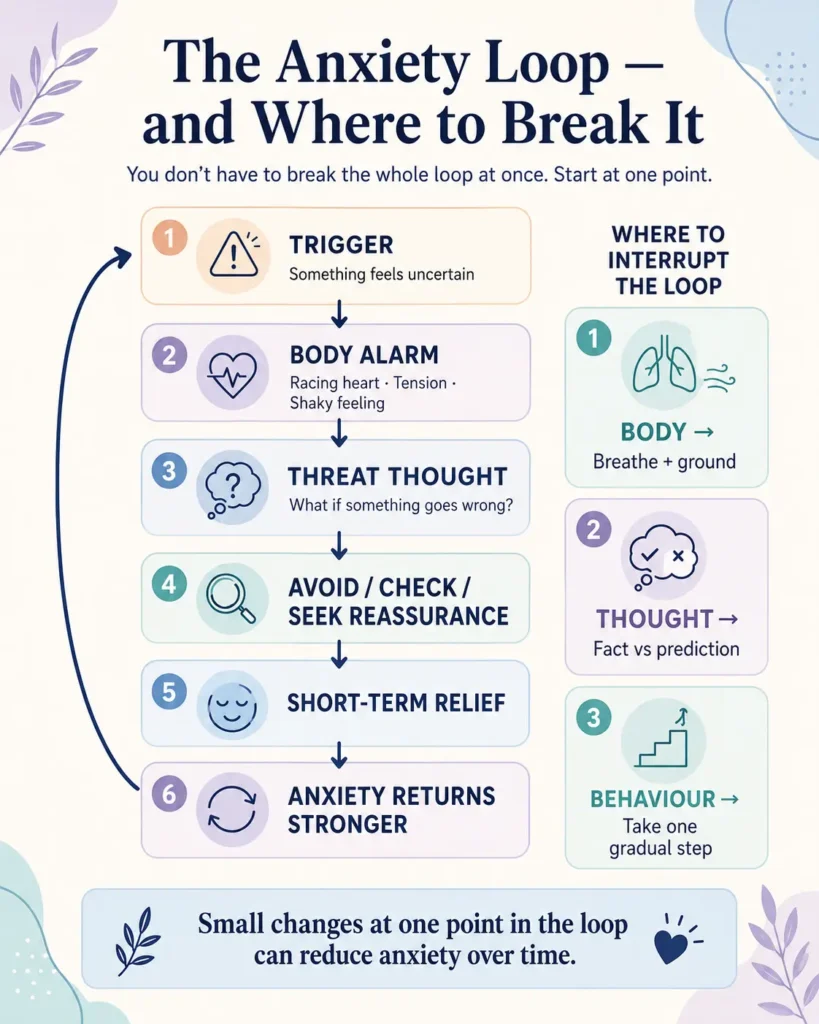
Example
- Trigger: You’re invited to a social event.
- Body: Heart racing.
- Thought: “I’ll embarrass myself.”
- Behavior: Cancel.
- Immediate result: Relief.
Long-term result: Your brain gets another message that social situations are dangerous.
This is why anxiety management isn’t only about calming yourself. Sometimes you also need to change what happens after the anxious feeling appears.
How to Manage Anxiety Long Term
Stop Feeding Anxiety With Avoidance
Avoiding something frightening can make sense in the moment.
But repeated avoidance can maintain some anxiety problems because you never get the opportunity to learn that you can cope.
Exposure therapy, a form of CBT, uses gradual and supported contact with feared situations rather than jumping immediately into the hardest fear. NIMH identifies exposure-based approaches as established treatments for several anxiety disorders.
Build an Anxiety Ladder
If speaking in groups scares you:
- 2/10: Ask a shop assistant a question.
- 4/10: Speak during a small team conversation.
- 6/10: Share an opinion during a meeting.
- 8/10: Give a short presentation.
Start lower on the ladder.
You are practicing:
“I can experience anxiety and still do this.”
Not:
“I must stop feeling anxious before I do this.”
For severe anxiety, trauma-related fears, OCD, or panic symptoms, structured exposure is better planned with a qualified therapist.
Challenge the Story, Not the Emotion
Instead of asking:
“Why am I anxious?”
try:
“What is my anxiety predicting?”
Then examine:
Prediction:
“If I make one mistake, everyone will think I’m incompetent.”
Evidence for it:
“I made an error.”
Evidence against it:
“I’ve completed dozens of tasks successfully.”
More balanced thought:
“A mistake may be uncomfortable, but it does not define my ability.”
CBT focuses on relationships between thoughts, emotions, and behavior and teaches people to change patterns that contribute to distress.
Related: ACT vs CBT: What’s the Difference and Which Therapy May Fit You?
6. Move Your Body Regularly
Exercise is not a cure for anxiety, but regular physical activity can support anxiety and stress management.
You do not need an extreme workout.
Try:
- Walking;
- Yoga;
- Cycling;
- Swimming;
- Dancing;
- Strength training.
NHS guidance for generalized anxiety disorder includes regular exercise alongside sufficient sleep and regular meals as useful self-care strategies.
Check Your Caffeine
If you regularly feel:
- shaky;
- restless;
- wired;
- Unable to sleep;
- aware of your heartbeat;
Notice how much caffeine you are consuming and when.
Caffeine can worsen anxiety or sleep problems for some people, and NHS guidance specifically recommends reducing excessive caffeine when managing anxiety.
You do not necessarily need to eliminate coffee. Track whether changing the amount or timing changes your symptoms.
Stop Treating Every Anxious Thought as Urgent
Try creating a 15-minute worry window.
When worry appears during the day:
- Write it down;
- Tell yourself you’ll revisit it during your worry time;
- Return to your current activity;
- Review the list later.
You may discover that some worries no longer feel urgent by the time you return to them.
This is particularly useful for the type of anxiety that constantly demands:
“Think about me right now.”
What Should You Do Based on Your Anxiety Pattern?
| If anxiety looks like… | Start with… |
|---|---|
| Racing heart or shaky body | Slow breathing + grounding |
| Endless “what if” thoughts | Fact vs prediction |
| Avoiding situations | Gradual anxiety ladder |
| Constant reassurance-seeking | Delay reassurance briefly |
| Anxiety mostly at bedtime | Worry window + sleep routine |
| Coffee makes you jittery | Track and reduce caffeine |
| Anxiety disrupts daily life | Professional assessment |
This is not a diagnostic table. Different anxiety disorders can require different approaches.
Are You Avoiding Anxiety or Managing It?
Ask yourself:
Does this action help me cope, or does it only help me escape?
Examples:
Coping:
Taking ten minutes to regulate before attending an event.
Avoidance:
Canceling every event because anxiety might appear.
Coping:
Asking your partner for clarification once.
Reassurance loop:
Asking repeatedly whether they still love you until the anxiety temporarily disappears.
Coping:
Preparing for your presentation.
Anxiety loop:
Practicing it 40 times because it never feels “safe enough.”
This distinction matters because something can reduce anxiety right now while strengthening it in the long term.
Is Anxiety Affecting Your Everyday Life?
Not sure whether what you’re experiencing is occasional stress or a broader anxiety pattern?
Take the Free Anxiety Test to reflect on:
- Persistent worry;
- Restlessness;
- Difficulty relaxing;
- Physical anxiety symptoms;
- Avoidance;
- How anxiety may be affecting everyday life.
Quick self-check · Instant result · Not a diagnosis
When Should You Seek Help for Anxiety?
Consider professional support when anxiety:
- repeatedly interferes with work or study;
- damages relationships;
- disrupts sleep;
- causes frequent panic;
- makes you avoid serious situations;
- feels difficult to control;
- continues despite self-help efforts.
Psychotherapy and medication are among the established treatment options for anxiety disorders, depending on the particular condition and the person’s needs. CBT is one of the most widely studied psychological treatments, and exposure-based methods are commonly used when fear and avoidance are central to the problem.
Want Professional Support With Anxiety?
You do not have to wait until anxiety becomes unbearable.
A therapist can help you understand:
- What triggers your anxiety;
- Which thoughts and behaviors maintain it;
- How to reduce avoidance;
- Which coping tools fit your situation;
- Whether CBT, ACT, or another approach may be appropriate.
👉 Book an Anxiety Therapy Session
Talk to Soululu When Your Thoughts Feel Loud
Sometimes you don’t need another generic calming tip. You need somewhere to untangle what is happening.
Use Soululu to explore:
- What triggered this anxiety?
- What am I predicting?
- What do I actually know?
- What am I avoiding?
- What’s one manageable next step?
Soululu supports emotional reflection and coping practice. It does not diagnose anxiety disorders or replace care from a qualified mental-health professional.
Final Thought
The goal isn’t to feel anxiety again.
A more realistic goal is:
Notice the alarm → calm the body → question the prediction → choose the next useful action.
Sometimes anxiety gets quieter first.
Sometimes you learn that you can keep living even while it is still there.
Both are progress.