

How to Reconnect With Your Partner Emotionally: A 7-Day Reset

Last Updated: October 4, 2026
Reconnect With Your Partner Emotionally
Table of Contents

Emotional reconnection usually happens through small, repeated moments of attention, honesty, and responsiveness, not one dramatic date night. If you still care about each other but conversations feel practical, affection has faded, or you feel more like roommates than partners, start by rebuilding connection in small ways.

You don’t have to fix the whole relationship this week. Try one thing each day.

Why Do I Feel Disconnected From My Partner?

Emotional distance can develop even when love is still there.

Stress, routine, unresolved disagreements, missed attempts to connect, and conversations becoming mostly about work, chores, or schedules can gradually create distance.

The Gottman Institute describes emotional connection as something strengthened through trust, empathy, communication, shared experiences, appreciation, and consistent everyday rituals.

If you’re trying to understand emotional intimacy itself, read SoulBot’s How to Build Emotional Intimacy in a Relationship.

Try This 7-Day Emotional Reconnection Reset

Day 1: Name the Distance Without Blame

Avoid:

“You don’t care about us anymore.”

Try:

“I’ve felt more distant from you lately, and I miss feeling close.”

The first version assigns a motive. The second tells your partner what you’re actually experiencing.

If saying what you feel is difficult, SoulBot’s guide to expressing feelings in a relationship may help.

Day 2: Ask One Question You Don’t Know the Answer To

Skip “How was your day?” for once.

Ask:

“What’s been taking up the most space in your mind lately?”

Or:

“When have you felt closest to me recently?”

Curiosity matters because partners continue changing. SoulBot’s 35 Deep Relationship Questions has more conversation starters if you need them. Deep Relationship Questions to Ask Your Partner

Day 3: Notice One Attempt to Connect

Connection doesn’t always arrive as:

“Can we have a deep conversation?”

It may look like your partner showing you a meme, telling you something unimportant about work, touching your shoulder, or asking you to watch something with them.

Relationship researchers commonly call these small attempts bids for connection. Responding with interest, rather than repeatedly ignoring them, can help maintain closeness.

Today, notice one.

Day 4: Give Specific Appreciation

Instead of:

“You’re the best.”

Try:

“I noticed you checked on me before your meeting today. That made me feel cared for.”

Specific appreciation tells your partner exactly what mattered.

It also helps you notice what is still working instead of focusing only on what’s missing.

Day 5: Spend 20 Minutes Without Logistics

No bills. No groceries. No calendars. No household administration.

Use 20 minutes to talk about something personal: what you’re worried about, excited about, missing, learning, or looking forward to.

Put the phones away. The activity matters less than giving each other undivided attention.
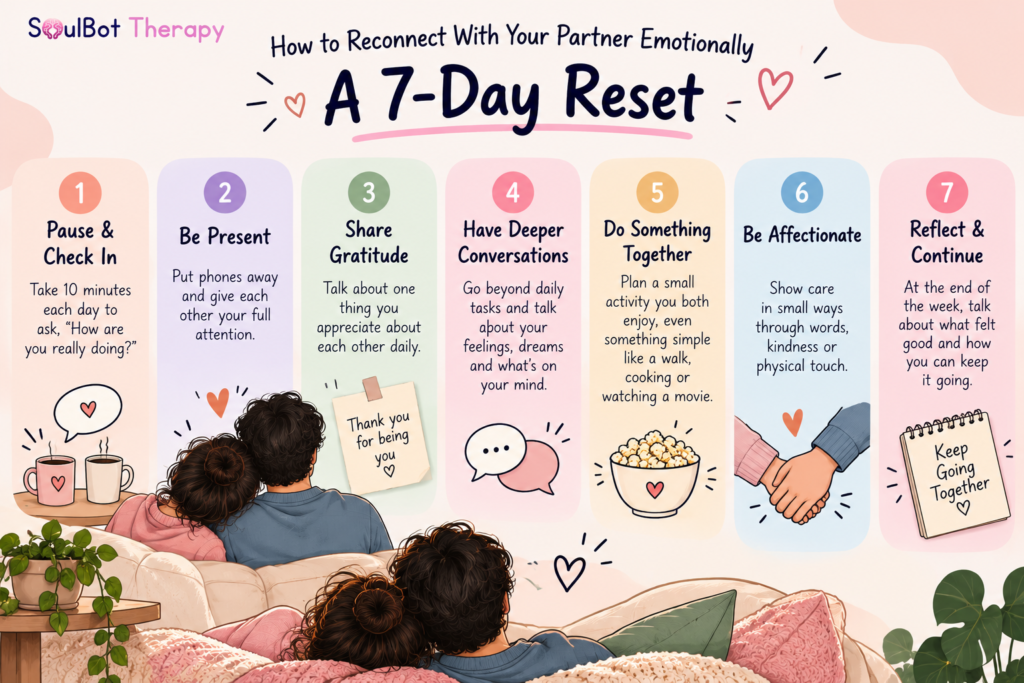
Reconnect With Your Partner Emotionally

Day 6: Repair One Small Unresolved Hurt

Do not try to solve your entire relationship history tonight.

Ask:

“Is there something between us lately that we haven’t properly talked about?”

Listen before defending yourself.

If an old disagreement keeps creating distance, the goal isn’t to decide who remembers everything correctly. The goal is to understand what still feels unresolved.

Day 7: Create One Ritual You Can Actually Keep

Connection works better when it doesn’t depend on remembering to “try harder.”

Choose something repeatable:

  • 10-minute evening check-in.
  • Sunday morning walk.
  • Phone-free dinner once a week.
  • One meaningful question every Friday.

The ritual should be easy enough that you’ll still do it during a busy week.

How Do You Know If Reconnection Is Working?

Don’t measure progress by whether you suddenly feel “in love again.”

Look for smaller changes:

  • You talk about more than logistics.
  • You feel safer bringing things up.
  • Curiosity starts returning.
  • Affection feels less forced.
  • Both of you initiate connection.
  • Small disagreements get repaired more quickly.

SoulBot’s Relationship Growth Checklist can also help you reflect on whether you’re becoming closer or gradually growing apart.

What If You’re the Only One Trying to Reconnect?

One person can start a reconnection attempt.

One person cannot create mutual emotional intimacy alone.

If your partner occasionally struggles to open up, that is different from consistently mocking, dismissing, ignoring, or refusing to engage in every attempt to communicate.

Ask yourself:

When I reach toward this person, do they eventually reach back?

If the answer remains no, the problem may no longer be how you’re trying to reconnect.

If you’re feeling increasingly unwanted or emotionally alone, read Feeling Unwanted in a Relationship: Why It Happens and What to Do.

And if the relationship includes fear, coercion, humiliation, manipulation, or abuse, a 7-day connection exercise is not the appropriate solution. Consider professional or specialist support.

talk to soululu

Not Sure What’s Creating the Distance?

Sometimes you know something has changed but can’t identify exactly what.

Talk privately with Soululu about when the distance started, what you miss, what happens when you try to connect, and what you need now.

You can also take SoulBot’s Free Love Language Test to reflect on how you prefer to give and receive affection.

The goal isn’t to recreate the beginning of your relationship.

It’s to get curious about who both of you are now and decide whether you’re willing to meet each other there.


FAQ

Frequently Asked Questions

Start with small, repeatable moments of connection. Talk without blame, ask meaningful questions, notice your partner’s attempts to connect, show specific appreciation, and create simple rituals like a daily check-in or weekly walk.
Love can still be present while emotional connection weakens. Stress, routine, unresolved conflict, poor communication, or repeatedly missed bids for attention can all create distance over time.
Yes. Emotional connection can often be rebuilt when both partners are willing to communicate, repair unresolved issues, and consistently make space for closeness. It usually happens gradually rather than through one big conversation.
Start by creating time that is not focused on chores, schedules, or responsibilities. Bring back curiosity, affection, shared experiences, and conversations about feelings, goals, and what each of you misses in the relationship.
You can initiate connection, but you cannot create mutual intimacy alone. If your partner consistently dismisses, avoids, or refuses attempts to reconnect, it may be worth discussing the pattern directly or seeking professional support.

About the Author:

Picture of Sonali Shastri

Sonali Shastri

Sonali Shastri is a Content Expert at SoulBot Therapy, where she creates mental health and self-discovery content that feels clear, relatable, and emotionally grounded. She specializes in translating psychology-informed ideas into simple, relatable blogs, test pages, and reflection-based resources. Her work helps readers understand themselves better while reducing stigma around mental health conversations.

More Blog Posts

You May Look Fine, But It Feels Heavy Inside

Ready to explore your full SoulMap?

🟢The Grounded Socializer

Social Moments Feel Mostly Manageable

Ready to explore your full SoulMap?

🟡The Quiet Overthinker

You Show Up, But Your Mind Replays It

Ready to explore your full SoulMap?

🟠The Cautious Connector

Connection Matters, But It Can Feel Hard

Ready to explore your full SoulMap?

Your emotional compass wants love, but stays cautious.

Ready to explore your full SoulMap?

Avoidant Attachment
Independent, With Boundaries

Your emotional compass values space and self-reliance.

Ready to explore your full SoulMap?

Anxious Attachment
Deep, But Seeking Reassurance

Your emotional world is intense and connection-driven.

Ready to explore your full SoulMap?

Secure Attachment – Calm & Connected

Your emotional compass feels steady and safe.


Ready to explore your full SoulMap?

The Storm Mind (Severe Anxiety)

Intense, overwhelming, and hard to control at times.

Ready to explore your full SoulMap?

The Overthinker (Moderate Anxiety)

Your mind is active, often running ahead of you.

Ready to explore your full SoulMap?

The Gentle Worrier (Mild Anxiety)

Occasional overthinking, but still in control.
You feel stress at times, but it doesn’t take over your day.

Ready to explore your full SoulMap?

Moderately Emotionally Available- Opening, With Caution

Your emotional compass shows growth, with a few guarded zones.

Ready to explore your full SoulMap?

Your emotional compass points toward openness and connection.

Ready to explore your full SoulMap?

Your emotional compass leans toward self-protection right now.

Ready to explore your full SoulMap?

Submissive Personality

Gentle and supportive. You bring calm energy and emotional depth to every space.

Ready to explore your full SoulMap?

Balanced Personality

Grounded and fair-minded. You value harmony, empathy, and shared understanding.

Ready to explore your full SoulMap?

Dominant Personality

Driven and decisive. You lead naturally, think fast, and act with purpose.

Ready to explore your full SoulMap?

Homosexual —
True North, Same-Gender

Your love compass points to people of the same gender.

Ready to explore your full SoulMap?

Restless and always in motion. May talk fast, act quickly, or jump between ideas. 

Ready to explore your full SoulMap?

High Likelihood
ADHD Combined Type (ADHD-C)

Shows both inattentive and hyperactive traits where focus shifts, energy spikes, and motivation come in waves.

Ready to explore your full SoulMap?

Low Likelihood
ADHD Inattentive Type (ADHD-I)

Often loses focus and misses details, with drifting thoughts that leave tasks unfinished.

Ready to explore your full SoulMap?

🔧 The Virtuoso - ISTP

Hands-On Expert

Ready to explore your full SoulMap?

📋 The Logistician - ISTJ

Steady Rock

Ready to explore your full SoulMap?

🌻 The Adventurer - ISFP

Gentle Spirit

Ready to explore your full SoulMap?

🛡️ The Defender - ISFJ

Caring Guardian

Ready to explore your full SoulMap?

🤔 The Logician - INTP

Curious Explorer

Ready to explore your full SoulMap?

🏛️ The Architect - INTJ

Strategic Mastermind

Ready to explore your full SoulMap?

🦄 The Mediator - INFP

Gentle Idealist

Ready to explore your full SoulMap?

🔮 The Advocate - INFJ

Quiet Visionary

Ready to explore your full SoulMap?

🚀 The Entrepreneur - ESTP

Action Hero

Ready to explore your full SoulMap?

📊 The Executive - ESTJ

Results Driven

Ready to explore your full SoulMap?

🎭 The Entertainer - ESFP

Life of the Party

Ready to explore your full SoulMap?

🤗 The Consul - ESFJ

Heart of Gold

Ready to explore your full SoulMap?

🧠 The Debater - ENTP

Mental Gymnast

Ready to explore your full SoulMap?

👑 The Commander - ENTJ

Strategic Powerhouse

Ready to explore your full SoulMap?

🎨 The Campaigner - ENFP

Creative Visionary

Ready to explore your full SoulMap?

🌟 The Protagonist - ENFJ

Natural Born Leader

Ready to explore your full SoulMap?

🤗 Physical Touch

Hugs Over Hype

Ready to explore your full SoulMap?

🕰 Quality Time

Presence Over Presents

Ready to explore your full SoulMap?

🎁 Receiving Gifts

Thoughtful Tokens, Big Feelings

Ready to explore your full SoulMap?

🤝 Acts of Service

Love in Action

Ready to explore your full SoulMap?

Words of Affirmation

You Speak from the Heart

Ready to explore your full SoulMap?

Gay, Lesbian, or
Queer and Proud

Your love compass points to the same gender

Ready to explore your full SoulMap?

Bisexual -
Go with the Flowy

Your love compass swings in the middle

Ready to explore your full SoulMap?

Heteroflexible —
Some Wiggle in the Compass

You’ve got a touch of bi-curiosity

Ready to explore your full SoulMap?

Hetero -
Straight Up Honest

Your love compass points to the opposite sex.

Ready to explore your full SoulMap?