

Quick Answer: What Is the Difference Between ACT and CBT?
CBT and ACT both help you respond differently to difficult thoughts, emotions and behaviours but they start with different questions.
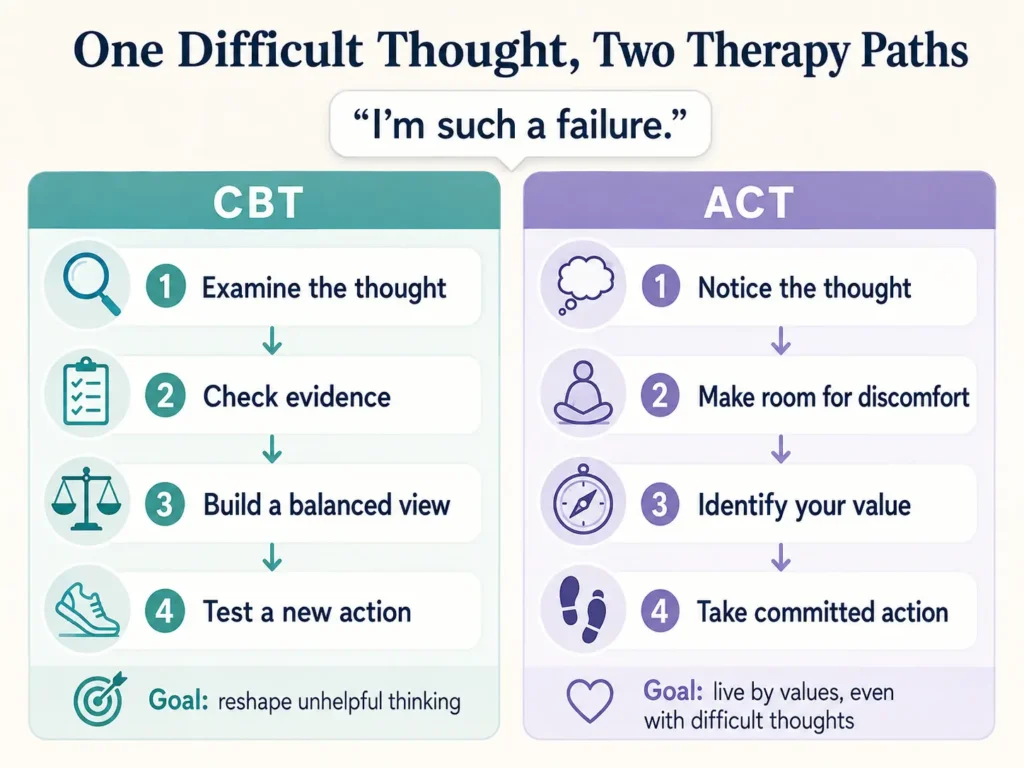
- CBT asks: Is this thought accurate or useful, and what evidence supports it?
- ACT asks: Can I notice this thought without letting it control what I do next?
CBT often uses cognitive restructuring, behavioural experiments and exposure. ACT uses acceptance, cognitive defusion, mindfulness, values and committed action.
Neither therapy is universally better. The right approach depends on your symptoms, goals, preferences and therapist.
What Is CBT?
Cognitive Behavioural Therapy, or CBT, focuses on the connection between thoughts, feelings and behaviour.
A CBT therapist may help you:
- recognise unhelpful thinking patterns
- test thoughts against evidence
- reduce avoidance
- practise healthier responses
- complete exercises between sessions
CBT is not about replacing every negative thought with a positive one. It helps you develop a more balanced view and change behaviours that keep a problem going.
The American Psychological Association’s CBT guide explains that CBT commonly involves reevaluating unhelpful thinking and learning more effective ways of coping.
What Is ACT?
Acceptance and Commitment Therapy, or ACT, helps you make room for difficult thoughts and feelings while taking action guided by your values.
ACT may help you:
- notice thoughts without treating them as facts
- allow uncomfortable emotions to be present
- stay connected to the current moment
- identify what matters to you
- act according to your values despite discomfort
Acceptance does not mean approving of pain, tolerating mistreatment or giving up. The goal is psychological flexibility: responding to the situation rather than automatically obeying fear or avoidance.
Read the complete guide: Acceptance and Commitment Therapy: How ACT Works.
ACT vs CBT: Main Differences
| CBT | ACT |
|---|---|
| Examines and tests unhelpful thoughts | Changes your relationship with thoughts |
| May ask, “Is this thought accurate?” | May ask, “Do I have to obey this thought?” |
| Uses cognitive restructuring and behavioural experiments | Uses defusion, acceptance and values work |
| Often tracks symptom and behaviour change | Often tracks values-based action and flexibility |
| Usually feels structured and goal-focused | Often includes mindfulness and experiential exercises |
The approaches overlap. Both can include exposure, behaviour change, goals and practice outside therapy.
One Thought, Two Therapy Approaches
Imagine making a mistake at work and thinking:
“Everyone will realise I’m incompetent.”
How CBT may approach it
- Identify possible all-or-nothing thinking.
- Review evidence for and against the belief.
- Form a balanced thought: “I made one mistake, and I can correct it.”
- Take a practical step, such as asking for feedback.
How ACT may approach it
- Notice: “I’m having the thought that I’m incompetent.”
- Allow the anxiety to be present without arguing with it.
- Identify a value, such as responsibility or growth.
- Correct the mistake even while the anxious thought remains.
CBT changes how you evaluate the thought. ACT changes how tightly you hold it. Both aim to help you take a more useful action.
ACT vs CBT for Anxiety: Which Is Better?
Both approaches can be used for anxiety.
CBT may feel more suitable when you want to:
- test fearful predictions
- reduce specific avoidance
- follow a clear treatment structure
- challenge recurring unhelpful beliefs
ACT may feel more suitable when:
- arguing with your thoughts makes them feel louder
- you understand that a fear is unlikely but still feel stuck
- avoidance is limiting your life
- you want to act according to your values despite anxiety
Current comparative evidence does not show that ACT is universally superior. A July 2026 systematic review of 34 randomised trials found no overall advantage for full-model ACT over other established psychotherapies.
How Do You Choose Between CBT and ACT?
Consider CBT if you prefer:
- structured sessions
- worksheets and written exercises
- measurable goals
- examining specific thoughts
- behavioural experiments
Consider ACT if you:
- feel exhausted from trying to control thoughts
- get trapped in endless analysis
- want clarity about what matters to you
- need help acting while discomfort remains
- connect well with mindfulness-based exercises
You do not need to make this decision alone. A qualified therapist can assess what is maintaining the problem and may use techniques from both approaches.
Try the SoulBot Evidence–Distance–Direction Check
When a thought feels overwhelming, ask:
Evidence: What facts support or challenge this thought?
Distance: Can I say, “I’m having the thought that…”?
Direction: What small action matches my values right now?
The first question is CBT-informed. The second and third are ACT-informed.
This is a reflection exercise, not therapy.
Are Looping Thoughts Affecting Daily Life?
The Free Anxiety Test can help you reflect on worry, restlessness, avoidance and overthinking patterns.
Quick self-check · Instant result · Not a diagnosis
Talk to Soululu About CBT and ACT
Soululu can help you:
- organise a difficult thought
- separate facts from assumptions
- notice what emotion is present
- identify what matters to you
- choose one realistic next step
Soululu supports reflection. It does not provide CBT or ACT therapy, diagnose mental health conditions or replace a qualified therapist.
Final Thought
ACT vs CBT is not a contest.
CBT can help you examine and change patterns that keep distress going. ACT can help you stop waiting for difficult thoughts to disappear before living according to your values.
The useful question is not:
“Which therapy wins?”
It is:
“Which approach helps me engage with my life more effectively?”