
Quick Answer: What Causes Bad Sleep?
Bad sleep can be caused by stress and anxiety, an irregular sleep schedule, caffeine or alcohol, nighttime screen use, an uncomfortable sleep environment, physical health conditions, medications, or an underlying sleep disorder.
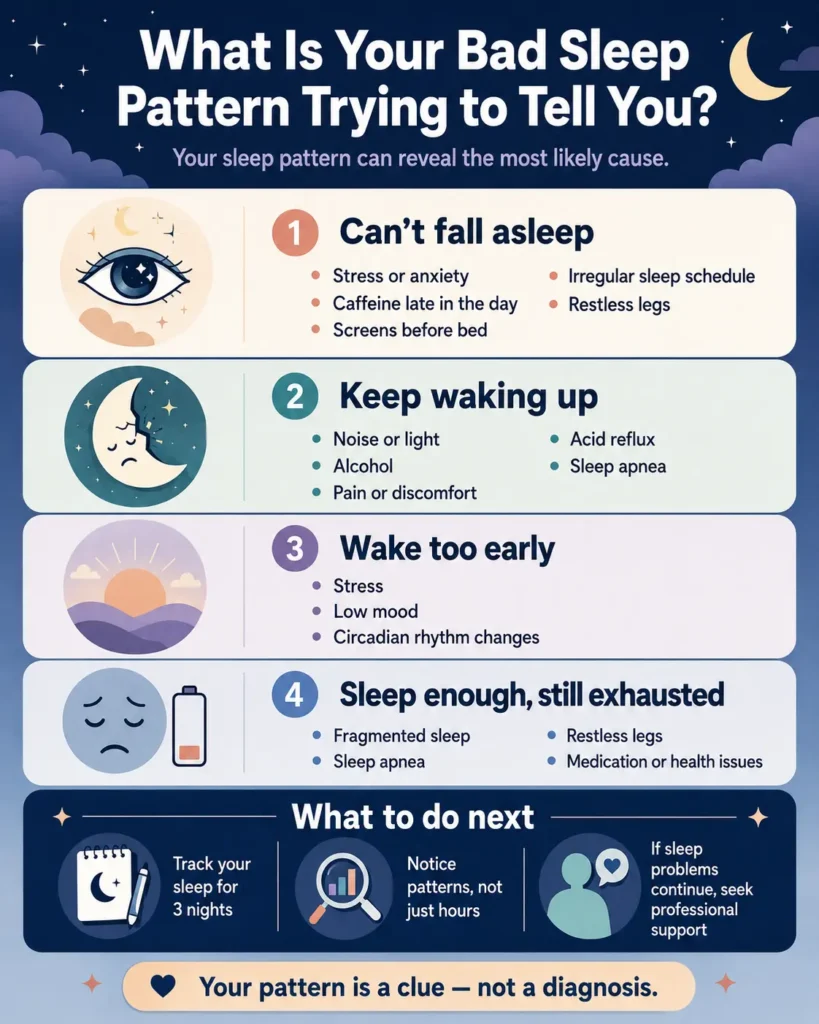
The way your sleep is disrupted can offer useful clues.
For example:
- Cannot fall asleep: stress, caffeine, an irregular body clock or restless legs may contribute.
- Wake repeatedly: noise, alcohol, pain, reflux, needing the bathroom or sleep apnea may be involved.
- Wake too early: stress, mood changes or changes in your sleep-wake rhythm may contribute.
- Sleep enough but still feel exhausted: your sleep may be fragmented even if the number of hours looks adequate.
These are clues, not diagnoses.
The National Heart, Lung, and Blood Institute lists stress, changing schedules, electronic devices, caffeine, nicotine, alcohol and environmental factors among recognised contributors to insomnia.
First: What Does “Bad Sleep” Actually Mean?
Poor sleep is not only getting too few hours.
You may have poor sleep quality if you:
- struggle to fall asleep
- wake repeatedly
- wake earlier than intended
- sleep for several hours but wake unrefreshed
- feel excessively sleepy during the day
The CDC defines quality sleep as uninterrupted and refreshing sleep, not simply time spent in bed.
Sleep problems are common
New U.S. National Health Interview Survey data published in 2026 found that in 2024:
- 30.5% of adults usually slept less than seven hours
- 15.4% had trouble falling asleep most days or every day
- 18.1% regularly had trouble staying asleep
The SoulBot Sleep Pattern Decoder
Instead of immediately blaming your phone or bedtime, start with how your sleep is actually breaking down.
| Your sleep pattern | Possible causes worth checking |
|---|---|
| Takes a long time to fall asleep | Stress, anxiety, caffeine, late stimulation, irregular schedule, restless legs |
| Wake several times | Noise, temperature, alcohol, pain, reflux, bathroom trips, sleep apnea |
| Wake too early | Stress, mood changes, circadian timing |
| Sleep enough but feel unrefreshed | Fragmented sleep, sleep apnea, restless legs, medication effects |
| Sleep times constantly shift | Shift work, weekend schedule changes, travel, inconsistent routine |
This table should be one of the main AI-answerable sections on the page.
1. Stress and a Mind That Will Not Switch Off
Stress is one of the most established causes of bad sleep.
You may lie down physically exhausted while your mind starts processing:
- work
- money
- relationships
- unfinished tasks
- conversations
- future problems
Stress can make falling asleep harder, and worrying about not sleeping can create another cycle of anxiety around bedtime.
Try this tonight
Before bed, write:
- What is bothering me?
- Can I do anything about it tonight?
- If not, when will I return to it tomorrow?
The goal is not to eliminate thoughts. It is to stop asking your bed to become your problem-solving space.
Related SoulBot read: How Stress Affects Sleep (and Vice Versa).
2. Your Sleep Schedule Keeps Moving
Your body’s internal clock responds to patterns.
Frequently changing when you sleep and wake, especially through shift work, travel, or large weekday/weekend changes, can disrupt your sleep-wake rhythm.
Instead of obsessing over the perfect bedtime, start with consistency.
The CDC recommends going to bed and getting up at approximately the same time each day.
Already struggling with this specifically? Read How to Reset Your Sleep Schedule Naturally rather than repeating that entire process here.
3. Caffeine, Nicotine or Alcohol Is Affecting Your Night
Caffeine and nicotine are stimulants and may make falling asleep more difficult.
Alcohol is trickier: it can make you sleepy initially but is associated with lighter, more disrupted sleep later in the night.
Before deciding that you have unexplained insomnia, track for three nights:
- when you had your last coffee or tea
- alcohol intake
- nicotine
- bedtime
- how often you woke
Patterns can be more informative than guessing.
4. Your Phone Is Delaying Sleep, But Not Just Because of “Blue Light”
The old explanation that screens automatically spike cortisol is too simplistic, so remove that from the current article.
Phones can affect sleep through several routes:
- delaying bedtime
- exposure to light
- notifications
- emotionally stimulating content
- replacing your wind-down routine
A recent cohort-only systematic review found that greater screen exposure was consistently associated with poorer sleep outcomes across age groups, although the association does not prove that screens are the sole cause.
The CDC recommends turning electronic devices off at least 30 minutes before bedtime.
Better experiment
Don’t begin with an unrealistic two-hour digital detox.
Try:
30 minutes without scrolling for seven nights.
Then compare how long it takes you to fall asleep.
5. Your Bedroom Keeps Interrupting You
Light, noise and uncomfortable temperatures can interfere with sleep.
NHLBI specifically lists nighttime light, noise and uncomfortable temperatures among environmental factors that can disrupt the sleep-wake cycle.
Ask:
- Is there light entering the room?
- Does traffic or another person wake me?
- Am I too warm?
- Do notifications disturb me?
- Is my bed physically uncomfortable?
If the problem is repeated waking rather than falling asleep, investigate the environment before assuming it is purely psychological.
6. A Physical Condition or Medication May Be Involved
Not every poor night’s sleep is caused by mindset or habits.
Sleep can also be affected by conditions such as:
- chronic pain
- acid reflux
- thyroid problems
- frequent nighttime urination
- pregnancy
- some mental-health conditions
Certain prescription and over-the-counter medicines can also interfere with sleep.
Do not stop medication because you think it affects your sleep. Discuss timing, dosage or alternatives with the professional who prescribed it.
7. You May Have an Undiagnosed Sleep Disorder
This is the biggest gap in the old article.
Sometimes sleep hygiene does not fix bad sleep because sleep hygiene is not the underlying problem.
Sleep apnea
Possible signs include:
- loud snoring
- breathing that stops and restarts
- gasping during sleep
- repeated waking
- daytime sleepiness
- morning headaches
Restless legs syndrome
Restless legs syndrome can cause uncomfortable sensations and a strong urge to move the legs, particularly during rest and at night, making it difficult to fall or stay asleep.
If these patterns sound familiar, speak with a healthcare professional rather than repeatedly adding more sleep hacks.
Try the SoulBot 3-Night Sleep Cause Check
This is the unique element I would add to this article.
For only three nights, track:
| Check | Night 1 | Night 2 | Night 3 |
|---|---|---|---|
| Bedtime | |||
| Approx. time to fall asleep | |||
| Times you woke | |||
| Final caffeine | |||
| Screens in final 30 min | |||
| Stress level 0–10 | |||
| Alcohol | |||
| Pain/discomfort | |||
| Morning rested 0–10 |
Then ask:
What changed on the night I slept best?
Do not change seven habits simultaneously. If everything changes, you will not know what actually helped.
The CDC also recommends sleep diaries that record sleep times, waking, naps, exercise, caffeine, alcohol and medications when investigating sleep problems.
What Actually Helps Improve Bad Sleep?
Start with the cause most likely to affect your pattern.
If your schedule changes → work on consistency.
If worry keeps you awake → work on your pre-sleep mental routine.
If you wake from noise → improve the sleep environment.
If caffeine is late → move it earlier.
If you snore and wake exhausted → seek assessment rather than buying another pillow.
For long-term insomnia, healthy sleep habits are useful, but they are not the only treatment. NHLBI describes CBT-I—Cognitive Behavioural Therapy for Insomnia as a usual first treatment option for chronic insomnia.
When Should You Get Help for Poor Sleep?
Talk to a healthcare professional if:
- sleep problems happen regularly
- poor sleep affects work, driving or daily functioning
- you are extremely sleepy during the day
- you repeatedly gasp or stop breathing during sleep
- uncomfortable leg sensations keep you awake
- pain or another medical problem interrupts sleep
- improving your routine has not helped
Persistent insomnia is different from occasionally having a bad night. NHLBI defines chronic insomnia as difficulty sleeping three or more nights per week for more than three months when another problem does not fully explain it.
Talk to Soululu Before Bed
If your problem is mental noise rather than a suspected sleep disorder, Soululu can help you reflect on:
- what is keeping your mind active
- which thought keeps repeating
- what happened during the day
- what can wait until tomorrow
- one small wind-down action
Soululu can support emotional reflection and routines. It cannot diagnose insomnia, sleep apnea or another sleep disorder.
Final Thought
The question is not simply:
“How do I sleep better?”
Start with:
“What keeps interrupting my sleep?”
Your caffeine, thoughts, routine, bedroom, and health can all affect the same night in different ways.
Find the pattern first. Then change the cause you can actually influence.