
Quick Answer: How Do You Fix Your Sleep Schedule?
To fix a disrupted sleep schedule, focus first on when you wake up, not on forcing yourself to fall asleep earlier.
Start with these four anchors:
- Wake at roughly the same time each day
- Get daylight after waking
- Go to bed when you are actually sleepy
- Keep evenings darker and less stimulating
Your circadian rhythm responds strongly to regular light-dark and sleep-wake cues. NIH explains that light, darkness and other environmental signals help synchronise the body’s internal clock.
If anxiety is keeping you awake, the goal is not to force sleep. It is to stop turning bedtime into a nightly test you feel you have to pass.
Can’t switch your mind off at night? Take the Free Anxiety Test to explore whether anxiety patterns may be affecting your sleep.
👉 Take the Anxiety Test
Why Does Your Sleep Schedule Get Messed Up?
Your body uses a roughly 24-hour circadian rhythm to help determine when you feel alert and sleepy.
That rhythm can shift because of:
- sleeping and waking at very different times
- late-night light and screen exposure
- travel or jet lag
- shift work
- late caffeine
- stress or anxiety
- long or late naps
Light is one of the strongest signals for your circadian system. Your internal clock also influences melatonin release and sleep timing.
This is why simply saying:
“Tonight I will sleep at 10 PM.”
often fails when your body has become used to sleeping at 2 AM.
The SoulBot 4-Anchor Sleep Reset
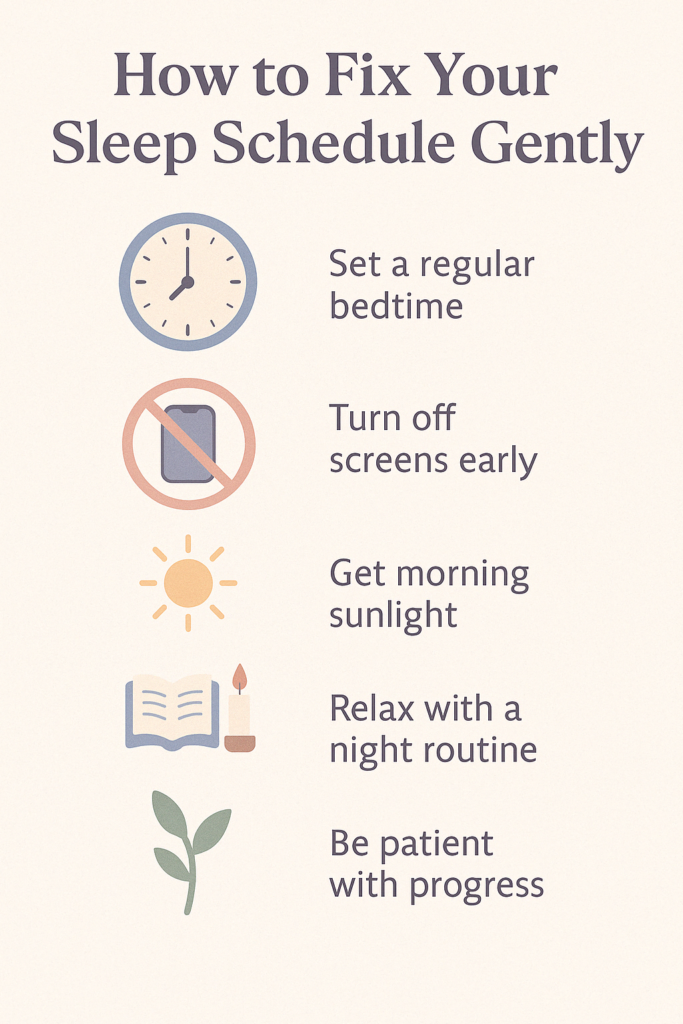
1. Anchor Your Wake-Up Time
A consistent wake time gives your day a reliable starting point.
A fixed morning getting-up time can be more important than forcing a fixed bedtime, because going to bed before you are sleepy may make falling asleep harder.
Choose a wake time you can realistically maintain on weekdays and weekends.
Avoid repeatedly compensating for a bad night by sleeping several hours later the next morning.
Important
If you are severely sleep-deprived, safety comes first. Do not drive or perform dangerous tasks while excessively sleepy.
2. Get Light After You Wake Up
Once awake, open your curtains, step outside or spend some time in natural daylight.
You do not need to chase an internet rule such as “sunlight between exactly 6 and 9 AM.”
The useful timing is relative to your wake time and circadian pattern.
Daylight helps reinforce that:
This is the beginning of my day.
In the evening, do the opposite: reduce unnecessary bright light and stimulation as you approach bedtime. NIH explains that artificial evening light can interfere with normal sleep-wake signalling.
3. Stop Going to Bed Just Because the Clock Says So
This is especially important if anxiety has made your bed a place for:
- overthinking
- checking the clock
- scrolling
- worrying about tomorrow
- trying desperately to sleep
Go to bed when you are becoming sleepy rather than spending hours trying to manufacture sleep.
If you are lying there increasingly frustrated, get up and do something quiet in low light. Return when you feel sleepy again.
This idea forms part of stimulus control, a component of CBT for insomnia designed to rebuild the association between bed and sleep.
4. Move Your Evening Cues Earlier
Your evening should gradually signal that the active part of your day is ending.
You do not need a complicated 12-step sleep routine.
Choose two or three consistent cues:
- dim lights
- stop work
- put your phone away
- shower
- read
- stretch
- listen to quiet music
- write tomorrow’s tasks down
NHLBI recommends a regular wind-down routine and reducing electronic-device exposure before sleep.
How to Fix Your Sleep Schedule When Anxiety Keeps You Awake
Trying harder to sleep can become part of the problem. Check anxiety and sleep
You might think:
“I have to fall asleep now.”
Then:
“I only have six hours left.”
Then:
“Tomorrow is going to be terrible.”
Now your attention is focused entirely on whether sleep is happening.
Try a Sleep Permission Statement instead:
“I don’t need to force sleep. My job is to rest and give sleep the opportunity to happen.”
Then use a short worry check:
Write down:
- What am I thinking about?
- Does anything need to be done tonight?
- If not, when will I deal with it tomorrow?
UCLH specifically suggests setting aside a worry period or keeping a worry diary rather than carrying unresolved problems into bed.
A Simple 7-Day Sleep Schedule Reset
Don’t introduce a new sleep hack every night. Use the same anchors for one week.
| Day | Focus |
|---|---|
| Day 1 | Choose a realistic fixed wake time |
| Day 2 | Add daylight after waking |
| Day 3 | Move caffeine earlier |
| Day 4 | Reduce late-night scrolling |
| Day 5 | Build a 20–30 minute wind-down |
| Day 6 | Keep weekend wake time consistent |
| Day 7 | Review what actually changed your sleep |
Throughout the week:
Wake → Light → Normal day → Wind down → Bed when sleepy
That sequence matters more than creating the “perfect” bedtime routine.
What About Caffeine?
You do not necessarily need to stop coffee completely.
But caffeine can interfere with the biological sleep drive and may remain stimulating for hours. NIH specifically identifies caffeine as something that can disrupt the sleep-wake process.
If your sleep is drifting late, experiment with moving your last caffeine earlier.
NHS guidance advises avoiding tea or coffee for at least six hours before bedtime.
Should You Nap While Resetting Your Sleep Schedule?
Long or late naps can reduce your sleep drive at night.
If possible, avoid using a long afternoon nap to recover from every difficult night while trying to reset your schedule.
NHLBI recommends avoiding naps, particularly in the afternoon, when struggling with insomnia.
Shift workers are different and may need a personalised strategy.
Your Schedule Is Resetting If…
Don’t judge progress only by whether you fell asleep at your target time.
Look for these signs:
- you begin feeling sleepy earlier
- waking becomes easier
- your sleep timing varies less
- you spend less time trying to force sleep
- weekend sleep no longer shifts several hours
- you feel more alert during your normal daytime hours
A useful metric
Track:
Bedtime → Approximate sleep time → Wake time → Morning energy 0–10
for seven days.
That creates more useful information than judging your sleep based on one difficult night.
Read about how sleep and mental health are connected.
When a Sleep Schedule Reset Isn’t Enough
A routine change may not solve the problem if you have:
- persistent insomnia
- loud snoring or gasping during sleep
- extreme daytime sleepiness
- restless or uncomfortable legs at night
- shift-work-related sleep problems
- a sleep schedule that remains several hours delayed despite consistent efforts
Long-term insomnia may require CBT-I (Cognitive Behavioural Therapy for Insomnia) rather than additional sleep-hygiene tricks.
If sleep problems have lasted for months or significantly affect daily functioning, seek professional assessment.
Talk to Soululu Before Bed
If nighttime overthinking is interfering with your routine, use Soululu for a short check-in:
- What’s keeping my mind active?
- What can wait until tomorrow?
- What am I trying to solve in bed?
- What would make tonight feel less pressured?
- What’s one calming action I can take now?
Soululu can support reflection and routines. It cannot diagnose or treat insomnia or circadian-rhythm disorders.
Final Thought
You usually don’t fix your sleep schedule by forcing an earlier bedtime.
Give your body clearer timing cues instead:
Wake consistently. Get daylight. Stay awake through your day. Wind down. Go to bed when sleepy. Repeat.
Consistency teaches your body what time it is.