

Quick Answer: What CBT Techniques Help With Anxiety?
Five practical CBT techniques for anxiety are:
- Thought records — examine anxious predictions
- Worry time — contain repetitive worrying
- Gradual exposure — reduce avoidance of feared situations
- Behavioural experiments — test whether an anxious prediction actually happens
- Problem-solving — turn solvable worries into specific actions
The right technique depends on what your anxiety is doing.
If your mind keeps predicting disaster, start with a thought record. If you are avoiding something because of fear, gradual exposure may be more relevant.
CBT is an established treatment for anxiety disorders, and NICE recommends CBT as one of the high-intensity psychological interventions for adults with generalized anxiety disorder.
What Is CBT for Anxiety?
Cognitive Behavioral Therapy (CBT) looks at the relationship between:
Thoughts → Emotions → Physical sensations → Behaviour
Anxiety can create a cycle:
“Something will go wrong.”
↓
You feel anxious.
↓
You avoid the situation.
↓
You feel temporary relief.
↓
Your brain learns:
“Avoiding it kept me safe.”
↓
The situation feels even harder next time. CBT helps identify where that cycle can be interrupted.
It is more accurate than saying: “Change your thoughts, and your emotions will change.”
CBT works with both thinking and behaviour. NHS guidance describes CBT as a talking therapy that helps people change how they think and act.
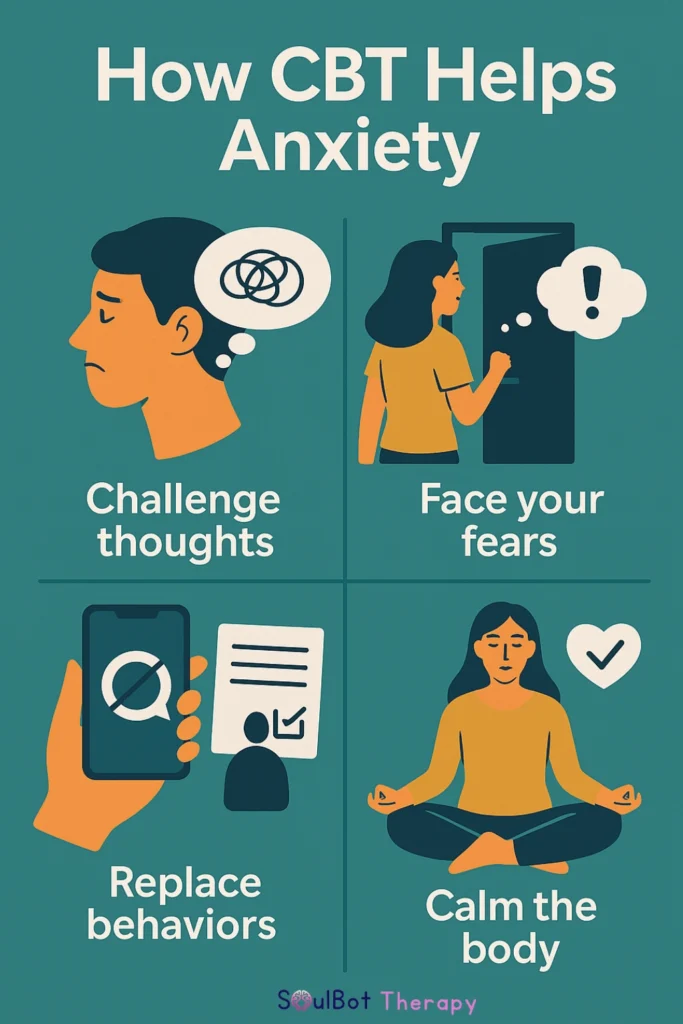
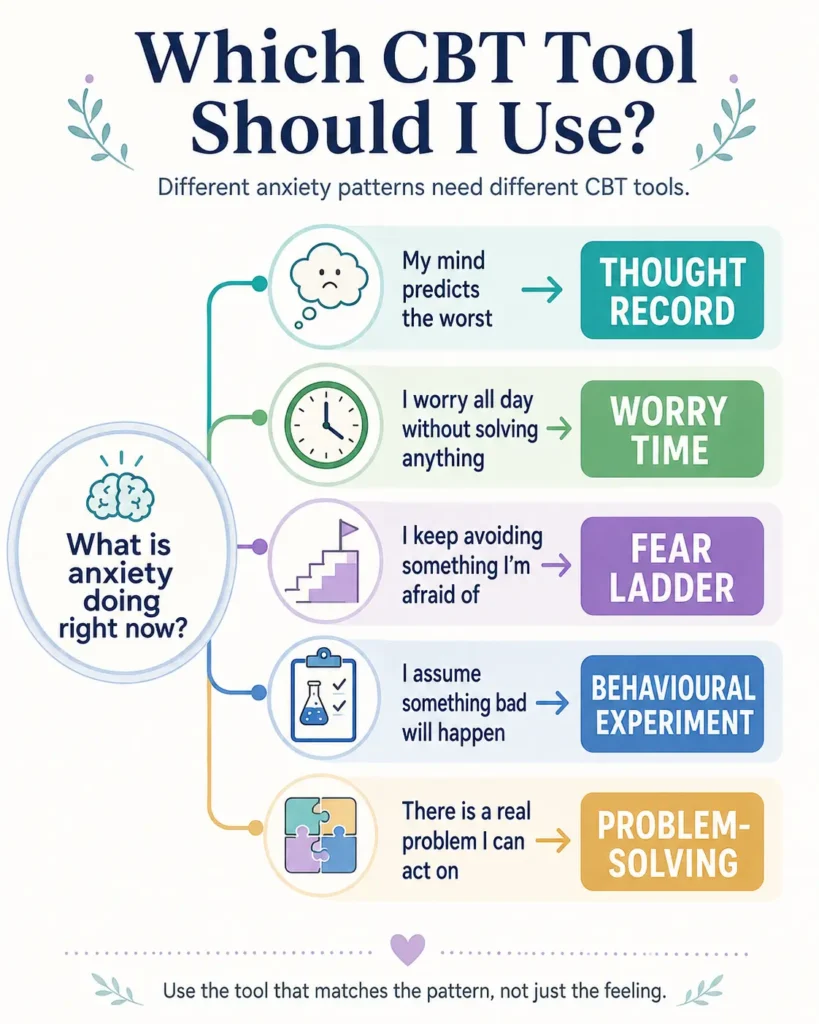
Which CBT Technique Should You Try?
| If anxiety looks like… | CBT technique to explore |
|---|---|
| “Something terrible will happen.” | Thought record |
| Worrying about the same things all day | Worry time |
| Avoiding situations because you’re scared | Gradual exposure |
| “If I do this, everyone will judge me.” | Behavioural experiment |
| Worrying about a real problem you can act on | Problem-solving |
This is not a diagnostic tool. Different anxiety disorders may require different forms of CBT.
1. Use a Thought Record to Check Anxious Predictions
A CBT thought record helps you slow down an anxious thought and examine it rather than automatically believing it.
The NHS describes thought records as a common CBT exercise for examining a situation, thoughts, feelings, and evidence before developing another way of viewing it.
Example
Situation:
Your manager schedules a meeting.
Automatic thought:
“I’m going to get fired.”
Emotion:
Anxiety — 8/10
Evidence supporting the thought:
“I made a mistake yesterday.”
Evidence against it:
- “My manager regularly schedules meetings.”
- “Nobody has said my job is at risk.”
- “I’ve received positive feedback recently.”
Balanced thought:
“I don’t know what the meeting is about yet. I can prepare without assuming the worst.”
Notice that the goal is not: “Everything will definitely be fine.” It is to move from a prediction toward a more evidence-based interpretation.
Questions to ask
- What evidence supports this thought?
- What evidence does not?
- Am I treating a possibility like a certainty?
- Is there another explanation?
- What would I say to a friend thinking this?
2. Use “Worry Time” When Anxiety Takes Over Your Whole Day
Some worries appear once. Others interrupt you every 15 minutes.
Trying to force yourself to: “Stop worrying.”
Usually gives your mind another thing to fight with. Instead, CBT-based self-help can use scheduled worry time.
When Arry appears at 2 PM: “What if I mess up tomorrow?”
Write it down. Then tell yourself: “I’ll come back to this during my worry time at 7 PM.”
At 7 PM, look at the worry again.
Ask: Can I do something about it?
Yes:
Create an action. “I can practice the first five minutes of the presentation.”
No:
Acknowledge the uncertainty: “I cannot guarantee everyone’s reaction tomorrow.”
The goal is not to eliminate worry. It is to stop giving every anxious thought immediate access to your attention.

3. Build a Fear Ladder Instead of Avoiding Everything
Avoidance often reduces anxiety immediately. That is exactly why it can become difficult to stop. If you avoid every feared situation, you have fewer opportunities to learn:
“I can handle this.”
CBT uses gradual exposure to help people progressively face feared situations.
Example: Fear of Speaking in Meetings
Build a ladder from easier to harder:
- 2/10 — Say hello to someone before the meeting
- 3/10 — Ask one colleague a question
- 5/10 — Make one comment in a small meeting
- 7/10 — Explain an idea to the group
- 9/10 — Give a short presentation
Start lower down.
Repeat the step rather than immediately jumping to the most frightening situation.
Important
Exposure is not: “Throw yourself into your worst fear.”
And complex exposure for conditions such as severe panic, OCD, PTSD, or significant phobias may be better planned with a qualified professional.
4. Test Anxiety With a Behavioral Experiment
This is one of the most useful CBT techniques that generic anxiety articles often miss. Anxiety makes predictions: “If I disagree with someone, they’ll hate me.”
Instead of debating the prediction forever, a behavioral experiment tests it.
NHS clinical materials describe behavioral experiments as identifying an behavioraldiction and designing an experiment to see whether the feared outcome occurs and how the person would cope if it did.
Use this four-step format
Prediction
“If I ask a question in the meeting, everyone will think I’m stupid.”
Experiment
Ask one genuine question.
What actually happened?
My manager answered it. Nobody reacted negatively.
What did I learn?
“Feeling embarrassed doesn’t mean other people think I’m incompetent.”
The goal is to collect real-world evidence, not endlessly reassure yourself.
5. Separate Solvable Problems From Hypothetical Worries
Not every worry needs challenging. Sometimes anxiety is pointing to a real problem.
Example: “I haven’t prepared for tomorrow’s interview.”
That is different from: “What if I embarrass myself and nobody ever hires me?”
The first can be acted on. The second is largely hypothetical.
Use the CBT problem-solving check
Ask: Is there a practical action I can take?
If yes: Define the problem.
“I haven’t researched the company.”
List possible actions.
- Read the company website
- Review the job description
- Prepare three examples
- Practice one answer
Choose one next step.
If no:
Return to uncertainty.
“I cannot guarantee what the interviewer will think.”
This prevents problem-solving from turning into endless overthinking.
One Anxiety, Five Different CBT Tools
Imagine you have a presentation tomorrow and keep thinking:
“I’m going to embarrass myself.”
Here’s how the five CBT exercises approach the same anxiety:
| CBT tool | What would you do |
|---|---|
| Thought record | Examine evidence you’ll actually embarrass yourself |
| Worry time | Postpone repetitive worrying until a planned period |
| Exposure | Gradually practice speaking in increasingly challenging settings |
| Behavioural experiment | Speak once in a meeting and observe what actually happens |
| Problem-solving | Prepare the slides or practice the opening |
This is why there isn’t one universal “CBT trick for anxiety.”
First, identify what is keeping the anxiety going.
Try the SoulBot CBT Decision Check
When anxiety appears, ask:
1. Is this mainly a prediction?
→ Check the thought
2. Is the worry repeating without progress?
→ Schedule worry time
3. Am I avoiding something because I’m afraid?
→ Consider gradual exposure
4. Am I assuming I know what will happen?
→ Run a behavioral experiment
5. Is there a real problem I can act on?
→ Problem-solve one next step
This is a self-reflection framework, not a replacement for CBT with a qualified therapist.
Is Anxiety Affecting Your Daily Life?
If you’re not sure how much anxiety is affecting your thoughts, behavior, sleep, or everyday functioning, take the Free Anxiety Test.
It can help you reflect on:
- persistent worry
- difficulty relaxing
- restlessness
- avoidance
- physical anxiety symptoms
- impact on daily life
Quick self-check · Instant result · Not a diagnosis
Can Soululu Help You Practice CBT Exercises?
Soululu can support structured self-reflection, such as helping you organize:
- a situation
- an anxious thought
- organize for and against it
- a more balanced perspective
- One action to try next
But do not describe Soululu as delivering CBT unless you have clinically validated it as a CBT intervention.
Soululu is an emotional-wellness companion. It does not provide psychotherapy or replace treatment from a qualified professional.
When Are CBT Self-Help Techniques Not Enough?
Self-guided CBT exercises can be useful for mild anxiety and skill practice, but they are not the same as receiving CBT from a therapist.
Consider professional support if anxiety:
- regularly interferes with work, study, or relationships
- causes frequent panic
- severely restricts what you do
- leads to substantial avoidance
- continues despite self-help
- feels difficult to manage safely
CBT is an evidence-based treatment used for several anxiety disorders, but the specific CBT protocol can differ depending on whether someone has GAD, panic disorder, social anxiety, a phobia, or another condition.
Want Professional Help With Anxiety?
A therapist can help identify the specific cycle maintaining your anxiety and choose CBT techniques appropriate to your situation.
👉 Book an Anxiety Therapy Session
Final Thought
CBT for anxiety is not about repeating: “Think positive.”
It is about testing what anxiety tells you.
Ask:
- What am I predicting?
- What am I avoiding?
- What does the evidence show?
- What small experiment can I try?
Sometimes you change your thoughts. Sometimes you change the behavior. Often, you work on both.
Related SoulBot Reads
- How to Deal With Anxiety: Practical Strategies That Actually Help
- ACT vs CBT: What’s the Difference and Which Therapy May Fit You?
- Acceptance and Commitment Therapy: How ACT Works
- What Causes Bad Sleep? 7 Common Reasons You’re Not Sleeping Well
- How to Fix Your Sleep Schedule When Anxiety Keeps You Awake