Home > Blog > Signs of a Healthy Relationship And How to Know If You Have One
Signs of a Healthy Relationship And How to Know If You Have One
Relationship
Last Updated: September 2, 2026
Table of Contents
Most people know what a bad relationship feels like. The anxiety, the walking on eggshells, the constant uncertainty.
But fewer people know what a genuinely healthy relationship actually looks and feels like from the inside, especially if they have never seen one modelled.
Here is how to know.
Signs of a Healthy Relationship (Quick Answer)
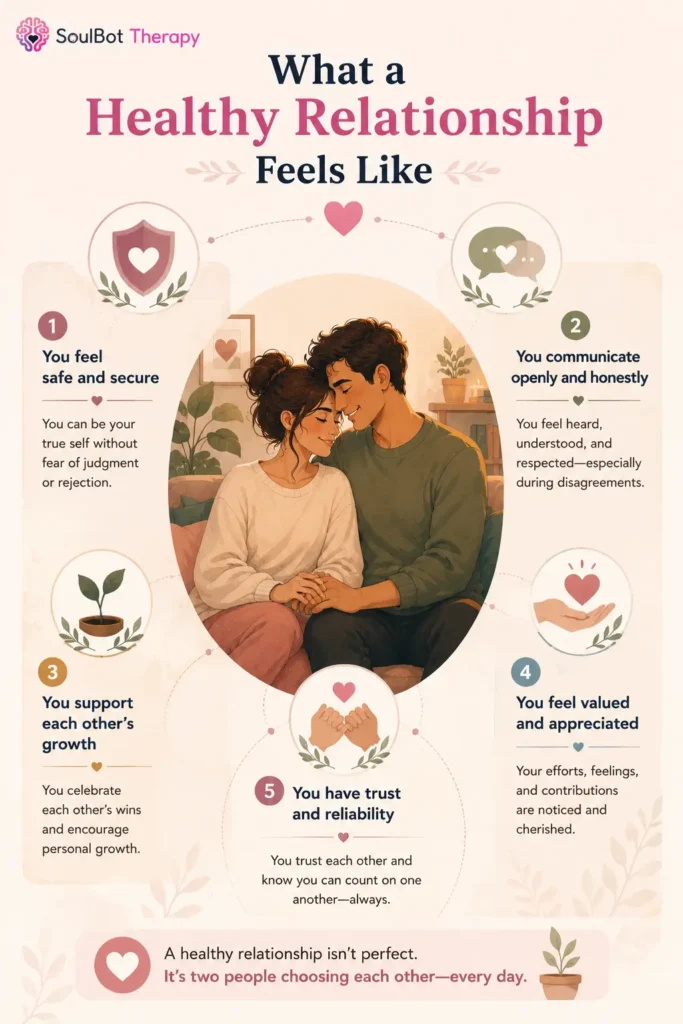
You feel safe to be yourself fully, without editing.
Conflict happens, but gets resolved without cruelty.
Both people consistently give and receive care.
You each have identity and space outside the relationship.
Trust exists without needing constant proof.
You feel better about yourself in this relationship, not worse.
💬 Not sure if your relationship is healthy? Talk to Soululu fora private, judgment-free space to think it through.
10 Signs of a Healthy Relationship
1. You trust each other without needing constant proof
There is no hidden agenda, no secrets, no need to check phones or demand reassurance constantly. Trust feels like a baseline, not something you have to earn every day.
2. You can be honest even when it is uncomfortable
One of the hallmarks of a healthy relationship is living in an atmosphere of truth-telling, being honest without being harsh or cruel. You can say hard things and still feel safe.
3. Conflict gets resolved, not avoided or weaponised
When you have disagreements, you discuss them respectfully and reach fair compromises. Arguments do not end with one person feeling destroyed. They end with both people feeling heard.
4. You both have an identity outside the relationship
You enjoy doing things together, but you also have quality time apart doing what is most important to each of you. A healthy relationship does not consume you. It coexists with the rest of your life.
5. You feel genuinely safe
Not just physically, but emotionally. A healthy relationship exists when value is placed not only on who you are together but also on who you are individually. You do not shrink yourself to keep the peace.
6. Effort is mutual
Both of you contribute your fair share to the relationship. It is not always equal; life has seasons, but the effort is consistent from both sides over time.
One of the clearest signs of a strong relationship is that your partner is not just there for the hard times; they are also your go-to person for sharing your wins. You celebrate together, not just survive together.
8. You allow each other to be influenced
Mutual influence means you are willing to let your partner’s needs, vulnerabilities, and perspectives shape you and even change something about your own behaviour. When both partners experience mutual influence, relationships are more stable and loving.
9. Your boundaries are respected
You respect each other’s boundaries and privacy rights. Saying no does not start a fight. Needing space does not become a crisis.
10. You feel better about yourself in this relationship
This is the one most people forget to check. A healthy relationship does not chip away at your self-worth. It adds to it. Research consistently shows that relationship satisfaction is associated with better physical and mental health, and daily relationship quality directly affects how we feel about ourselves.
🧠 SoulTip: You do not need a perfect relationship. You need a safe one where both people are trying, growing, and choosing each other honestly. That is what healthy looks like in real life.
A healthy relationship is not the absence of conflict, difference, or hard days.
It is a place where both people feel safe enough to be honest, brave enough to repair, and consistent enough to keep choosing each other.
If this blog made you feel relieved, that is a good sign.
Either way, you deserve clarity. And you deserve a relationship that feels like safety, not survival. Sometimes it helps to talk privately about how your relationship actually feels, without judgment.
Trust without constant proof, honest communication, conflict that resolves respectfully, mutual effort, individual identity outside the relationship, and feeling genuinely safe and valued.
Ask yourself: Do I feel safe being myself? Are my needs respected? Do I feel better about myself since being with this person? Do arguments get resolved, or are they just repeated? If several answers feel uncertain, it is worth exploring further.
Yes. Conflict is normal in any relationship. What matters is how it is handled, whether both people feel heard and whether resolution happens without cruelty or contempt.
Emotional safety: the ability to be yourself, express your needs, and know that the relationship can handle honesty. Without that foundation, most other signs become difficult to sustain.
In a healthy relationship, both people feel safe, valued, and able to grow individually and together. In an unhealthy relationship, one or both people feel anxious, controlled, or consistently worse about themselves.
Sonali Shastri is a Content Expert at SoulBot Therapy, where she creates mental health and self-discovery content that feels clear, relatable, and emotionally grounded. She specializes in translating psychology-informed ideas into simple, relatable blogs, test pages, and reflection-based resources. Her work helps readers understand themselves better while reducing stigma around mental health conversations.