
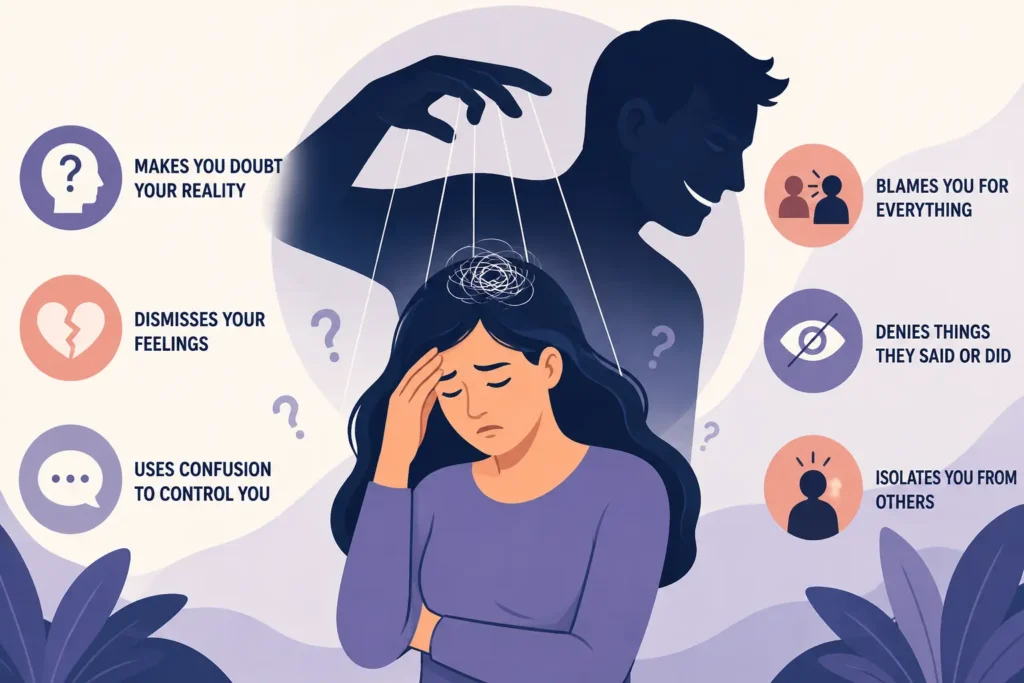
Gaslighting in a relationship is a repeated pattern that makes you question your memory, feelings, or understanding of what happened. You may start apologising constantly, second-guessing yourself, or leaving arguments unsure of what is real.
One disagreement or forgotten conversation is not automatically gaslighting. The key is repetition and the effect the pattern has on your ability to trust yourself.
🧠 Not sure how your relationship patterns affect you? Take the free Emotional Availability Test to better understand yourself.
What Does Gaslighting in a Relationship Look Like?
Gaslighting can be particularly confusing in romantic relationships because it comes from someone you trust.
The National Domestic Violence Hotline describes gaslighting as a form of emotional abuse that can cause someone to question their feelings, instincts, and sanity.
Here are common signs to watch for.
10 Signs of Gaslighting in a Relationship
1. They repeatedly deny things that happened
You clearly remember a conversation, promise, or event, but your partner insists:
“That never happened.”
Different memories are normal. The concern is when your memory is consistently treated as unreliable.
2. You’re always told you’re overreacting
Concerns are repeatedly answered with:
- “You’re too sensitive.”
- “You’re being dramatic.”
- “It’s not that serious.”
Over time, you may stop raising problems altogether.
3. The story keeps changing
Details of previous conversations or arguments shift depending on what helps your partner avoid responsibility.
For specific conversation examples, read Gaslighting: Signs, Examples and How to Respond.
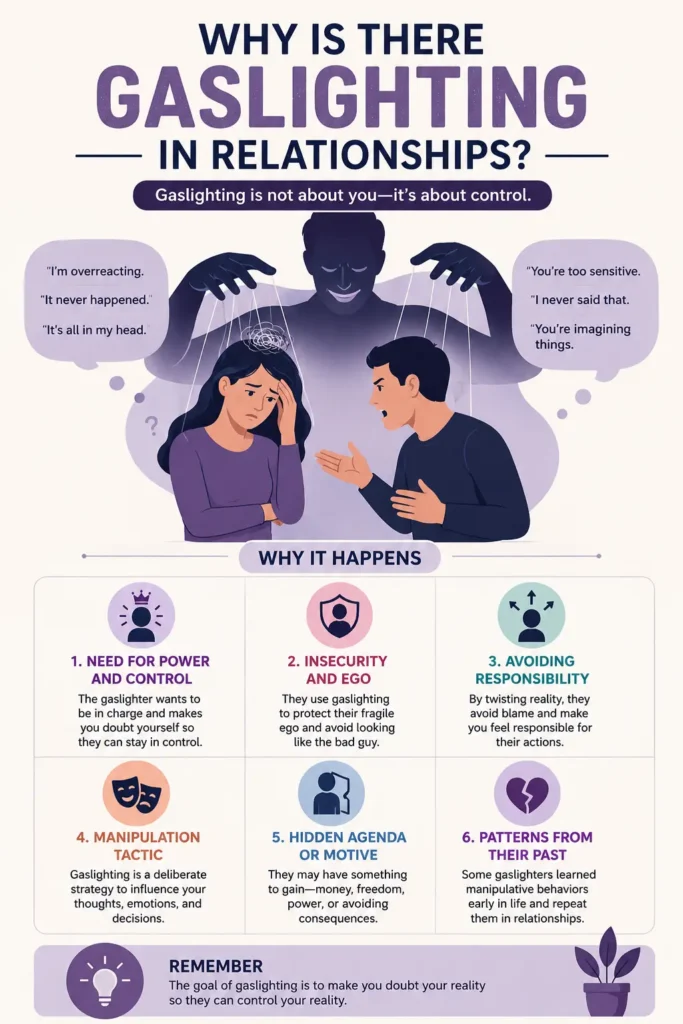
4. Your insecurities are used against you
Something personal you’ve shared-your fears, past experiences, confidence, or mental health-later gets used to discredit your reaction.
5. Accountability always comes back to you
You raise something they did, but somehow the conversation ends with you apologising.
This pattern of blame-shifting is more concerning than an occasional defensive reaction.
6. You become distant from people you trust
Your partner may criticise your friends or family, create tension when you spend time with them, or make you feel guilty for seeking outside support.
Isolation is also an important relationship red flag. Read Toxic Relationship Red Flags You Shouldn’t Ignore for the broader pattern.
7. Arguments leave you confused
You enter the conversation knowing what upset you but leave wondering:
“Was I wrong about everything?”
Persistent confusion after conflict is one of the strongest clues to examine the relationship more closely.
8. You’re constantly apologising
“Sorry” becomes automatic, even when you’re not sure what you’ve done wrong.
You may apologise simply to stop conflict.
9. You trust yourself less than you used to
Ask yourself:
“Have I become less confident in my own judgment since this relationship began?”
A noticeable loss of self-trust deserves attention.
10. You regularly defend their behaviour to others
Friends express concern, but you automatically explain:
“They didn’t mean it.”
“They’re just stressed.”
“It’s not normally like this.”
One explanation means little. Repeatedly needing to justify harmful behaviour may signal a larger pattern.
🧠 SoulTip: Gaslighting is not about one bad argument or one difficult week. It is a pattern.
Gaslighting vs Normal Relationship Conflict
| Normal conflict | Possible gaslighting pattern |
|---|---|
| Both people can disagree | Only one version is considered valid |
| “I remember it differently.” | “You’re imagining things.” |
| Both can take accountability | Responsibility repeatedly becomes yours |
| Arguments eventually bring clarity | You repeatedly leave confused |
| You can safely express concerns | You become afraid to bring things up |
The difference is not whether you argue. It is whether disagreement repeatedly leaves you doubting your own reality.
What Should You Do If You Notice These Signs?
First, look for patterns rather than trying to diagnose your partner.
You can:
- write down important incidents while they’re fresh
- stay connected with trusted friends or family
- notice how your partner responds when you set boundaries
- avoid endless arguments about whether your feelings are “valid”
- speak with a qualified mental health professional if the relationship is affecting your wellbeing
Our separate guide How to Respond to Gaslighting: What Actually Works covers practical responses in more detail.
If controlling behaviour, threats, isolation, fear, or abuse are involved, specialist domestic-abuse support may be more appropriate than confronting the person alone. The National Domestic Violence Hotline provides information on gaslighting and safety planning.
Feeling Unsure About What You’re Experiencing?
You don’t need to label your relationship immediately.
Talk to Soululu to put what happened into words, reflect on how it made you feel, and notice patterns you may want to explore further.
You can also use the SoulBot Journal to privately record situations over time.