
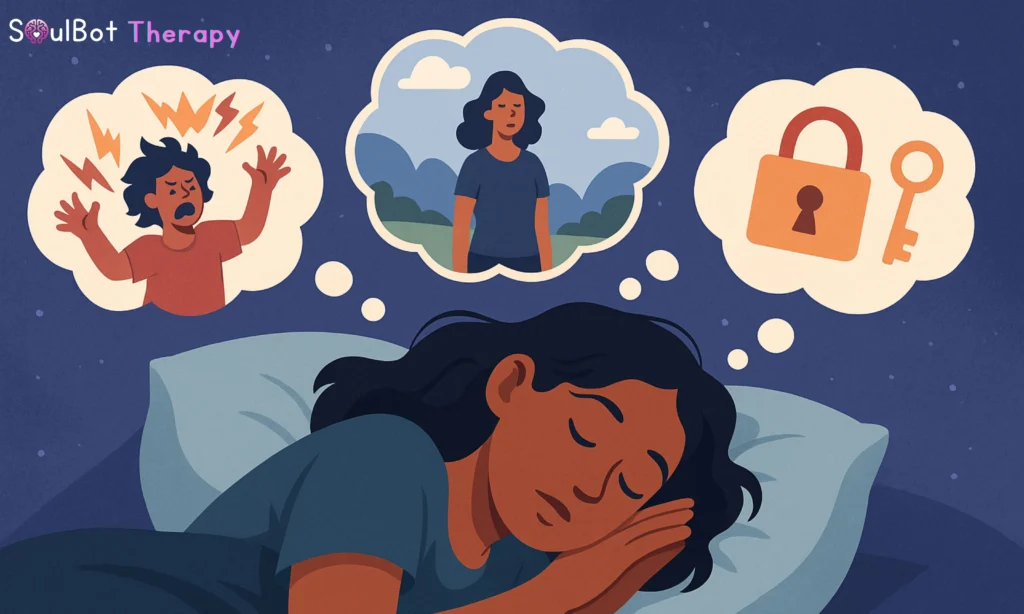
Quick Answer: What Does Psychology Say About Dreams?
The psychology of dreams does not support one universal meaning for every dream.
Current research suggests that dreams can draw from:
- recent experiences
- memories
- emotions
- personal concerns
- personality traits
- stress and major life events
Dreaming occurs during all stages of sleep, although dreams are usually more vivid and elaborate during REM sleep.
A dream about being chased, losing teeth, or failing an exam therefore does not have one scientifically proven interpretation.
A better question is:
What emotion did the dream create, and does that emotion connect with anything happening in my waking life?
What Are Dreams in Psychology?
Dreams are mental experiences that occur during sleep and may include:
- images
- thoughts
- emotions
- sounds
- sensations
- memories
- imagined events
Scientists still do not have one accepted explanation for why we dream.
Different theories propose that dreaming may relate to memory processing, emotion, simulation of experiences, or spontaneous brain activity during sleep.
This uncertainty matters.
Psychology does not currently support the claim that every dream contains a hidden message waiting to be decoded.
Do Dreams Only Happen During REM Sleep?
No. This is one correction the old article needs.
Dreams can occur during both rapid eye movement (REM) and non-rapid eye movement (non-REM) sleep, although REM dreams tend to be more vivid, emotional, and story-like.
REM sleep is strongly associated with dreaming, but:
REM sleep ≠ the only time you dream.
Do Dreams Reflect Your Real Life?
Sometimes, although usually not as a literal replay.
A major 2026 study published in npj Mental Health Research analyzed 3,366 reports of dreams and waking experiences from 207 adults collected between 2020 and 2024.
Researchers found that dream content was influenced by both:
- relatively stable personal characteristics
- events and experiences occurring in waking life
Dreams appeared to combine real-life material with imagination rather than simply replaying the previous day.
This supports what researchers often call the continuity hypothesis: that aspects of waking concerns and experiences can carry over into dreams.
But continuity does not mean: “I dreamed about falling, therefore I secretly feel out of control.”
Dreams transform waking-life information in complex and highly individual ways.
Do Dreams Reveal Your Subconscious Mind?
There is no scientific test that can read a dream and reliably reveal a hidden subconscious truth.
Historically, Sigmund Freud proposed that dreams disguised unconscious wishes, while Carl Jung viewed dreams as meaningful expressions of unconscious psychological material.
Those theories strongly influenced psychotherapy and popular dream interpretation. Modern dream science is more cautious. Researchers study relationships between dream content and:
- memory
- emotion
- personality
- waking experiences
- sleep stages
- mental-health symptoms
But there is no scientifically validated dictionary where:
teeth = insecurity
falling = loss of control
flying = freedom
The meaning of a dream, if it feels meaningful at all, depends heavily on the individual.
What Do Common Dreams Mean in Psychology?
Instead of assigning fixed meanings, use common dream themes as prompts for reflection.
| Dream | Don’t automatically assume | Ask instead |
|---|---|---|
| Being chased | “I’m avoiding something.” | What emotion was strongest: fear, pressure, or helplessness? |
| Falling | “I’ve lost control.” | Where have I recently felt uncertain or unsafe? |
| Teeth falling out | “I’m insecure.” | What did losing the teeth mean to me in the dream? |
| Failing an exam | “I fear failure.” | Am I currently being evaluated, or am I putting pressure on myself? |
| Being late | “I’m missing opportunities.” | Is there something in waking life that currently feels urgent? |
| Someone from the past | “They are thinking about me.” | What memory, emotion, or period of my life does this person represent to me? |
The key difference is: Use the dream to generate questions, not answers.
What Is the Connection Between Dreams and Mental Health?
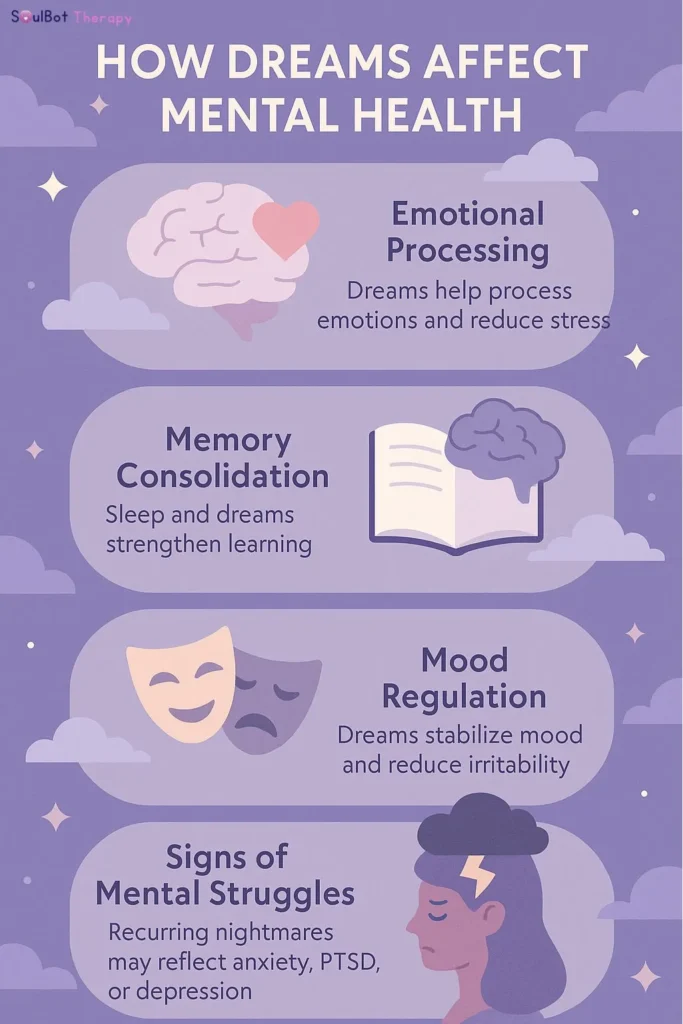
Dreams can change alongside psychological stress, but dreams alone cannot diagnose a mental-health condition.
Nightmares, for example, can become more frequent during periods of:
- stress
- anxiety
- traumatic experiences
- disrupted sleep
The American Academy of Sleep Medicine notes that stress, anxiety, irregular sleep, and being overtired can increase nightmare risk.
Research also finds relationships between nightmares, REM-sleep disruption, and emotional regulation across several psychiatric conditions.
But: Having an anxiety dream does not mean you have an anxiety disorder.
And: Having a disturbing dream does not prove that you are repressing trauma.
Look at the broader pattern of waking symptoms and functioning.
Why Do Stressful Dreams Feel So Real?
Dreams can contain intense emotion even when the storyline makes little sense. During dreaming, the brain can combine:
- fragments of memory
- familiar people
- recent concerns
- imagined situations
- strong emotional reactions
That is why you may wake up knowing the event was impossible, yet still feel genuinely frightened, embarrassed, or sad.
The emotion is real. The dream scenario does not have to be.
Try the SoulBot Dream Reality Check
If a dream stays with you, don’t immediately search: “What does my dream mean?”
Try these four questions instead.
1. SCENE
What actually happened?
“I was running through a train station but couldn’t find the platform.”
2. FEELING
What was the strongest emotion?
Panic and frustration.
3. WAKING LINK
Where have I recently felt something similar?
“I’m trying to make an important career decision.”
4. IMPACT
Is the dream simply interesting, or is it affecting my sleep or daily life?
This creates reflection without pretending a dream has one correct interpretation.

Why Do I Keep Having the Same Dream?
A recurring dream does not automatically mean your subconscious is desperately trying to send you a message.
Recurring dreams may occur during:
- repeated stress
- unresolved waking concerns
- major life transitions
- recurrent nightmares
- trauma-related sleep problems
Rather than decoding the symbol, track:
- When did the dream occur?
- What was happening that week?
- How stressed was I?
- How was my sleep?
Patterns across several dreams may tell you more than analyzing one symbol.
When Should Nightmares Be Taken More Seriously?
Occasional nightmares are common. Consider professional support if nightmares:
- happen repeatedly
- frequently wake you
- make you afraid to sleep
- cause significant daytime distress
- began after a traumatic experience
- interfere with work, study, mood, or normal functioning
Repeated frightening dreams that cause significant distress or impairment can form part of nightmare disorder, which is a recognized sleep disorder.
Can Dream Journaling Help?
A dream journal can be useful for reflection and pattern tracking.
After waking, record:
- What you remember
- Strongest emotion
- Major people or situations
- Stress level the previous day
- How well did you sleep
After several weeks, look for patterns. Avoid treating the journal as evidence that every symbol carries a secret psychological meaning.
Talk to Soululu About a Dream That’s Stuck With You
Soululu can help you reflect on:
- What happened in the dream
- What emotion stayed with you
- Whether that emotion connects with something happening now
- Whether stress or poor sleep may be contributing
- What you need after a disturbing dream
Soululu can support reflection. It cannot interpret dreams as psychological facts, diagnose a mental-health condition, or predict future events.
Final Thought
Dreams can contain pieces of your memories, emotions, personality, and waking experiences.
But psychology does not give us a universal decoder.
Instead of asking: “What does this symbol secretly mean?”
try:
“What did I feel, what has been happening in my life, and is this dream affecting me while I’m awake?”
Your dream may be worth reflecting on. It doesn’t need to be treated like a prophecy