
Quick Answer: How Does Mental Illness Affect Daily Life?
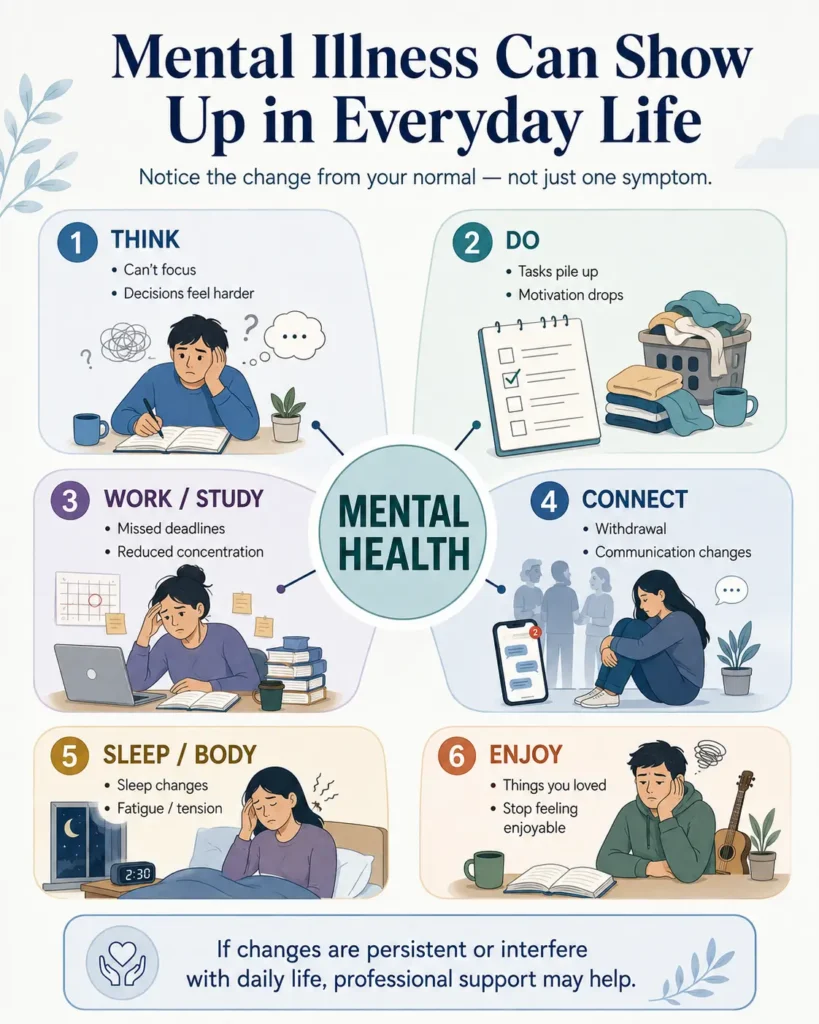
Mental illness can affect how you think, feel, sleep, work, make decisions, maintain relationships, and complete everyday tasks.
The impact is different for everyone. One person may struggle mainly with concentration and motivation, while another may experience disrupted sleep, social withdrawal, panic, low mood, or difficulty taking care of basic responsibilities.
A useful question is not only:
“What symptoms do I have?”
but also:
“What has become harder for me to do than usual?”
Mental disorders are generally associated with distress or difficulty functioning in important areas of life, although the degree of impairment varies by condition and person.
Mental Health vs Mental Illness: What’s the Difference?
Mental health refers to your overall emotional, psychological, and social well-being.
Mental illness, or a mental disorder, refers to a clinically significant disturbance in thinking, emotional regulation, or behavior that is usually associated with distress or impaired functioning.
They are related, but they are not identical.
Someone can:
- Experience poor mental well-being without having a diagnosed disorder;
- Live with a mental-health condition while functioning well with treatment and support;
- Feel mentally well in some areas of life while struggling in others.
Read: What Are the 4 Types of Mental Health? 4 Dimensions Explained
.
🧠 Navigating mental health often brings identity questions too. Explore your feelings with this helpful Sexual Orientation Self-Discovery Test.The SoulBot Daily Function Map
Mental illness does not affect everyone in the same way.
Look at these seven areas:
| Area | What you may notice |
|---|---|
| Thinking | Poor concentration, forgetfulness, racing thoughts |
| Motivation | Difficulty starting or completing tasks |
| Work/Study | Missed deadlines, reduced productivity, absence |
| Relationships | Withdrawal, irritability, difficulty communicating |
| Sleep & Energy | Insomnia, oversleeping, fatigue |
| Daily Care | Meals, hygiene, chores, appointments becoming harder |
| Enjoyment | Losing interest in things that usually matter to you |
One difficult day does not automatically indicate mental illness.
What matters more is whether there has been a meaningful change from your usual functioning, how long it lasts, and how much it interferes with your life.
1. Concentration and Decision-Making Can Become Harder
Mental-health conditions can affect:
- concentration;
- memory;
- organisation;
- problem-solving;
- decision-making.
You might read the same email several times without absorbing it or spend 20 minutes trying to make a simple decision.
NIMH lists difficulty concentrating and inability to complete usual tasks among signs that may warrant professional attention when they are persistent or severe.
Try this
When your brain feels overloaded, reduce the decision:
Instead of:
“How do I fix everything today?”
ask:
“What is the next task that actually needs my attention?”
2. Ordinary Tasks Can Start Feeling Much Bigger
Mental illness does not always look dramatic.
Sometimes it looks like:
- Dishes piling up;
- Unanswered messages;
- Repeatedly postponing a shower;
- Avoiding appointments;
- Struggling to get out of bed;
- Forgetting to eat;
- Leaving simple tasks unfinished.
This is why functioning matters.
A task that looks “easy” from the outside can require much more effort when someone is experiencing significant depression, anxiety, trauma symptoms, or another mental-health condition.
3. Work and School Can Be Affected
Mental-health difficulties can influence:
- focus;
- attendance;
- confidence;
- productivity;
- communication;
- ability to manage pressure.
You might still show up every day while using much more energy than usual just to keep functioning.
A 2025 CDC publication notes that mental health can influence everyday functioning, including work productivity and academic performance.
Difficulty working does not mean someone is lazy or incapable. It may be one sign that additional support is needed.
4. Relationships Can Change
Mental illness can affect relationships even when the relationship itself is not the cause.
You may:
- Withdraw from people;
- Reply less often;
- Become more irritable;
- Struggle to explain what you feel;
- Need more reassurance;
- Stop enjoying social situations;
- Assume you are a burden.
Friends or partners may interpret withdrawal as:
“They don’t care about me.”
When the person may actually be thinking:
“I don’t have the energy to talk.”
Social connection can support people’s ability to manage stress, anxiety, and depression, while isolation can make coping harder.
This makes communication important:
“I’m struggling at the moment. If I’m quieter than usual, it isn’t because I don’t care.”
5. Sleep and Energy Can Change
Mental health and sleep influence each other.
Some people experience:
- difficulty falling asleep;
- waking repeatedly;
- sleeping much longer;
- waking too early;
- nightmares;
- Exhaustion despite sleeping.
NIMH includes sleep disturbance and low energy among symptoms that can occur alongside mental-health difficulties.
If sleep is your biggest issue, read What Causes Bad Sleep? 7 Common Reasons You’re Not Sleeping Well.
6. Mental Illness Can Affect Physical Well-Being
Mental and physical health are connected, but avoid oversimplifying this as:
“Mental illness causes physical disease.”
The relationship is more complex.
For example, the CDC notes that depression is associated with an increased risk for several chronic physical conditions, while living with chronic illness can also increase the risk of mental health problems.
Mental-health condmental healthso be accompanied by physical experiences such as:
- fatigue;
- headaches;
- muscle tension;
- digestive discomfort;
- appetite changes;
- Sleep problems.
Physical symptoms should still be properly evaluated rather than automatically blamed on mental health.
7. You May Stop Feeling Like Yourself
Sometimes the hardest effect is less visible:
“I don’t recognise myself lately.”
You might lose interest in hobbies, stop making plans, feel disconnected from your personality, or begin defining yourself entirely by what you are struggling with.
A diagnosis can describe a condition.
It does not describe the whole person.
This distinction matters because symptoms can change over time, depending on circumstances, treatment, and severity.
What Causes Mental Illness?
There is not a single cause. Mental health issues can usually develop through a complex combination of:
- Genetics and biology;
- Psychological factors;
- Stressful or traumatic experiences;
- Family circumstances;
- Physical health;
- Substance use;
- Social isolation;
- Poverty, discrimination, violence, or other environmental pressures.
WHO specifically describes mental-health risk and protective factors as operating across individual, family, community, and structural levels.
So remove the old sentence:
“A chemical imbalance in the brain causes depression and anxiety.”
That explanation is far too simplistic and is not an accurate general explanation for mental illness.
Signs Your Mental Health May Need More Attention
Instead of looking for one universal list of “red flags,” use the Change–Duration–Impact check.
CHANGE
Is something noticeably different from your normal?
For example:
- mood;
- sleep;
- concentration;
- motivation;
- behaviour.
DURATION
Has it continued rather than passing after a difficult day?
IMPACT
Is it passing with:
- Work;
- Study;
- Relationships;
- Self-care;
- Sleep;
- Normal responsibilities?
NIMH advises considering professional help when severe symptoms persist for two weeks or longer, including sleep difficulties, concentration problems, loss of interest or pleasure, irritability, or inability to complete usual activities.
The two-week guideline is not appropriate for every mental-health condition, so urgent or severe symptoms should not be ignored simply because two weeks have not passed.
Is Anxiety the Main Thing Affecting Your Day?
If persistent worry, tension, overthinking, or avoidance is interfering with your daily life, the Free Anxiety Test can help you reflect on your current anxiety patterns.
Quick self-check · Instant result · Not a diagnosis
Read: How to Deal With Anxiety: Practical Strategies That Actually Help
What Can Help When Mental Health Is Affecting Daily Life?
The right support depends on the problem.
Possible next steps include:
Talk to someone you trust
You do not need to explain everything perfectly.
Try:
“I’ve been finding normal things harder lately, and I think I need some support.”
Protect basic routines
When everything feels overwhelming, prioritize:
- Regular meals;
- Sleep;
- Basic hygiene;
- Movement;
- Medication as prescribed;
- One manageable responsibility at a time.
These are supports, not treatments, for every mental illness.
Reduce the size of tasks
Instead of:
“Clean the apartment.”
try:
“Put the clothes into one basket.”
Small tasks reduce cognitive load when concentration and motivation are low.
Stay connected
Isolation can make struggling feel even heavier.
Connection does not require a long social event. It might be one message, call, walk, or conversation with someone safe.
Seek professional support
Psychotherapy, medication, or a combination may be appropriate depending on the mental-health condition, severity, preferences, and individual circumstances.
Do not self-diagnose a specific disorder from a list of symptoms.
The SoulBot Daily Function Check
If you’re unsure whether something has changed, ask yourself these five questions:
- What has become harder for me recently?
- When did I first notice the change?
- Which part of my day is affected most?
- What am I avoiding or no longer doing?
- What support would make one part easier?
Write down your answers for a week.
The goal is not to diagnose yourself. It is to create a clearer picture of what is happening, information that can also be useful if you later speak with a therapist or doctor.
Talk to Soululu About What’s Changed
If you know you haven’t felt like yourself but cannot explain why, use Soululu to reflect on:
- What feels different;
- Which part of daily life is hardest;
- Emotions you have been carrying;
- Patterns you have noticed;
- one manageable next step.
Soululu supports emotional reflection and self-awareness. It does not diagnose mental illness or replace professional mental-health care.
Final Thought
Mental illness does not affect only your thoughts.
It can change how you sleep, work, connect, decide, care for yourself, and experience everyday life.
So instead of asking only:
“What’s wrong with me?”
try:
“What has changed, how long has it been happening, and where do I need support?”
That question gives you somewhere useful to begin.