
Quick Answer: Does AI Sleep Coaching Actually Work?
AI sleep coaching may help you notice sleep patterns, build routines, track habits, and receive personalized reminders. But it cannot currently replace proper assessment or evidence-based treatment for a sleep disorder.
The important distinction is:
- AI sleep coaching uses algorithms or conversational AI to provide feedback and support for habit formation.
- Sleep trackers estimate patterns such as sleep duration, timing, heart rate, or movement.
- Digital CBT-I delivers structured Cognitive Behavioral Therapy for Insomnia through an app or online program.
Of these, digital CBT-I has the strongest clinical evidence for insomnia. Generic AI sleep coaching should be viewed mainly as a support tool unless the product itself has been clinically validated.
What Is AI Sleep Coaching?
AI sleep coaching uses software to analyze your sleep data and suggest actions to improve it.
Depending on the platform, it may use:
- Your reported bedtime and wake time;
- Sleep diary entries;
- Wearable data;
- Activity levels;
- Caffeine or alcohol habits;
- Nighttime routines;
- Stress or mood check-ins.
An AI sleep coach might then notice:
“Your wake time varies by more than two hours across the week.”
and suggest:
“Try keeping tomorrow’s wake time closer to your weekday schedule.”
That is useful pattern recognition and behavioral support.
It is not the same as diagnosing insomnia, sleep apnea, restless legs syndrome, or another sleep disorder.
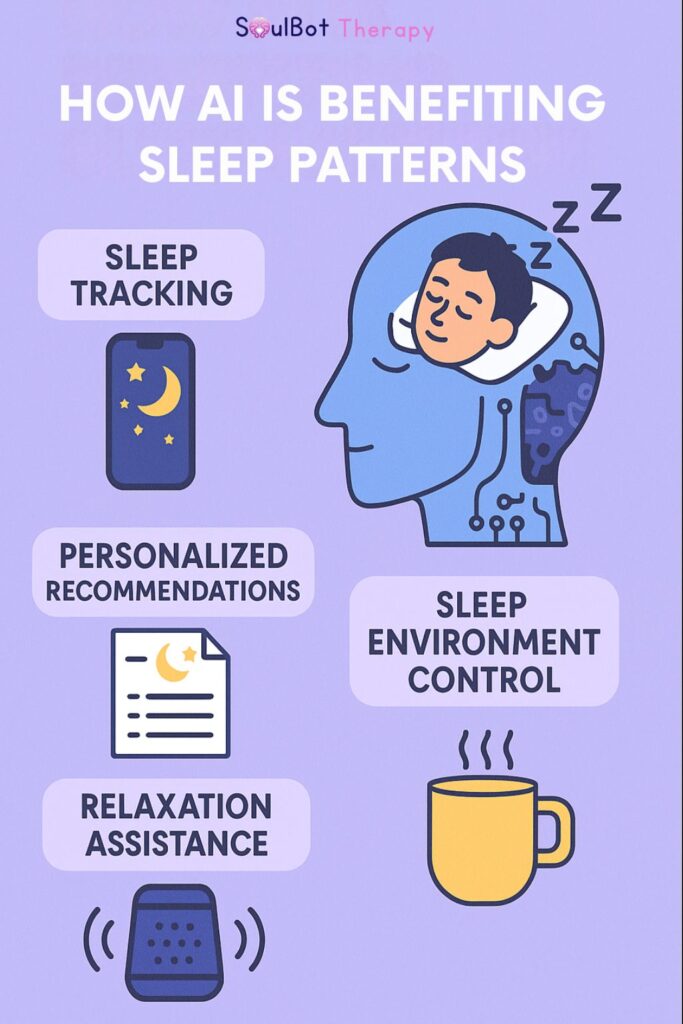
AI Sleep Coach vs Sleep Tracker vs Digital CBT-I
This distinction is important enough to make explicit:
| Tool | What it does | Evidence level |
|---|---|---|
| AI sleep coach | Gives personalized feedback, prompts, and habit suggestions | Emerging; depends heavily on the individual product |
| Consumer sleep tracker | Estimates sleep timing, duration, movement, heart rate, and sometimes sleep stages | Useful for trends; not equivalent to clinical sleep testing |
| Digital CBT-I | Delivers structured insomnia treatment based on CBT-I principles | Stronger evidence from randomized trials |
| Sleep, therapist/clinician | Assesses symptoms, health history, sleep disorders, and personalized treatment | Needed when clinical assessment is required |
The American Academy of Sleep Medicine has cautioned that consumer sleep technologies should not be used to diagnose or treat sleep disorders without appropriate clinical evaluation.
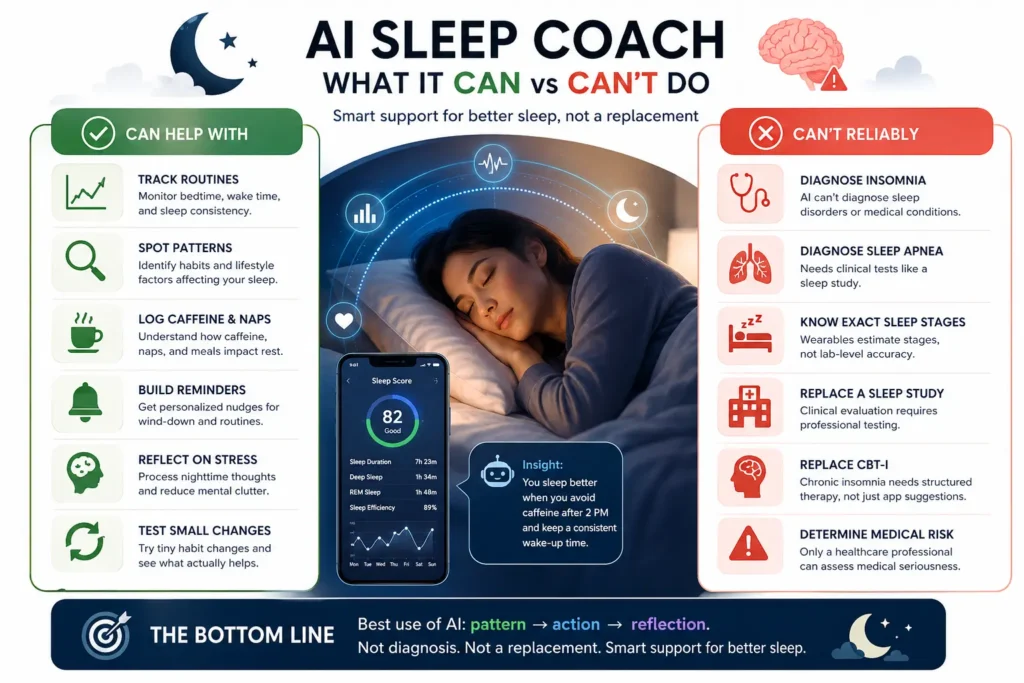
What Can an AI Sleep Coach Actually Help With?
1. Spotting patterns you miss
You may believe:
“I sleep badly randomly.”
But a few weeks of data could reveal:
- Later sleep after evening caffeine;
- Large weekend sleep-ins;
- Inconsistent wake times;
- More difficulty sleeping after stressful days.
AI can make those patterns easier to see.
2. Keeping a sleep diary
Sleep diaries are useful because memory is unreliable when you’re tired.
Instead of trying to remember the week, you can track:
- bedtime;
- estimated sleep time;
- awakenings;
- wake time;
- caffeine;
- naps;
- Morning energy.
The AI can then summarise the pattern rather than requiring you to analyze every entry yourself.
3. Turning advice into a routine
Knowing that consistent sleep timing matters is different from doing it.
An AI coach can prompt:
“It’s 30 minutes before your planned wind-down.”
or:
“You slept late today. Rather than forcing an early bedtime, keep tomorrow’s wake time consistent.”
That accountability may be more useful than another article telling you to “sleep better.”
4. Helping you reflect on nighttime anxiety
If your problem is overthinking rather than a suspected sleep disorder, conversational AI may help you organize what is keeping your mind active.
For example:
- Thought: “I won’t function tomorrow.”
- What do I know? “I’ve had difficult nights before and still managed the next day.”
- What can wait? “Tomorrow’s work problem does not need solving at 1 AM.”
AI can support this reflection. It is not psychotherapy.
What AI Sleep Coaching Cannot Reliably Do?
Diagnose sleep apnea
Consumer wearables and AI models are being studied for detecting obstructive sleep apnea, but current evidence does not support replacing standard clinical assessment with wearable AI alone. A 2024 systematic review concluded that wearable AI showed promise, but its performance was not yet sufficient for routine clinical use.
Know your exact sleep stages
A wearable may display:
Deep sleep: 1h 14m
REM: 1h 47m
Treat those numbers as estimates, not laboratory measurements.
Consumer devices infer sleep from sensors such as movement and heart rate. Accuracy can vary, particularly when sleep is fragmented.
Replace CBT-I for chronic insomnia
For chronic insomnia, Cognitive Behavioral Therapy for Insomnia remains an established first-line treatment. The American College of Physicians recommends CBT-I as the initial treatment for adults with chronic insomnia.
Decide whether a symptom needs medical assessment
An AI coach may recognize a pattern, but symptoms such as:
- loud snoring;
- gasping during sleep;
- severe daytime sleepiness;
- persistent insomnia;
- unusual movements;
- uncomfortable urges to move the legs
May require assessment by a healthcare professional.
The Biggest Mistake: Assuming More Sleep Data Means Better Sleep
This deserves its own section because wearable users can become obsessed with their nightly scores.
Imagine this:
Your watch says: Sleep score = 61
You feel: reasonably rested
You begin thinking:
“My sleep was terrible.”
Then you worry about the next night.
More data is useful only when it changes something you can act on.
Use the SoulBot Data → Decision Rule
For every sleep metric, ask:
DATA
What did the device or diary show?
“I slept later than usual three nights this week.”
DECISION
Is there something useful I can change?
“I’ll keep my wake time more consistent.”
DROP IT
If there is no useful action, stop analyzing the number.
“I don’t need to optimise my REM percentage tonight.”
Track patterns, not perfect scores.
AI Sleep Coaching vs Human Sleep Therapy
| AI sleep coaching | Human sleep professional |
|---|---|
| Available on demand | Scheduled care |
| Good for tracking habits | Can conduct clinical assessment |
| Can identify repeated patterns | Can explore medical and psychological causes |
| Can provide reminders | Can adapt treatment using clinical judgment |
| Scalable and often lower-cost | Usually more resource-intensive |
| Cannot perform a physical examination or sleep study | Can refer for appropriate diagnostic testing |
| May support behavioral changes | Can deliver or supervise evidence-based treatment |
The useful question isn’t:
“Will AI replace sleep therapists?”
It is:
“Which parts of sleep support can safely be automated?”
Right now, tracking, education, reflection, reminders, and basic behavioral support are much better candidates for automation than diagnosis.
What Does the Research Say About Digital Sleep Tools?
This is where the original blog needs an important correction.
There is evidence that digital sleep interventions can work, but that does not mean every “AI sleep coach” has been proven effective.
A 2025 systematic review and meta-analysis evaluated 29 randomized controlled trials involving 9,475 participants using fully automated digital CBT-I. The findings supported fully automated digital CBT-I as an accessible approach for insomnia, although engagement and adherence remain important considerations.
A separate randomized trial found that an interactive digital CBT-I program produced sustained improvements in insomnia symptoms and related outcomes.
There is also early research into conversational systems. A 2025 randomized study involving psychiatric outpatients evaluated a CBT-based chatbot designed to increase access to sleep training.
The takeaway is:
Evidence for digital sleep treatment is growing. Evidence for generic AI sleep coaching is still much less standardised.
Don’t use an unsupported statement such as:
“AI sleep coaching improves sleep efficiency by 20%.”
unless that exact AI intervention, population, and outcome were studied.
Who Might Benefit Most From AI Sleep Coaching?
AI sleep support may be useful if your main issue is:
- Inconsistent bedtime or wake time;
- Difficulty maintaining a wind-down routine;
- Uncertainty about which habits affect your sleep;
- Nighttime overthinking;
- Wanting to track patterns;
- Needing reminders or accountability.
It is less appropriate as the only solution when you have persistent or severe sleep symptoms.
Try the SoulBot 3-Minute AI Sleep Check-In
Instead of asking AI:
“How do I sleep better?”
Give it useful context.
Answer:
1. What time did I wake up today?
2. When was my last caffeine?
3. Did I nap?
4. What’s keeping my mind active tonight?
5. What is one thing I can realistically change?
Then focus on one action, not ten suggestions.
For example:
“My wake time has shifted by two hours all week. Tomorrow I’ll start by getting up at my usual time.”
AI becomes more useful when it helps you notice → choose → repeat, rather than generating another long sleep-hygiene checklist.
Talk to Soululu Before Bed
If stress or overthinking is affecting your sleep, use Soululu to reflect on:
- What your mind is trying to solve;
- What can wait until tomorrow;
- Patterns you’ve noticed in your sleep;
- Which habit do you want to test;
- One realistic wind-down step.
Soululu is an AI emotional-wellness companion. It does not diagnose sleep disorders, provide CBT-I, or replace a doctor, sleep specialist, or qualified therapist.
When Should You Stop Coaching Yourself and Get Help?
Consider professional assessment if:
- Sleep problems continue for months;
- You regularly struggle to function during the day;
- You snore loudly or gasp during sleep;
- Insomnia persists despite changing your routine;
- Excessive sleepiness affects driving safety;
- Another health condition may be contributing.
For chronic insomnia, CBT-I is an established first-line treatment, including when delivered through appropriately designed digital programs.
Final Thought
AI sleep coaching is most useful when it does three things:
Notices a pattern → helps you choose an action → checks whether it helped.
It becomes less useful when it pretends to diagnose a disorder, treats wearable estimates as medical facts, or gives you more sleep data to worry about.
AI probably doesn’t need to replace your sleep therapist. It needs to know when coaching is enough and when it isn’t.