Can sound actually help you sleep better?
Sometimes, yes. But the evidence is much stronger for relaxing music and certain forms of background noise than for claims about special “healing frequencies.”
If you want to try sound healing for better sleep, focus less on finding a magical frequency and more on choosing sounds that help you relax, mask disruptive noise, and become part of a consistent wind-down routine.
What Is Sound Healing for Sleep?
“Sound healing” is a broad wellness term for practices that use sound or music to encourage relaxation.
For sleep, this may include:
- calming music
- nature sounds
- white or pink noise
- singing bowls
- sound baths
- binaural beats
- frequency-based tracks such as 432 Hz or 528 Hz
These are not all scientifically equivalent.
Also, listening to relaxing sounds at home is not the same as professional music therapy, which involves structured therapeutic work with a trained music therapist.
Does Sound Healing Actually Improve Sleep?
The best-supported answer is:
Music may improve how people perceive their sleep quality, but evidence for many other sound-healing claims is still limited.
A Cochrane review found that listening to music may improve subjective sleep quality in adults with insomnia symptoms, although there was less certainty about effects on other sleep outcomes.
A 2024 systematic review also found that music interventions may improve sleep quality in people with mental health problems, while noting that more high-quality research is needed.
So music can be a useful sleep-support tool.
It should not be presented as a treatment that reliably “changes brainwaves” or cures insomnia.
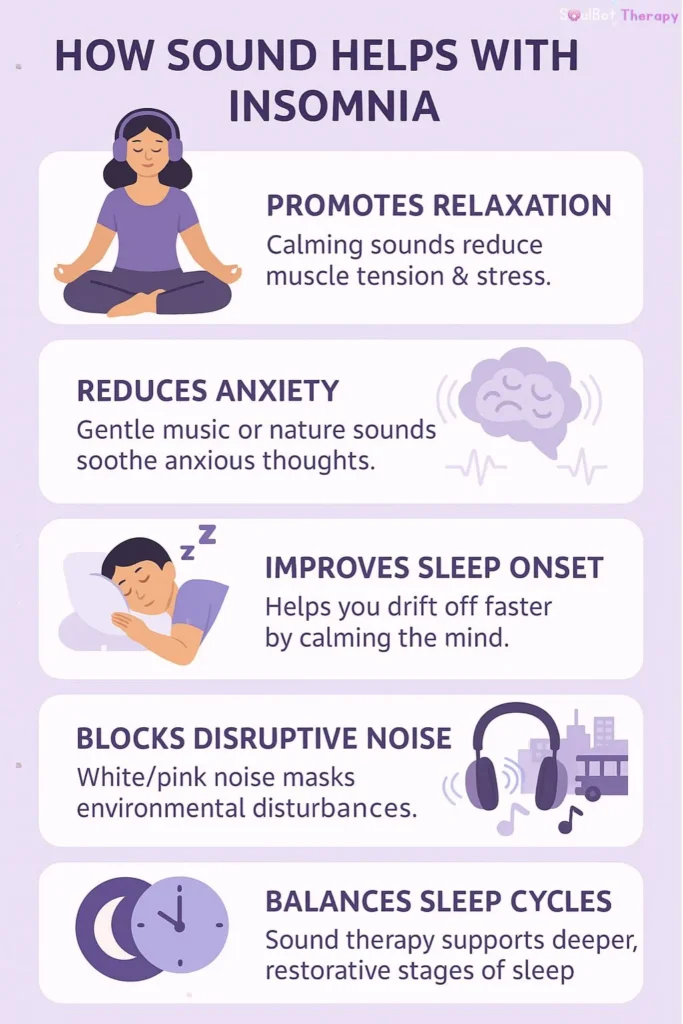
Which Sleep Sounds Have the Best Evidence?
| Sound | What research suggests | Best use |
|---|---|---|
| Relaxing music | Reasonable evidence for improving subjective sleep quality | Wind-down routine |
| White noise | Mixed evidence; may help when environmental noise is disrupting sleep | Masking traffic, voices, sudden sounds |
| Pink noise | Some promising findings, but research is still limited | Background sound if you find it comfortable |
| Binaural beats | Early and inconsistent evidence | Personal relaxation experiment |
| 432 Hz / 528 Hz | No strong evidence that these specific frequencies uniquely improve sleep | Use only if you personally find them calming |
| Sound baths / singing bowls | May support relaxation, but sleep-specific clinical evidence is limited | Relaxation before bed |
This is a better way to choose a sleep sound than asking:
“Which frequency heals insomnia?”
Is Relaxing Music Good for Sleep?
It can be.
Music may help by:
- giving your attention something predictable
- reducing mental stimulation from worry
- creating a repeated bedtime cue
- helping the body transition from activity to rest
A 2024 study of college students with insomnia found that incorporating music into a bedtime routine improved sleep-related outcomes, but no particular genre emerged as clearly superior.
That means you do not necessarily need:
“the scientifically perfect sleep song.”
Choose music that feels:
- familiar
- slow or non-stimulating
- emotionally comfortable
- unlikely to make you want to keep listening actively
Does White Noise Help You Sleep?
White noise can be useful when your problem is unpredictable environmental sound.
For example:
traffic → silence → car horn → silence → voices
A steady background sound may reduce the contrast between the room and sudden noises.
Research is mixed, though.
A systematic review found that studies of white and broadband noise varied considerably in quality and results.
Other research has found benefits in specific noisy environments, while some people report sleep difficulty due to environmental noise.
So think:
White noise = possible noise masker
rather than:
White noise = treatment for insomnia.
What About Pink Noise?
Pink noise contains relatively more low-frequency sound than white noise and is often perceived as softer.
A systematic review of auditory stimulation studies found promising results for pink noise, but the studies were small and varied in their methods.
If pink noise feels more comfortable than white noise, it is reasonable to try it.
You do not need to choose it because social media says it “creates deep sleep.”
Do Binaural Beats Work for Sleep?
A binaural beat is created when slightly different tones are played separately into each ear, producing the perception of another rhythmic beat.
They are often marketed using claims such as:
“Theta frequency puts your brain into sleep mode.”
The evidence is not that simple.
A systematic review of brainwave entrainment research found inconsistent results and highlighted major differences between studies.
A newer review also found potentially beneficial effects across several areas but concluded that larger, better-controlled trials are still needed.
So:
If binaural beats relax you, use them.
But do not assume they have reliably “synchronized your brainwaves.”

Are 432 Hz and 528 Hz Better for Sleep?
There is currently not strong clinical evidence showing that 432 Hz or 528 Hz has a unique sleep-healing effect compared with other calming music.
Claims such as:
- 432 Hz “aligns the body”
- 528 Hz “repairs emotions”
- A particular frequency “heals insomnia”
Go beyond what current evidence supports. If you like how a track sounds, that is enough reason to use it. You do not need a biological explanation that has not been demonstrated.
Try the SoulBot Sleep Sound Experiment
Instead of choosing sounds based on viral frequency claims, test what works for your sleep.
For three nights, try one sound type:
- Night 1: Relaxing music
- Night 2: White or pink noise
- Night 3: Your normal sleep environment
Each morning, record:
- How long do you think it took to fall asleep
- How often do you remember waking
- Morning energy from 0–10
- whether the sound felt calming, neutral, or distracting
Then ask:
Which sound actually helped me rather than which one was supposed to help?
Do not test a different sound every 20 minutes. That turns your bedtime into an experiment instead of a wind-down.
How to Use Sound for Better Sleep?
Keep it simple.
1. Choose predictable audio
Avoid tracks with:
- advertisements
- sudden volume changes
- dramatic transitions
- notifications
- autoplay into unrelated content
2. Keep the volume low
Louder does not mean more therapeutic.
WHO recommends keeping personal audio devices below roughly 60% of maximum volume and limiting prolonged exposure to loud sound.
If possible, use a speaker rather than sleeping all night with earbuds in your ears.
3. Use a timer
Try: 20–45 minutes before or after getting into bed,
Rather than automatically playing audio for eight hours.
4. Repeat the same cue
A consistent sound can become part of your wind-down routine:
dim lights → music → reading → bed
The routine may matter as much as the specific track.
Is Your Sleep Problem Bigger Than Background Sound?
Sound may help you relax, but it will not fix every reason for poor sleep.
If you regularly experience:
- difficulty falling asleep
- repeated nighttime waking
- waking exhausted
- loud snoring
- gasping during sleep
- severe daytime sleepiness
- months of insomnia
Look beyond sound healing.
For long-term insomnia, Cognitive Behavioral Therapy for Insomnia (CBT-I) is usually recommended as a first-line treatment option.
Read: What Causes Bad Sleep? 7 Common Reasons You’re Not Sleeping Well
Talk to Soululu Before Bed
If stress and overthinking are what keep you awake, use Soululu to explore:
- What is my mind stuck on?
- What can wait until tomorrow?
- What helped me feel calmer tonight?
- Is the sound actually helping or just distracting me?
- What’s one realistic wind-down step?
Soululu supports emotional reflection and bedtime routines. It does not diagnose or treat insomnia or other sleep disorders.
Final Thought
Sound can support sleep. But you probably do not need the “perfect healing frequency.”
The useful question is:
Does this sound help me relax, reduce disruption, and transition into sleep?
If yes, keep it.
If not, another frequency probably isn’t the answer.