Home > Blog > How to Stop Daydreaming: 7 Ways to Regain Your Focus
How to Stop Daydreaming: 7 Ways to Regain Your Focus
Mental Health
Last Updated: August 17, 2026
Table of Contents
Quick Answer: How Do You Stop Daydreaming So Much?
You do not need to eliminate daydreaming completely.
If your mind keeps drifting when you need to focus:
Notice the trigger — boredom, stress, music, pacing, loneliness, or a difficult task.
Name what the daydream gives you — stimulation, comfort, escape, excitement, or relief.
Interrupt the cue — change environment, remove music, stand up, or start a timed task.
Return to one concrete action rather than telling yourself to “focus harder.”
Track whether daydreaming is interfering with work, relationships, sleep, or everyday responsibilities.
If immersive daydreaming takes up hours, feels difficult to control, or causes significant distress, it may be worth discussing with a mental-health professional.
Is Daydreaming Normal?
Yes. Mind-wandering is extremely common.
A classic study involving 2,250 adults found that participants reported thinking about something other than their current activity during 46.9% of sampled moments.
That does not mean everyone spends exactly half their day “daydreaming.” Mind-wandering is a broader concept that can include memories, plans, worries, fantasies, and unrelated thoughts.
The useful question is not:
“Do I daydream?”
It is:
“Can I return when I need to?”
Normal Daydreaming vs Excessive Daydreaming
Normal daydreaming
Excessive or problematic daydreaming
Brief and occasional
May continue for long periods
Easy to interrupt
Difficult to stop
Does not significantly disrupt tasks
Work, study, sleep, or relationships may suffer
Can involve creativity or planning
Fantasy may become preferable to real activities
Little distress afterward
May cause guilt, frustration, or distress
Researchers use the term maladaptive daydreaming for persistent, immersive fantasy that causes distress or interferes with functioning.
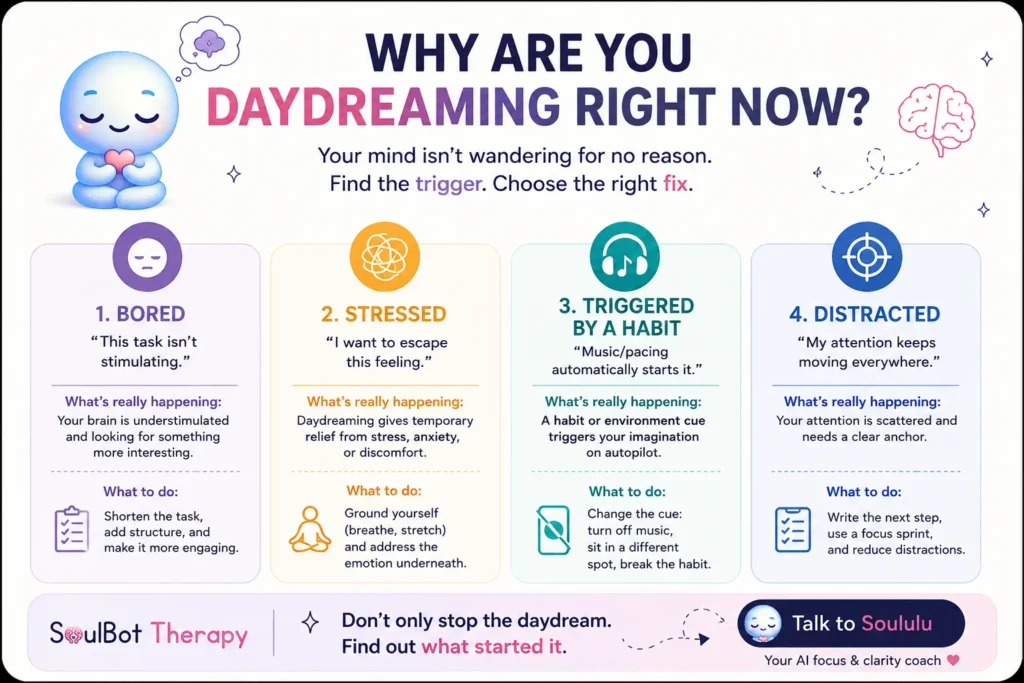
If a task provides very little stimulation, your mind may generate something more interesting.
This often happens during:
repetitive work
lectures
reading
commuting
household chores
2. Emotional escape
Fantasy can temporarily create relief when real life feels stressful, lonely, disappointing, or overwhelming.
The problem is not imagination itself. The problem begins when:
Fantasy becomes the main way you avoid uncomfortable reality.
Research on maladaptive daydreaming has found associations with anxiety, depression, ADHD, obsessive-compulsive symptoms, dissociation, and traumatic experiences. These are associations not proof that excessive daydreaming is caused by any one condition.
3. Habitual triggers
Some people notice that daydreams start automatically with:
specific music
pacing
being alone
lying in bed
repetitive movement
particular fictional stories
Once you know the cue, you have something concrete to change.
4. Attention difficulties
Frequent mind-wandering can occur alongside attention problems.
Before trying another productivity trick, identify your pattern.
Ask:
TRIGGER
What happened immediately before I drifted?
Boring task Stressful thought Music Loneliness
FUNCTION
What did the daydream give me?
Excitement Comfort Escape Control Connection
COST
What happened afterward?
Lost 5 minutes Lost 2 hours Missed work Felt better Felt guilty
This tells you what actually needs changing.
If the function is boredom, you need stimulation.
If it is an emotional escape, another Pomodoro timer probably will not solve the whole problem.
How to Stop Daydreaming and Stay Focused?
1. Catch It Without Fighting It
The first skill is simply recognizing: “I’m daydreaming.”
Do not follow it with: “Why am I doing this again?”
Try:
“My attention drifted. Back to this.”
Your goal is a faster return, not perfect concentration.
2. Give Yourself a Visible Next Step
“Finish my project” is vague.
Instead write:
Open document
Write heading
Finish first paragraph
When attention wanders, return to the exact next action.
This reduces the mental effort required to restart.
3. Remove Your Personal Daydreaming Cue
Generic advice says: “Remove distractions.”
Be more specific.
If you always daydream while listening to music, try instrumental audio or silence.
If pacing triggers fantasies, sit somewhere different.
If lying in bed triggers an hour of imagined scenarios, move your reflection time elsewhere.
Change the cue, not just your motivation.
4. Use Short Focus Sprints
If you repeatedly disappear into thought during long tasks, shorten the target.
Try:
15 minutes focused → 3-minute break → Repeat
You can increase the duration later.
The exact number is less important than making the task small enough to return to it repeatedly.
5. Ground Through Your Senses
When you notice yourself becoming deeply absorbed in fantasy, reconnect with the environment.
Try:
3 things I see
2 things I hear
1 thing I physically feel
Then immediately perform one task-related action.
Grounding works better here as a bridge back to the task, not as an end in itself.
6. Schedule Imagination Instead of Fighting It All Day
If you genuinely enjoy your internal stories, trying to ban them completely may create a constant struggle.
Experiment with: “I can return to this daydream after dinner for 20 minutes.”
Then redirect yourself during work.
This separates:
chosen imagination
from
Automatic escape.
7. Practice Attention Training
Mindfulness is essentially a practice in:
notice → return
A 2023 randomized study found that three weeks of mindfulness training reduced self-reported mind-wandering and improved some measures of sustained attention among college students.
That does not mean five minutes of meditation will “cure” excessive daydreaming.
A useful skill is learning to notice where your attention has gone and deliberately bring it back.
Try the SoulBot Notice–Name–Return Method
When you catch yourself drifting:
NOTICE
“I’ve left the task.”
NAME
“I’m imagining a conversation because this work feels boring.”
RETURN
“For the next five minutes, I’m finishing these three sentences.”
You do not have to resolve the entire reason you daydream before returning. Sometimes the next useful step is enough.
What If I Can’t Stop Daydreaming?
Pay attention to functioning, not just frequency. Consider professional support if daydreaming:
Consumes hours regularly
Interferes with work or study
Causes you to miss sleep
Replaces social interaction
Feels compulsive
Becomes difficult to interrupt
Causes substantial guilt or distress
Is your main method of coping with difficult emotions
There is currently no universally established treatment protocol specifically for maladaptive daydreaming.
Is ADHD Affecting Your Focus?
If daydreaming happens alongside patterns such as:
Remove personal triggers such as music or pacing, break studying into short focus periods, keep one next task visible, and redirect yourself immediately when you notice your attention drifting.
Not currently as an officially recognized standalone diagnosis. Researchers use the term maladaptive daydreaming when immersive fantasy becomes difficult to control and causes significant distress or functional impairment.
Frequent daydreaming and attention drift can occur in people with ADHD, but daydreaming alone is not enough to diagnose ADHD. Research suggests overlap between ADHD and maladaptive daydreaming, but they are not the same thing.
Long periods of daydreaming may be connected with habit, boredom, emotional escape, stress, or other psychological factors. If it feels compulsive or interferes with everyday life, consider discussing it with a mental-health professional.
Mindfulness may help strengthen the skill of noticing that attention has wandered and returning to the present task. Some studies have found reductions in mind-wandering or maladaptive daydreaming following mindfulness-based training, although results and populations vary.
Tisha Verma is a passionate writer at SoulBot Therapy, where she brings together insightful storytelling and emotional wellness to help individuals on their journey of self-discovery. Known for her transformative approach to mental health, she crafts relatable and impactful content that resonates deeply with readers. Her work focuses on practical tips for personal growth, emotional healing, and embracing mental wellness in daily life.