

Quick Answer: What Are the 4 Types of Mental Health?
There are not officially four clinical “types” of mental health.
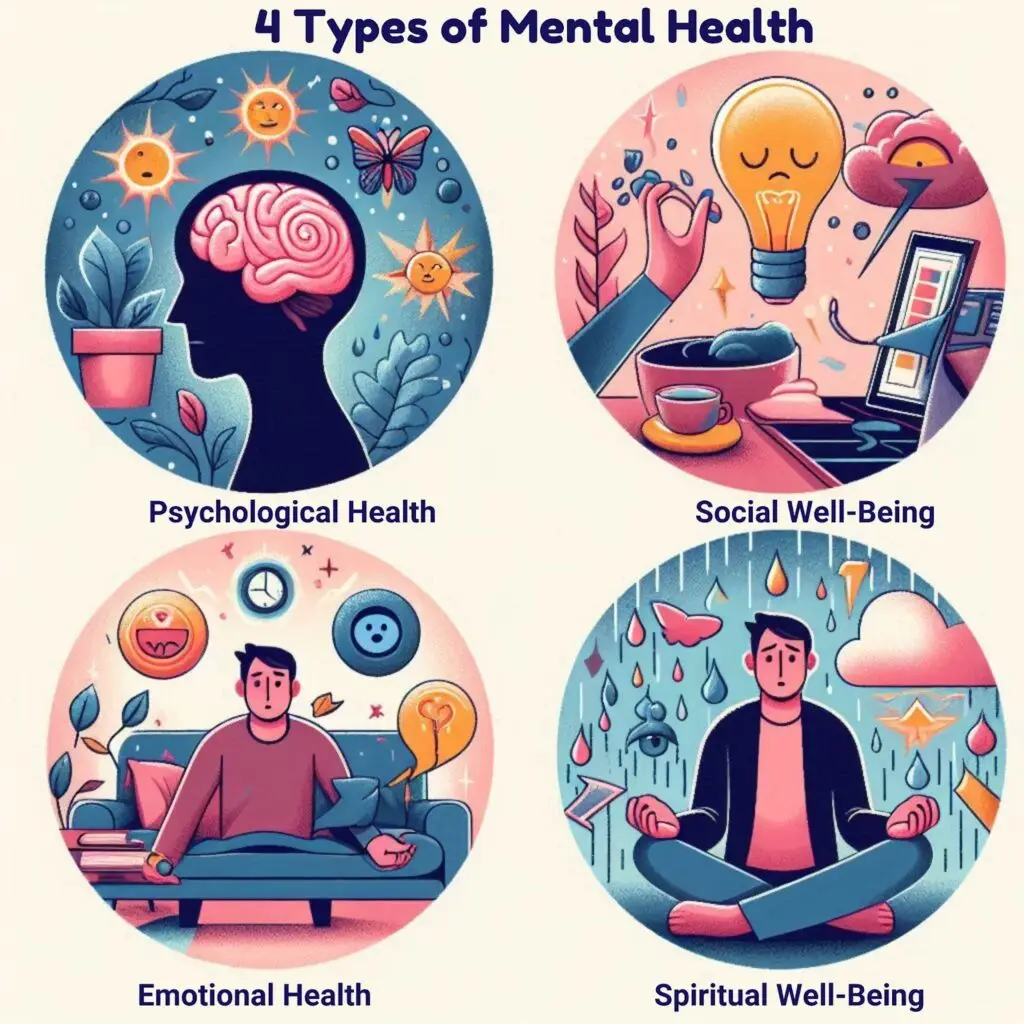
A more accurate way to think about mental health is through four connected dimensions:
- Emotional well-being– how you recognise, experience, and manage emotions
- Psychological well-being– how you think, cope, make decisions, and view yourself
- Social well-being– how connected, supported, and safe you feel with other people
- Meaning and purpose– the values, beliefs, or goals that give your life direction
The CDC formally describes mental health as including emotional, psychological, and social well-being. Meaning and purpose overlap with broader models of well-being rather than representing an official fourth clinical category.
So when people search for the “4 types of mental health,” it is better to think of them as four areas of mental well-being, not diagnoses.
What Is Mental Health?
Mental health affects how you think, feel, cope, connect with others, learn, work, and respond to everyday stress.
The World Health Organization defines mental health as a state of mental well-being that helps people cope with life’s stresses, realize their abilities, learn, work, and contribute to their communities.
Mental health is also not the opposite of mental illness.
Someone can:
- Have no diagnosed disorder but still be struggling emotionally;
- Live with a mental health condition while experiencing periods of good well-being;
- Feel strong in one area of mental health and struggle in another.
WHO describes mental health as a continuum, meaning it can change over time and differs from person to person.
1. Emotional Well-Being: How You Experience Feelings
Emotional health is not about being happy all the time.
It is your ability to:
- Recognize what you are feeling;
- Express emotions appropriately;
- Recover after difficult experiences;
- Tolerate uncomfortable emotions;
- Regulate reactions without suppressing everything.
For example, emotionally healthy responses can still include sadness, anger, disappointment, or anxiety.
The difference is that the emotion does not completely determine what you do next.
Signs this area may need attention
You might notice:
- Feeling emotionally numb;
- Frequent emotional outbursts;
- Avoiding feelings;
- Being overwhelmed by relatively small triggers;
- Difficulty identifying what you feel.
If emotions frequently feel difficult to recognize, read Feeling Emotionally Numb: Why It Happens and How to Cope.
One useful check-in
Instead of asking:
“Why am I feeling like this?”
start with:
“What exactly am I feeling, and what happened before it?”
Naming the experience can be more useful than immediately trying to remove it.
2. Psychological Well-Being: How You Think and Cope
Psychological well-being includes how you:
- Understand yourself;
- Respond to setbacks;
- Make decisions;
- Adapt to change;
- Solve problems;
- Maintain self-worth;
- Cope with stress.
It does not mean always thinking positively.
Healthy psychological functioning includes being able to notice an unhelpful thought without automatically treating it as fact.
For example:
“I failed at this.”
is different from:
“I am a failure.”
The first describes an event. The second turns one event into an identity.
Practices such as psychotherapy, regular physical activity, adequate sleep, supportive relationships, and stress-management strategies can all support mental well-being. NIMH recommends everyday self-care habits, including exercise, regular meals, sleep, relaxing activities, setting priorities, and staying connected.
Is Anxiety Affecting This Area?
If worry, tension, overthinking, or difficulty relaxing are affecting your daily life, the Free Anxiety Test can help you reflect on your current anxiety patterns.
Quick self-check · Instant result · Not a diagnosis
3. Social Well-Being: How Connected You Feel
You can spend every day around people and still feel socially disconnected.
Social well-being is less about the number of people you know and more about whether your relationships provide:
- Belonging;
- Emotional support;
- Mutual respect;
- Trust;
- Healthy communication;
- Room to set boundaries.
CDC reports that social connection can support people’s ability to manage stress, anxiety, and depression and can contribute to overall health and well-being.
Signs this area may need attention
You may:
- Feel lonely despite being around others;
- Avoid asking anyone for help;
- Stay in relationships where you cannot be yourself;
- Struggle to set boundaries;
- Feel disconnected from friends or family;
- Have no one you feel safe talking to.
Improving social well-being does not mean becoming more extroverted.
For one person, connection may mean a large community. For another, it may mean two relationships in which they feel genuinely understood.
4. Meaning and Purpose: What Gives Your Life Direction
This fourth dimension is sometimes called spiritual well-being, but spirituality does not have to involve religion.
A more inclusive description means and purpose.
It can come from:
- family;
- creativity;
- faith;
- work;
- learning;
- helping others;
- personal values;
- community;
- long-term goals.
CDC includes having a sense of meaning and purpose as part of positive emotional well-being.
You do not need to know your “life purpose.”
Purpose can be much smaller:
“I want to be a reliable friend.”
“I want to create something I’m proud of.”
“I want to care for my family.”
“I want to live according to my values.”
Signs this area may need attention
You may feel:
- Directionless;
- Disconnected from your values;
- As though every day feels repetitive;
- Successful externally but unfulfilled internally;
- Unsure why your goals matter to you.
The goal is not to manufacture meaning. It is to notice what already feels important.
The SoulBot 4D Mental Health Check-In
Instead of asking the huge question:
“Is my mental health good or bad?”
Check four areas separately.
| Dimension | Ask yourself |
|---|---|
| Feel | Can I recognize and manage what I’m feeling? |
| Think | Are my thoughts helping me cope and make decisions? |
| Connect | Do I have relationships where I feel safe and supported? |
| Meaning | Does something in my life currently feel important to me? |
Rate each from 0–10.
You may discover:
- Feel: 4
- Think: 6
- Connect: 8
- Meaning: 3
That tells you much more than simply deciding:
“My mental health is bad.”
Your lowest score is not a diagnosis. It is simply an area you may want to explore.
Can You Have Good Mental Health and Still Struggle?
Yes.
Mental health is not:
Healthy → Unhealthy
It is more like several sliders that can move independently.
You might:
- Have supportive relationships but high anxiety;
- Feel emotionally stable but lack direction;
- Have a mental health diagnosis and still experience strong relationships, purpose, and periods of well-being.
CDC specifically notes that people living with mental health conditions can still experience positive well-being, particularly when symptoms are managed and supportive environments are present.
This is why mental health should not be reduced to whether someone has a diagnosis.
How Can You Improve the 4 Areas of Mental Health?
Don’t try to “fix your entire mental health.”
Choose the area that currently needs the most attention.
| If you’re struggling with… | Try starting with… |
|---|---|
| Emotions | Name one emotion before reacting to it |
| Thoughts | Write down the thought and separate facts from assumptions |
| Connection | Contact one person you trust |
| Meaning | Choose one action that reflects something you value |
Small repeated actions are generally more realistic than completely redesigning your routine.
For more practical strategies, read How to Deal With Anxiety: Techniques That Actually Help and How Sleep and Mental Health Are Connected.
When Should You Seek Professional Help?
Consider speaking with a qualified mental health professional if changes in your thoughts, emotions, or behavior:
- Persist;
- Significantly affect work or study;
- Interfere with sleep;
- Damage relationships;
- Make everyday tasks difficult;
- Cause substantial distress.
NIMH recommends seeking professional help when distressing symptoms are severe or continue for two weeks or longer, including problems with sleep, concentration, interest, mood, or completing normal activities.
Reflect With Soululu
Not sure which area feels off?
Use Soululu to explore:
- What you’ve been feeling lately;
- Which thoughts keep repeating;
- Where you feel supported or disconnected;
- What currently matters to you;
- One realistic step you could take today.
Soululu supports emotional self-reflection. It does not diagnose mental health conditions or replace professional mental health care.
Final Thought
Mental health is not a single score, nor is it simply the absence of a disorder.
Think about four questions:
- How am I feeling?
- How am I thinking and coping?
- How connected do I feel?
- What currently gives my life meaning?
You do not need all four areas to feel perfect.