
Healthy Coping Mechanisms: 8 Practical Ways to Handle Stress

Last Updated: August 20, 2026
Healthy Coping Mechanisms
Table of Contents

Healthy coping mechanisms are practical ways to manage stress, difficult emotions, or everyday problems without creating bigger problems later.

The right coping strategy depends on the situation. Some problems need action. Others need emotional regulation, rest, or support.

A useful rule is:

Change what you can. Regulate what you cannot change right now. Ask for support when it is too much to carry alone.

What Are Healthy Coping Mechanisms?

The American Psychological Association defines a coping strategy as an action, series of actions, or thought process used to deal with a stressful or unpleasant situation or change your reaction to it.

Healthy coping does not mean staying calm or positive all the time.

It means responding to stress in a way that helps you function without repeatedly harming your physical health, relationships, responsibilities, or emotional well-being.

Coping strategies generally include:

  • Problem-focused coping: changing something about the situation.
  • Emotion-focused coping: managing how the situation makes you feel.

Neither is automatically better. What matters is choosing the strategy that fits the problem.

1. Solve the Part You Can Control

If the source of stress is practical, calming yourself without addressing it may only postpone the problem.

Ask:

  • What exactly is stressing me?
  • What part can I control?
  • What is one useful next step?

For example, if three deadlines are overwhelming you, the next step might be to prioritize one task, ask for clarification, or request more time.

The NHS recommends breaking large tasks into manageable steps and planning ahead for stressful situations.

2. Use Breathing When Stress Feels Physical

Stress can show up as muscle tension, a faster heartbeat, difficulty concentrating, or feeling overwhelmed.

When your body feels activated, try:

  1. Breathe in gently.
  2. Breathe out slowly.
  3. Repeat for one or two minutes.

You do not need to force extremely deep breaths. The goal is simply to slow down enough to decide what you need next.
talk to soululu

3. Move Your Body

Movement can help when stress leaves you restless, tense, or mentally stuck.

Try:

  • A 10-minute walk
  • Stretching
  • Yoga
  • Cycling
  • A short workout

You do not need to exercise intensely for movement to count as a coping strategy. The NHS includes regular physical activity as a practical approach to managing stress.

4. Talk to Someone

Not every difficult emotion needs to be handled alone.

You might tell someone: “I don’t need advice. I just need to talk.”

Or:

“Can you help me think through what to do next?”

Support may come from a friend, family member, colleague, support group, therapist, or another trusted person.

Talking about your feelings is also among the NHS recommendations when stress becomes difficult to manage.

5. Try the Feeling–Fact–Next Step Method

Journaling can be useful, but repeatedly writing about the same worry can turn into rumination.

Keep it structured:

FEELING

“I feel overwhelmed.”

FACT

“I have two deadlines tomorrow.”

NEXT STEP

“I’ll finish the urgent task first and ask whether the second deadline can move.”

This separates what you feel from what is actually happening and gives you something concrete to do.

6. Use Distraction Deliberately

Distraction is not automatically an unhealthy coping mechanism.

Watching a familiar show, listening to music, playing a game, or taking a short break can give you temporary emotional space.

Ask:

“Am I taking a break, or am I avoiding something I still need to deal with?”

If the activity helps you reset and return, it may be useful.

If it repeatedly replaces dealing with the problem, another coping strategy may be needed.

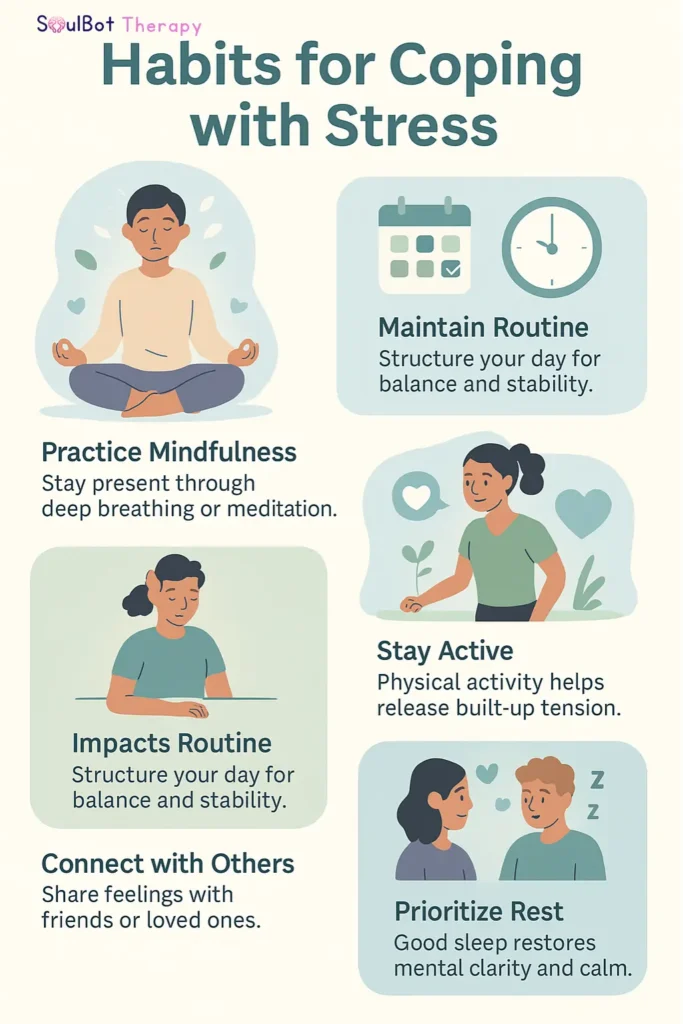
7. Protect Your Basic Routine

Stress often disrupts the habits that make coping easier.

During difficult periods, focus on a few basics:

  • Reasonably consistent sleep
  • Regular meals
  • Some physical movement
  • Time away from constant notifications
  • Contact with supportive people
  • Realistic daily goals

You do not need a perfect morning routine. The goal is to reduce unnecessary strain while you handle what is already difficult.

8. Notice When Coping Creates Another Problem

Some coping behaviors provide quick relief but become costly when repeated.

Examples can include:

  • Drinking or using substances to numb emotions
  • Compulsive spending
  • Doomscrolling for hours
  • Avoiding every difficult conversation
  • Constantly seeking reassurance
  • Isolating yourself whenever you feel distressed

Do not shame yourself for reaching for relief.

Instead ask:

What does this help me escape right now, and what does it cost me later?

That question makes it easier to find a healthier replacement.

Try the SoulBot Cope Check

When you’re overwhelmed, use three questions:

Can I change it?

Take one practical step.

Can I not change it right now?

Focus on regulating the emotion through breathing, movement, rest, journaling, or temporary distraction.

Is it too much to handle alone?

Reach out for support. This helps you avoid using the same coping mechanism for every kind of stress.

When Should You Get Professional Support?

Coping skills can help with everyday stress, but self-help is not always enough.

Consider professional support when stress, anxiety, low mood, or another emotional difficulty is persistently affecting:

  • Sleep
  • Relationships
  • Work or study
  • Eating
  • Daily responsibilities
  • Your ability to function

The NHS recommends seeking support when stress is affecting your life or you are struggling to cope.
Healthy Coping Mechanisms

Talk to Soululu

If you are not sure what you need in a difficult moment, use Soululu to explore:

  • What happened?
  • What am I feeling?
  • What can I control?
  • Do I need action, regulation, or support?
  • What is one realistic next step?

Talk to Soululu

Soululu can support emotional reflection and coping planning. It does not diagnose mental health conditions or replace professional therapy.

Final Thought

Healthy coping is not one perfect habit.

  • Sometimes coping means breathing.
  • Sometimes it means taking a walk.
  • Sometimes it means setting a boundary.

And sometimes it means dealing with the problem you have been avoiding.

The best coping mechanism is the one that helps with the current problem without creating a bigger one later.


Related SoulBot Reads

FAQ

Frequently Asked Questions

Healthy coping mechanisms are strategies that help you manage stress or difficult emotions while supporting your longer-term functioning and well-being.
Examples include problem-solving, exercise, breathing exercises, journaling, social support, setting boundaries, taking structured breaks, and breaking overwhelming tasks into smaller steps.
The difference often comes down to impact. A strategy may provide immediate relief but become unhelpful if it repeatedly creates problems with health, relationships, work, money, or daily functioning.
First, decide whether the situation needs action, emotional regulation, or support. If you can change the problem, take one practical step. If you cannot change it immediately, regulate your response and consider reaching out to someone.
Coping strategies can help manage anxiety symptoms and stressful situations, but persistent or severe anxiety may require professional assessment and treatment.

About the Author:

Picture of Tisha Verma

Tisha Verma

Tisha Verma is a passionate writer at SoulBot Therapy, where she brings together insightful storytelling and emotional wellness to help individuals on their journey of self-discovery. Known for her transformative approach to mental health, she crafts relatable and impactful content that resonates deeply with readers. Her work focuses on practical tips for personal growth, emotional healing, and embracing mental wellness in daily life.

More Blog Posts

You May Look Fine, But It Feels Heavy Inside

Ready to explore your full SoulMap?

🟢The Grounded Socializer

Social Moments Feel Mostly Manageable

Ready to explore your full SoulMap?

🟡The Quiet Overthinker

You Show Up, But Your Mind Replays It

Ready to explore your full SoulMap?

🟠The Cautious Connector

Connection Matters, But It Can Feel Hard

Ready to explore your full SoulMap?

Your emotional compass wants love, but stays cautious.

Ready to explore your full SoulMap?

Avoidant Attachment
Independent, With Boundaries

Your emotional compass values space and self-reliance.

Ready to explore your full SoulMap?

Anxious Attachment
Deep, But Seeking Reassurance

Your emotional world is intense and connection-driven.

Ready to explore your full SoulMap?

Secure Attachment – Calm & Connected

Your emotional compass feels steady and safe.


Ready to explore your full SoulMap?

The Storm Mind (Severe Anxiety)

Intense, overwhelming, and hard to control at times.

Ready to explore your full SoulMap?

The Overthinker (Moderate Anxiety)

Your mind is active, often running ahead of you.

Ready to explore your full SoulMap?

The Gentle Worrier (Mild Anxiety)

Occasional overthinking, but still in control.
You feel stress at times, but it doesn’t take over your day.

Ready to explore your full SoulMap?

Moderately Emotionally Available- Opening, With Caution

Your emotional compass shows growth, with a few guarded zones.

Ready to explore your full SoulMap?

Your emotional compass points toward openness and connection.

Ready to explore your full SoulMap?

Your emotional compass leans toward self-protection right now.

Ready to explore your full SoulMap?

Submissive Personality

Gentle and supportive. You bring calm energy and emotional depth to every space.

Ready to explore your full SoulMap?

Balanced Personality

Grounded and fair-minded. You value harmony, empathy, and shared understanding.

Ready to explore your full SoulMap?

Dominant Personality

Driven and decisive. You lead naturally, think fast, and act with purpose.

Ready to explore your full SoulMap?

Homosexual —
True North, Same-Gender

Your love compass points to people of the same gender.

Ready to explore your full SoulMap?

Restless and always in motion. May talk fast, act quickly, or jump between ideas. 

Ready to explore your full SoulMap?

High Likelihood
ADHD Combined Type (ADHD-C)

Shows both inattentive and hyperactive traits where focus shifts, energy spikes, and motivation come in waves.

Ready to explore your full SoulMap?

Low Likelihood
ADHD Inattentive Type (ADHD-I)

Often loses focus and misses details, with drifting thoughts that leave tasks unfinished.

Ready to explore your full SoulMap?

🔧 The Virtuoso - ISTP

Hands-On Expert

Ready to explore your full SoulMap?

📋 The Logistician - ISTJ

Steady Rock

Ready to explore your full SoulMap?

🌻 The Adventurer - ISFP

Gentle Spirit

Ready to explore your full SoulMap?

🛡️ The Defender - ISFJ

Caring Guardian

Ready to explore your full SoulMap?

🤔 The Logician - INTP

Curious Explorer

Ready to explore your full SoulMap?

🏛️ The Architect - INTJ

Strategic Mastermind

Ready to explore your full SoulMap?

🦄 The Mediator - INFP

Gentle Idealist

Ready to explore your full SoulMap?

🔮 The Advocate - INFJ

Quiet Visionary

Ready to explore your full SoulMap?

🚀 The Entrepreneur - ESTP

Action Hero

Ready to explore your full SoulMap?

📊 The Executive - ESTJ

Results Driven

Ready to explore your full SoulMap?

🎭 The Entertainer - ESFP

Life of the Party

Ready to explore your full SoulMap?

🤗 The Consul - ESFJ

Heart of Gold

Ready to explore your full SoulMap?

🧠 The Debater - ENTP

Mental Gymnast

Ready to explore your full SoulMap?

👑 The Commander - ENTJ

Strategic Powerhouse

Ready to explore your full SoulMap?

🎨 The Campaigner - ENFP

Creative Visionary

Ready to explore your full SoulMap?

🌟 The Protagonist - ENFJ

Natural Born Leader

Ready to explore your full SoulMap?

🤗 Physical Touch

Hugs Over Hype

Ready to explore your full SoulMap?

🕰 Quality Time

Presence Over Presents

Ready to explore your full SoulMap?

🎁 Receiving Gifts

Thoughtful Tokens, Big Feelings

Ready to explore your full SoulMap?

🤝 Acts of Service

Love in Action

Ready to explore your full SoulMap?

Words of Affirmation

You Speak from the Heart

Ready to explore your full SoulMap?

Gay, Lesbian, or
Queer and Proud

Your love compass points to the same gender

Ready to explore your full SoulMap?

Bisexual -
Go with the Flowy

Your love compass swings in the middle

Ready to explore your full SoulMap?

Heteroflexible —
Some Wiggle in the Compass

You’ve got a touch of bi-curiosity

Ready to explore your full SoulMap?

Hetero -
Straight Up Honest

Your love compass points to the opposite sex.

Ready to explore your full SoulMap?