

If you’re searching for how to build self-esteem, you’ve probably already seen advice like “think positive” or “repeat affirmations.”
That can help some people, but self-esteem usually grows from something more concrete: how you talk to yourself, what you do when things go wrong, the boundaries you keep, and the evidence you build that you can trust yourself.
Healthy self-esteem is not believing you are perfect. It is being able to recognize your strengths and weaknesses without turning every mistake, rejection, or setback into proof that something is wrong with you.
What Does Self-Esteem Mean?
Self-esteem is your overall sense of personal worth and how you evaluate yourself.
Healthy self-esteem sounds like:
“I have flaws, but I still deserve respect.”
It is different from self-confidence.
- Self-confidence is often about ability: “I’m confident I can give this presentation.”
- Self-esteem is broader: “Even if the presentation goes badly, I am not a failure.”
The NHS recommends identifying negative beliefs, challenging them with evidence, practicing self-kindness, becoming more assertive, and taking on manageable challenges when working on low self-esteem.
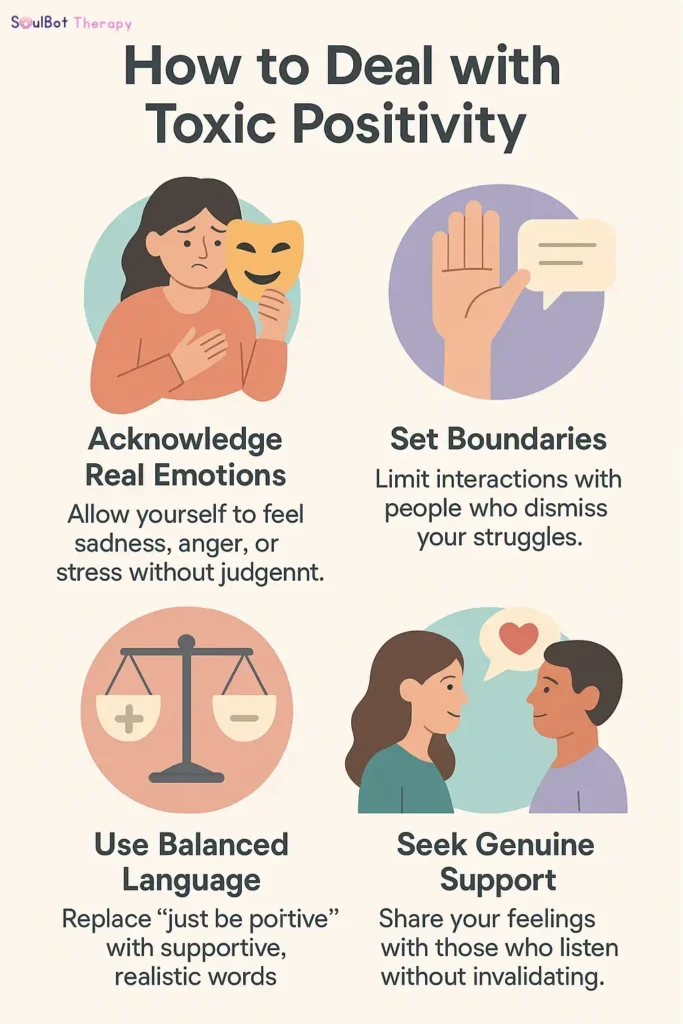
Why Toxic Positivity Does Not Build Real Confidence
Toxic positivity happens when difficult emotions are dismissed with responses such as:
- “Just stay positive.”
- “Everything happens for a reason.”
- “Don’t think negatively.”
The problem is not positivity itself. The problem is pretending an uncomfortable feeling should not exist.
Instead of: “I shouldn’t feel disappointed.”
try: “I am disappointed, and I can still decide what to do next.”
Instead of: “I have to believe I’m amazing.”
try:
“I don’t need to be amazing to deserve respect.”
Realistic self-talk is easier to believe and more useful than forced positivity.
1. Stop Turning One Event Into Your Identity
Low self-esteem often turns specific experiences into global judgments.
Event: “I didn’t get the job.”
Self-attack: “I’m a failure.”
These are not the same statement.
Try separating the event from the identity:
“I didn’t get this job. That tells me something about this application, not my entire worth.”
Ask:
- What actually happened?
- What am I making it mean about me?
- Is that conclusion supported by evidence?
2. Build a Self-Esteem Evidence Bank
Instead of repeatedly telling yourself: “I’m confident.”
Start collecting evidence. At the end of each day, write down one example of:
- A promise you kept to yourself
- Something difficult you attempted
- A boundary you respected
- A mistake you repaired
- A value you acted on
For example:
- “I said I would walk for 15 minutes, and I did.”
- “I spoke up even though I felt nervous.”
- “I said no instead of agreeing automatically.”
Small actions create evidence that challenges the belief:
“I never follow through.”
3. Change Harsh Self-Talk Without Faking Positivity
Healthy self-talk does not mean replacing every negative thought with something cheerful.
Instead of: “I’m useless.
try:
“I struggled with this task.”
Instead of: “Nobody will ever want me.”
try:
“Rejection hurts, but one person’s decision does not determine my worth.”
Instead of: “I always mess everything up.”
try:
“I made a mistake. What can I repair?”
The goal is accuracy, not positivity.
4. Do Things Before You Feel Confident
Waiting until you feel confident can keep you stuck.
Self-esteem often grows after you prove to yourself that you can handle discomfort.
Start small.
If speaking up is difficult:
- Ask one question.
- Share one opinion.
- Speak during a small group discussion.
- Gradually take on more challenging situations.
Avoidance can protect you from discomfort today while reinforcing self-doubt tomorrow.
5. Practice Boundaries
Low self-esteem can show up as:
- Saying yes when you want to say no
- Constantly apologising
- Over-explaining yourself
- Accepting disrespect
- Needing repeated reassurance
- Putting everyone else’s needs first
You do not have to become completely confident before setting boundaries.
The boundary itself can help build self-respect.
Try:
- “I can’t do that today.”
- “I need some time before I decide.”
- “I’m not comfortable with that.”
- “I’d prefer something different.”
6. Respond to Mistakes With Self-Compassion
Self-compassion does not mean avoiding responsibility.
It means correcting yourself without attacking yourself.
Instead of: “I’m so stupid.”
try:
“That was a mistake. What needs fixing?”
You can take responsibility and still treat yourself with respect.
Research consistently finds a relationship between self-compassion, lower self-criticism, and psychological well-being.

7. Stop Measuring Your Worth Through Other People
If your self-esteem depends entirely on:
- Compliments
- Romantic attention
- Social media engagement
- Approval from your boss
- Reassurance from friends
Your sense of worth can change every time someone responds differently.
Ask:
“Would I still respect this choice if nobody praised me for it?”
Start building an identity around your own values, not only other people’s reactions.
Try the SoulBot Event–Story–Evidence Check
When something damages your confidence, use three questions:
EVENT
What actually happened?
“Someone rejected me.”
STORY
What am I telling myself it means?
“I’m not attractive enough.”
EVIDENCE
What facts support or challenge that conclusion?
“One person did not want this relationship. That does not tell me how every person will see me.”
This helps separate painful experiences from global judgments about your worth.
Signs Your Self-Esteem Is Improving
You may notice that:
- Criticism does not ruin your entire day
- You need less reassurance
- You can accept a compliment
- You try things you may fail at
- Rejection hurts without defining you
- You set boundaries with less guilt
- You recover faster after mistakes
- You compare yourself with others less often
Improving self-esteem does not mean you will never doubt yourself again. It means self-doubt has less control over what you do.
Think You May Have Low Self-Esteem?
If you recognize patterns such as constant self-criticism, comparison, reassurance-seeking, or feeling “not good enough,” explore our Low Self-Esteem Self-Check.
It can help you reflect on where low self-worth may be showing up in your everyday life.
When Should You Get Professional Support?
Consider speaking with a mental-health professional if low self-esteem:
- Significantly affects relationships
- Prevents you from taking opportunities
- Causes severe avoidance
- Is connected with persistent anxiety or depression
- Leads to intense self-criticism
- Makes everyday functioning difficult
Therapies such as CBT can help identify negative beliefs and the behaviors that keep them active.
Talk to Soululu When Your Inner Critic Gets Loud
Use Soululu to explore:
- What happened?
- What am I saying about myself because of it?
- Is that a fact or a judgment?
- What evidence am I ignoring?
- What would a self-respecting next step look like?
Soululu supports emotional reflection and self-awareness. It does not diagnose mental-health conditions or replace professional therapy.
Final Thought
Building self-esteem is not about convincing yourself:
“I’m amazing.”
It is about becoming able to say:
“I can make mistakes, get rejected, struggle, and still deserve respect.”
- Challenge the story.
- Take the action.
- Collect the evidence.
That is how healthier self-esteem is built.