

Setting a boundary can be simple.
Living with the guilt afterward is often the harder part.
If you struggle to say no, worry that you are disappointing people, or keep explaining yourself until your boundary disappears, learning how to set boundaries without guilt starts with one important distinction:
Someone being disappointed with your boundary does not automatically mean you did something wrong.
Healthy boundaries communicate what you are comfortable with, what you can realistically give, and what you will do when a limit is crossed.
What Are Emotional Boundaries?
Emotional boundaries help separate:
- What you feel from what someone else feels
- What you are responsible for from what you cannot control
- What support can you offer beyond your capacity
- What behavior will you accept, and what will you step away from
For example:
“I care about what you’re going through, but I don’t have the capacity for a long conversation tonight.”
You can care about someone’s feelings without making yourself responsible for fixing them.
NHS guidance on relationships and communication describes boundaries as an important part of looking after yourself and notes that while you can influence an interaction, you cannot control the other person’s response.
Why Do I Feel Guilty for Setting Boundaries?
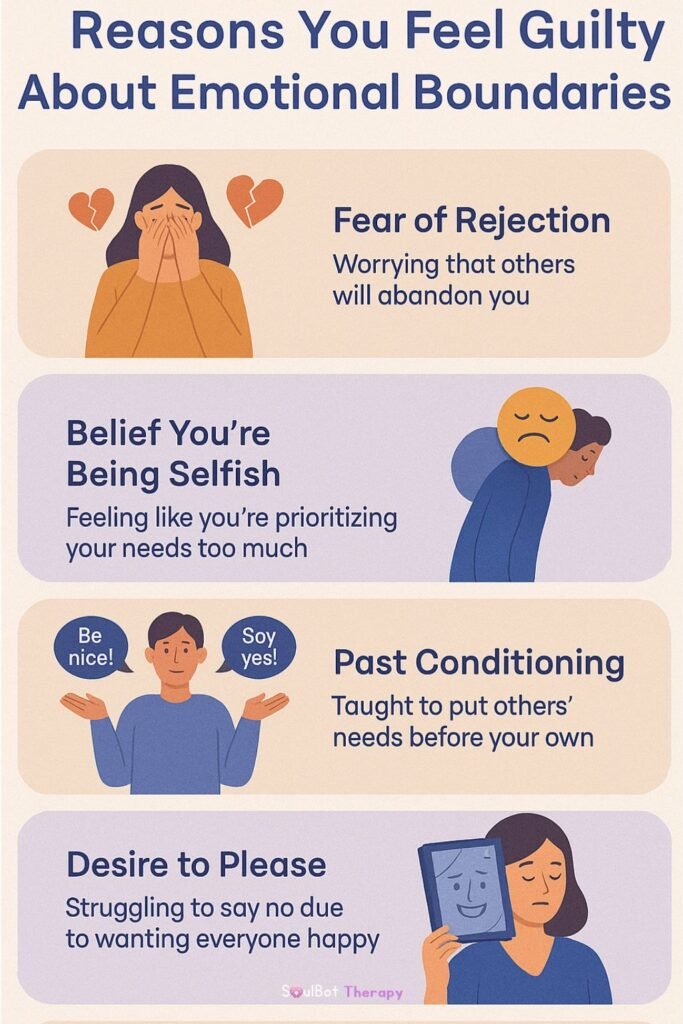
Boundary guilt can happen for different reasons.
You may be used to:
- Saying yes automatically
- Avoiding conflict
- Keeping other people happy
- Worrying about being considered selfish
- Over-explaining your decisions
- Taking responsibility for other people’s emotions
Sometimes what feels like guilt is actually discomfort with disappointing someone.
Those are not always the same thing.
You might say: “I can’t help this weekend.”
and immediately think: “They’re disappointed. I must have done something wrong.”
But their disappointment and your wrongdoing are two separate questions.
1. Pause Before Automatically Saying Yes
If your first response is always:
“Sure.”
Create a pause.
Try:
- “Let me check and get back to you.”
- “I need to think about whether I have capacity.”
- “Can I confirm later today?”
You do not need to decide immediately simply because someone asked. That pause gives you time to ask:
Do I actually want to say yes, or am I afraid to say no?
2. Make the Boundary Specific
“I need better boundaries” is difficult to act on.
Instead, identify exactly what needs to change.
For example:
Too vague: I need more space.
Clearer: “I don’t want to discuss work after 8 p.m.”
Or:
“If we’re shouting at each other, I’m going to pause the conversation and come back when we’re calmer.”
A useful boundary tells someone what you need or what you will do.
3. Say Less
People often weaken a boundary by trying to get the other person to fully agree with it.
You say: “I can’t come tonight because I’ve had such a long week, and I know I said I might, and I feel really bad, and maybe I could come later…”
Now your no sounds negotiable.
Try: “Thanks for inviting me. I can’t make it tonight.”
Clear does not have to mean rude.
Assertiveness involves expressing your own needs while respecting the rights and needs of other people.
4. Stop Trying to Control Their Reaction
A boundary does not guarantee that another person will like it.
They may feel:
- disappointed
- annoyed
- confused
- surprised
You can acknowledge that without removing the boundary.
For example:
“I understand you’re disappointed. I still can’t do it tonight.”
Or:
“I know you wanted a different answer. My decision hasn’t changed.”
Your job is to communicate respectfully. Your job is not to create a response that makes everyone happy.
5. Use the SoulBot Boundary Guilt Check
When guilt appears, ask three questions.
Did I cause unnecessary harm?
Did I insult, threaten, manipulate, or intentionally hurt the person?
If yes, repair what needs repairing.
Did I simply communicate a reasonable limit?
For example:
- “I’m not available.”
- “I don’t want to discuss that.”
- “Please ask before borrowing my things.”
If yes, the discomfort may not require you to undo the boundary.
Am I feeling responsible for their reaction?
Someone else’s feelings matter.
But their feelings do not automatically decide what you must do.
This distinction helps you separate:
responsibility
from
discomfort.
6. Match the Boundary to the Situation
Different boundaries need different language.
| Situation | Boundary example |
|---|---|
| Friend | “I can listen for a little while, but I don’t have capacity for a long call tonight.” |
| Family | “I’m not discussing my relationship. Let’s change the subject.” |
| Work | “I can finish X or Y by Friday, but I can’t complete both. Which is the priority?” |
| Messages | “I don’t normally respond to work messages after 7 p.m.” |
| Conflict | “If we start shouting, I’ll pause the conversation and come back later.” |
| Request | “I can’t commit to that.” |
| Repeated pressure | “I’ve already answered. My decision hasn’t changed.” |
You do not need one perfect boundary script. You need language you can actually use.
7. Follow Through
A boundary that repeatedly disappears under pressure becomes difficult for other people to understand.
Suppose you say: “If you insult me during an argument, I’m going to end the conversation.”
If the insults begin, follow through:
“I’m ending this conversation now. We can talk later.”
This is different from trying to control them by saying:
“You are not allowed to get angry.”
You cannot completely control another adult’s behavior.
You can decide what you will participate in.
Boundary or Control: What’s the Difference?
This distinction matters.
Boundary:
“If I’m shouted at, I’ll leave the conversation.”
Control:
“You’re not allowed to be angry.”
Boundary:
“I’m not comfortable sharing my passwords.”
Control:
“You aren’t allowed to talk to that person.”
Boundaries describe your limits, choices, participation, and responses. They are not a tool for controlling another person’s life.
Signs You May Need Stronger Emotional Boundaries
Consider looking at your boundaries if you regularly:
- Say yes and regret it later
- Feel responsible for everyone’s mood
- Become resentful after helping
- Apologize for having normal needs
- Avoid saying what you really want
- Let conversations continue after becoming uncomfortable
- Fear that saying no will make people leave
- Feel exhausted from being constantly available
One sign alone does not mean your boundaries are unhealthy. Look for repeated patterns.
What If Someone Gets Angry When I Set a Boundary?
First, distinguish disagreement from intimidation.
Someone saying: “I’m disappointed.”
is different from someone:
- threatening you
- monitoring you
- humiliating you
- deliberately frightening you
- preventing you from seeing people
- controlling your money or movements
Controlling, threatening, coercive, or violent behavior can be a sign of abuse rather than a simple boundary disagreement.
If setting a boundary could put your safety at risk, prioritize your safety and professional support over trying to communicate the boundary perfectly.

Try the One-Sentence Boundary Formula
When you do not know what to say, use: Situation + Limit + What I’ll do
For example: “When conversations become insulting, I won’t continue them. I’ll come back when we can speak respectfully.”
Or:
“I can’t take on another project this week. I can look at it next Monday.”
Or simply: “I’m not comfortable with that, so I’m going to say no.”
Not every boundary needs a long explanation.
How Do You Stop Feeling Guilty After Setting a Boundary?
You may not be able to eliminate guilt immediately.
Instead of waiting until the boundary feels completely comfortable:
- Notice the guilt.
- Check whether you actually did something harmful.
- Remind yourself why the boundary was needed.
- Avoid immediately reversing it just to reduce discomfort.
- Give yourself time to adjust to communicating differently.
The goal is not: “I will never feel guilty.”
A more realistic goal is:
“I can feel uncomfortable and still communicate a reasonable limit.”
Build the Self-Esteem Behind Better Boundaries
If you repeatedly feel that other people’s needs are automatically more important than yours, boundary work may be connected to self-worth.
Read: How to Build Self-Esteem Without Toxic Positivity
For boundaries specifically in romantic relationships, read: How to Set Healthy Relationship Boundaries
Talk to Soululu Before a Difficult Boundary Conversation
If you know what you want to say but keep second-guessing yourself, use Soululu to reflect on:
- What am I uncomfortable with?
- What do I actually need?
- What am I afraid will happen if I say no?
- Am I responsible for fixing the other person’s reaction?
- How can I say this clearly without being unnecessarily harsh?
Soululu can help you organize your thoughts and practice conversations. It does not replace professional therapy or relationship support.
Final Thought
Setting boundaries without guilt does not mean becoming indifferent to other people’s feelings.
It means recognizing that two things can be true:
“I care about you.”
and
“I still need this limit.”
You do not need everyone to approve of your boundary before you are allowed to have one.