

Gaslighting: Signs, Examples and How to Respond

Last Updated: August 8, 2026
gaslighting
Table of Contents
Gaslighting is a pattern of manipulation that can make you question your own memory, perceptions, or understanding of what happened. 

It may sound like “That never happened,” “You’re imagining things,” or “You’re too sensitive” when these responses are repeatedly used to undermine your version of events. The American Psychological Association defines gaslighting as manipulating someone into doubting their perceptions, experiences, or understanding of events.

One disagreement, forgotten conversation, or insensitive comment does not automatically mean someone is gaslighting you. The pattern matters.

What Is Gaslighting?

Gaslighting happens when someone repeatedly distorts, denies, or dismisses another person’s experience in a way that makes them increasingly doubt themselves.

It can happen in romantic relationships, families, friendships, workplaces, and other power dynamics.

The term comes from the 1938 play Gas Light and its later film adaptations, where a husband deliberately manipulates his wife into doubting what she sees and remembers.

Merriam-Webster named gaslighting its 2022 Word of the Year after searches for the term increased dramatically.

What Are the Signs of Gaslighting?

You may be experiencing a gaslighting pattern if you regularly:

  • second-guess things you clearly remember
  • leave conversations more confused than when they began
  • apologise even when you are unsure what you did wrong
  • feel as though your reactions are always presented as the problem
  • make excuses for the other person’s behaviour
  • become anxious before raising concerns
  • hide relationship problems from people you trust
  • notice that you have become less confident over time

Gaslighting can be especially difficult to recognise because undermining someone’s ability to trust their own perceptions can increase the other person’s power within the relationship.

If several of these patterns feel familiar, our guide to toxic relationship red flags can help you look at the relationship more broadly.

Gaslighting Examples: What Does It Sound Like?

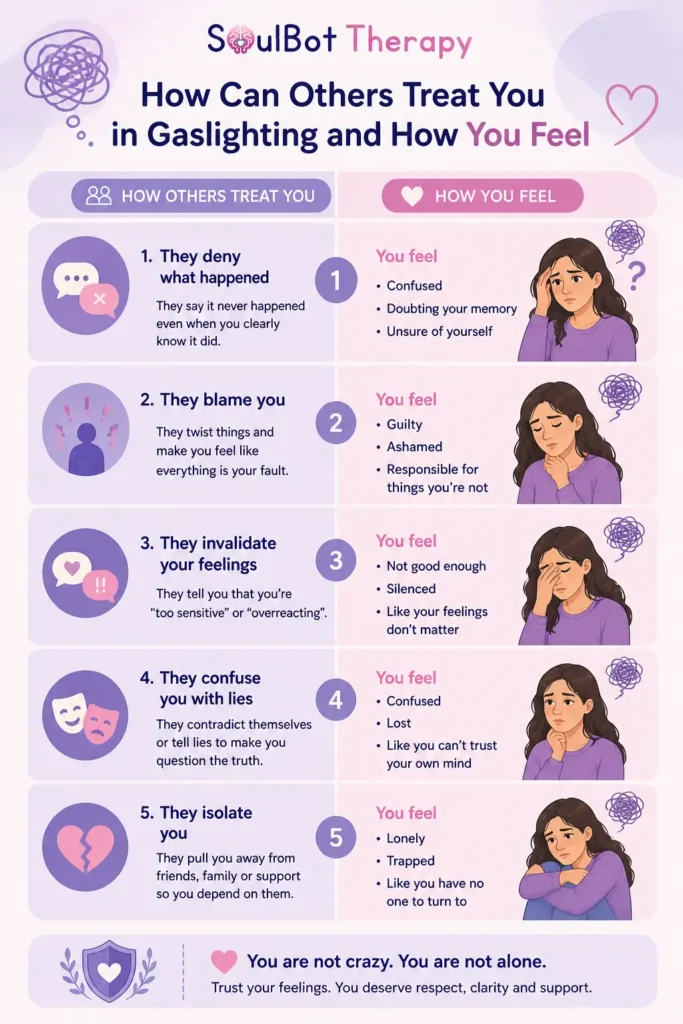
Common examples include:

Denying something happened

“I never said that.”
“You’re making that up.”

Dismissing your feelings

“You’re too sensitive.”
“You’re overreacting again.”

Questioning your memory

“You never remember anything correctly.”
“That’s not how it happened.”

Shifting responsibility

“I only reacted like that because of you.”
“Look what you made me do.”

Using other people against you

“Everyone agrees you’re the problem.”
“Even your friends think you’re overreacting.”

These phrases are not proof of gaslighting by themselves. Look at frequency, context, intent, and the overall pattern.

Read more about what narcissistic gaslighting is.

Gaslighting vs a Normal Disagreement

A normal disagreement allows two people to remember or interpret the same event differently.

Gaslighting is different because one person’s perception is repeatedly undermined.

Normal conflictPossible gaslighting pattern
“I remember it differently.”“That never happened. You’re imagining it.”
Both people can explain their perspectiveOnly one person’s version is treated as valid
Either person can acknowledge mistakesResponsibility is repeatedly redirected
Conflict can eventually bring clarityYou repeatedly leave doubting yourself
Feelings can be discussedFeelings are routinely dismissed or mocked

A useful rule: different memories are normal; repeatedly making you distrust your own mind is not.
gaslighting

How Can Gaslighting Affect You?

Repeated psychological manipulation may contribute to:

  • self-doubt
  • lower confidence
  • anxiety
  • difficulty making decisions
  • dependence on the other person’s interpretation
  • social withdrawal
  • feeling disconnected from your previous sense of self

Psychological abuse more broadly can include humiliation, intimidation, isolation, rejection and excessive control, according to the APA.

If you’re questioning whether emotional openness is healthy in your relationship, you can also take SoulBot’s Emotional Availability Test. It is designed for self-reflection rather than diagnosis.

How Do You Respond to Gaslighting?

You do not have to prove every detail of your experience during an argument.

Try these steps:

1. Record important incidents.
Write down what happened while the memory is fresh.

2. Keep contact with people you trust.
An outside perspective can help when you have begun questioning your own judgment.

3. Avoid endless debates about your reality.
You can say, “I remember this differently, and I’m not going to argue about whether my feelings are valid.”

4. Set boundaries.
It is reasonable to pause conversations that become circular, insulting, or manipulative.

5. Pay attention to patterns.
One argument tells you less than what happens repeatedly over weeks or months.

For more practical responses, read How to Respond to Gaslighting: What Actually Works rather than trying to cover the entire topic again on this page.

If you feel unsafe, controlled, isolated, or afraid of your partner, seek support from a trusted person or an appropriate professional service. The National Domestic Violence Hotline also describes gaslighting as a form of emotional abuse within abusive relationships.

Can You Recover From Gaslighting?

Yes. Recovery often involves rebuilding the ability to trust your own thoughts and decisions.

Helpful steps may include:

  • keeping a journal of your experiences
  • reconnecting with supportive people
  • making small independent decisions
  • identifying manipulation patterns
  • setting stronger boundaries
  • working with a therapist when the experience is significantly affecting your wellbeing

Recovery is less about proving that you were right in every past disagreement and more about regaining confidence in your ability to evaluate your own experiences.

Need a Private Space to Think It Through?

When repeated conversations leave you confused, writing down what happened can make patterns easier to see.

Talk to Soululu about what happened, how it made you feel, and what you want to understand next. You can also use the SoulBot Journal to privately track recurring relationship patterns over time.


FAQ

Frequently Asked Questions

A simple example is repeatedly denying something you said or did and insisting the other person imagined it, especially when this causes them to question their own memory.
Common phrases include “That never happened,” “You’re too sensitive,” “You’re imagining things,” and “You always remember things wrong.” A phrase alone is not proof of gaslighting; look for a repeated pattern.
You may notice persistent self-doubt, confusion after conversations, frequent unnecessary apologies, or feeling unable to trust your own memory around a particular person.
No. Someone can lie without trying to alter another person’s sense of reality. Gaslighting involves a broader pattern of manipulation that undermines someone’s confidence in their perceptions or memories.
People can deny, become defensive, or remember events differently without deliberately manipulating someone. This is why it is more useful to look at repeated behaviour and its impact than to label a person based on one conversation.

About the Author:

Picture of Sonali

Sonali

Sonali Shastri is the Co-founder and Creative Lead at SoulBot Therapy, where she transforms mental health education into content that truly resonates. With a background in psychology-based writing and storytelling, Sonali specializes in creating emotionally intelligent content that bridges empathy and impact. Her work focuses on mental wellness, self-discovery, and breaking stigma through honest, relatable narratives.

More Blog Posts

You May Look Fine, But It Feels Heavy Inside

Ready to explore your full SoulMap?

🟢The Grounded Socializer

Social Moments Feel Mostly Manageable

Ready to explore your full SoulMap?

🟡The Quiet Overthinker

You Show Up, But Your Mind Replays It

Ready to explore your full SoulMap?

🟠The Cautious Connector

Connection Matters, But It Can Feel Hard

Ready to explore your full SoulMap?

Your emotional compass wants love, but stays cautious.

Ready to explore your full SoulMap?

Avoidant Attachment
Independent, With Boundaries

Your emotional compass values space and self-reliance.

Ready to explore your full SoulMap?

Anxious Attachment
Deep, But Seeking Reassurance

Your emotional world is intense and connection-driven.

Ready to explore your full SoulMap?

Secure Attachment – Calm & Connected

Your emotional compass feels steady and safe.


Ready to explore your full SoulMap?

The Storm Mind (Severe Anxiety)

Intense, overwhelming, and hard to control at times.

Ready to explore your full SoulMap?

The Overthinker (Moderate Anxiety)

Your mind is active, often running ahead of you.

Ready to explore your full SoulMap?

The Gentle Worrier (Mild Anxiety)

Occasional overthinking, but still in control.
You feel stress at times, but it doesn’t take over your day.

Ready to explore your full SoulMap?

Moderately Emotionally Available- Opening, With Caution

Your emotional compass shows growth, with a few guarded zones.

Ready to explore your full SoulMap?

Your emotional compass points toward openness and connection.

Ready to explore your full SoulMap?

Your emotional compass leans toward self-protection right now.

Ready to explore your full SoulMap?

Submissive Personality

Gentle and supportive. You bring calm energy and emotional depth to every space.

Ready to explore your full SoulMap?

Balanced Personality

Grounded and fair-minded. You value harmony, empathy, and shared understanding.

Ready to explore your full SoulMap?

Dominant Personality

Driven and decisive. You lead naturally, think fast, and act with purpose.

Ready to explore your full SoulMap?

Homosexual —
True North, Same-Gender

Your love compass points to people of the same gender.

Ready to explore your full SoulMap?

Restless and always in motion. May talk fast, act quickly, or jump between ideas. 

Ready to explore your full SoulMap?

High Likelihood
ADHD Combined Type (ADHD-C)

Shows both inattentive and hyperactive traits where focus shifts, energy spikes, and motivation come in waves.

Ready to explore your full SoulMap?

Low Likelihood
ADHD Inattentive Type (ADHD-I)

Often loses focus and misses details, with drifting thoughts that leave tasks unfinished.

Ready to explore your full SoulMap?

🔧 The Virtuoso - ISTP

Hands-On Expert

Ready to explore your full SoulMap?

📋 The Logistician - ISTJ

Steady Rock

Ready to explore your full SoulMap?

🌻 The Adventurer - ISFP

Gentle Spirit

Ready to explore your full SoulMap?

🛡️ The Defender - ISFJ

Caring Guardian

Ready to explore your full SoulMap?

🤔 The Logician - INTP

Curious Explorer

Ready to explore your full SoulMap?

🏛️ The Architect - INTJ

Strategic Mastermind

Ready to explore your full SoulMap?

🦄 The Mediator - INFP

Gentle Idealist

Ready to explore your full SoulMap?

🔮 The Advocate - INFJ

Quiet Visionary

Ready to explore your full SoulMap?

🚀 The Entrepreneur - ESTP

Action Hero

Ready to explore your full SoulMap?

📊 The Executive - ESTJ

Results Driven

Ready to explore your full SoulMap?

🎭 The Entertainer - ESFP

Life of the Party

Ready to explore your full SoulMap?

🤗 The Consul - ESFJ

Heart of Gold

Ready to explore your full SoulMap?

🧠 The Debater - ENTP

Mental Gymnast

Ready to explore your full SoulMap?

👑 The Commander - ENTJ

Strategic Powerhouse

Ready to explore your full SoulMap?

🎨 The Campaigner - ENFP

Creative Visionary

Ready to explore your full SoulMap?

🌟 The Protagonist - ENFJ

Natural Born Leader

Ready to explore your full SoulMap?

🤗 Physical Touch

Hugs Over Hype

Ready to explore your full SoulMap?

🕰 Quality Time

Presence Over Presents

Ready to explore your full SoulMap?

🎁 Receiving Gifts

Thoughtful Tokens, Big Feelings

Ready to explore your full SoulMap?

🤝 Acts of Service

Love in Action

Ready to explore your full SoulMap?

Words of Affirmation

You Speak from the Heart

Ready to explore your full SoulMap?

Gay, Lesbian, or
Queer and Proud

Your love compass points to the same gender

Ready to explore your full SoulMap?

Bisexual -
Go with the Flowy

Your love compass swings in the middle

Ready to explore your full SoulMap?

Heteroflexible —
Some Wiggle in the Compass

You’ve got a touch of bi-curiosity

Ready to explore your full SoulMap?

Hetero -
Straight Up Honest

Your love compass points to the opposite sex.

Ready to explore your full SoulMap?