

Narcissist gaslighting describes gaslighting used by someone showing strong narcissistic traits to deny responsibility, protect their self-image, or maintain control in an interaction. It can leave you repeatedly questioning what happened, whether your feelings are reasonable, or whether you are somehow always at fault.
Importantly, gaslighting does not prove someone has narcissistic personality disorder (NPD). People can use manipulative behaviours without having a clinical diagnosis.
🕊️You can also take SoulBot's Emotional Availability Test to reflect on how you connect, communicate, and respond emotionally in relationships.
What Does Narcissist Gaslighting Look Like?
Gaslighting involves repeatedly undermining another person’s perception, memory, or interpretation of events.
When it appears alongside narcissistic behaviour, you may notice a pattern of:
- Denying things that were said or done
- Changing the story when confronted
- Shifting responsibility onto you
- Dismissing your emotional reactions
- Presenting themselves as the victim
- Making you question whether your memory is trustworthy
If you want the broader definition and everyday examples, read Gaslighting: Signs, Examples and How to Respond.
5 Narcissist Gaslighting Examples
1. “That never happened.”
You clearly remember an argument or comment, but they insist it never occurred.
The concern isn’t one forgotten conversation. It’s a repeated pattern of treating your memory as inherently unreliable.
2. “You’re too sensitive.”
Instead of discussing what hurt you, attention shifts to your reaction.
Eventually, you may start wondering whether you have the right to be upset at all.
3. “You misunderstood me.”
Clarifying a misunderstanding is normal.
It becomes concerning when the meaning of previous conversations changes repeatedly whenever accountability is required.
4. “You’re the one causing all these problems.”
You raise a concern about their behaviour, but within minutes you’re defending yourself.
This is a common form of blame-shifting.
5. “Everyone thinks you’re overreacting.”
Friends, family members, or unnamed “other people” may be brought into the argument to make you doubt your own judgment.
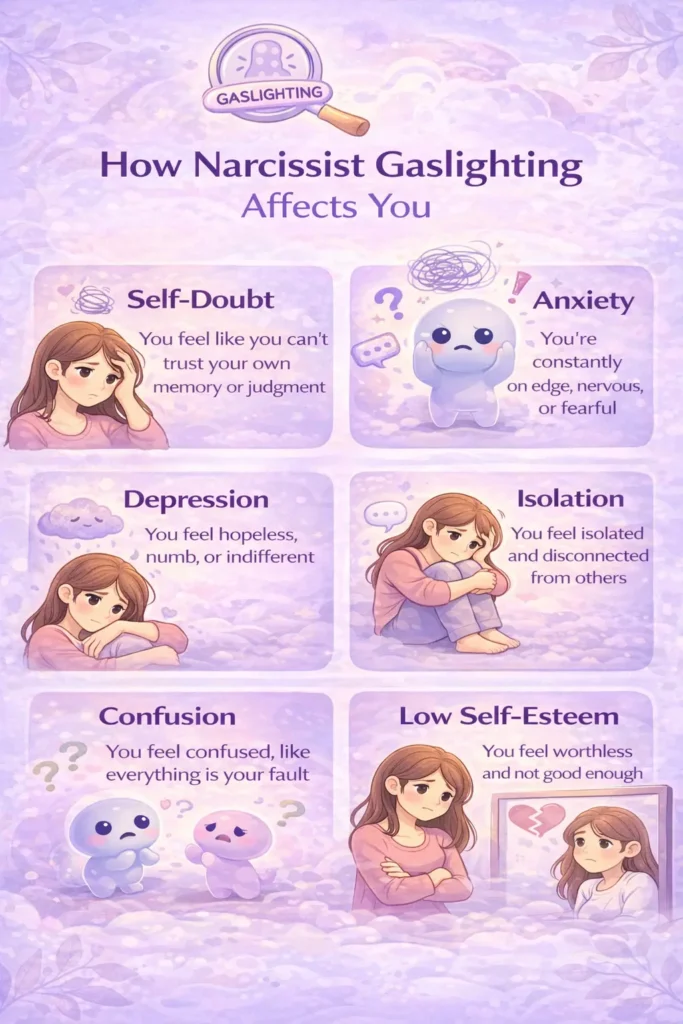
Signs Narcissistic Gaslighting May Be Affecting You
You might notice that you:
- Replay conversations repeatedly
- Apologise even when you’re unsure what you did wrong
- Struggle to trust your memory
- Feel confused after disagreements
- Avoid raising concerns because you know how they’ll end
- Depend increasingly on the other person’s explanation of what happened
- Feel less confident than you did before the relationship
These experiences overlap with broader patterns of narcissistic abuse.
If you’re trying to understand the clinical condition itself, read Narcissistic Personality Disorder: Symptoms & Real-Life Signs. Avoid diagnosing a partner based only on relationship behaviour.
Narcissist Gaslighting vs Normal Disagreement
The difference usually comes down to pattern and accountability.
| Normal disagreement | Possible gaslighting pattern |
|---|---|
| “I remember it differently.” | “That never happened. You’re making it up.” |
| Either person may be wrong | You are consistently portrayed as unreliable |
| Mistakes can be acknowledged | Responsibility repeatedly shifts back to you |
| Conflict can create clarity | Conflict leaves you increasingly confused |
Two people remembering something differently isn’t automatically gaslighting.
The concern is repeatedly being pushed to distrust your own experience.
How Do You Respond to Narcissist Gaslighting?
You may not be able to convince someone to agree with your version of events. Instead, focus on protecting your own clarity.
1. Stop arguing endlessly about what you experienced.
You can say: “We remember this differently. I’m not going to keep debating my experience.”
2. Record important incidents.
Writing down what happened soon afterwards can help you identify patterns.
3. Keep trusted people in your life.
Outside perspectives can be useful when you’re constantly questioning yourself.
4. Set boundaries around circular conversations.
It’s okay to end a discussion that has become insulting, confusing, or unproductive.
5. Seek professional support when needed.
If the relationship is significantly affecting your confidence, anxiety, or sense of safety, a qualified mental health professional can help you evaluate the situation more clearly.
For more specific scripts and strategies, internally link this section to How to Respond to Gaslighting: What Actually Works.
What Should You Avoid?
Try not to:
- spend hours proving every detail
- automatically accept blame to end an argument
- isolate yourself from supportive people
- assume every disagreement means you’re wrong
- focus more on diagnosing the other person than understanding the behaviour
The useful question isn’t only “Are they a narcissist?”
It’s:
“What keeps happening in this relationship, and what effect is it having on me?”
The National Domestic Violence Hotline’s guide to gaslighting
Feeling Confused After Repeated Conversations?
You don’t need to label someone before exploring how the relationship is affecting you.
Talk to Soululu to put the situation into words, reflect on what happened, and notice recurring patterns without judgment.