
Quick Answer: How Do You Know a Relationship Is Toxic?
A relationship may be unhealthy when you repeatedly feel controlled, criticised, manipulated, ignored, afraid or emotionally exhausted.
Common toxic relationship signs include:
- controlling your clothes, money or friendships
- humiliating or constantly criticising you
- denying things that happened
- ignoring your boundaries
- using jealousy as an excuse for control
- making you feel responsible for every problem
- isolating you from people you trust
- threatening, frightening or monitoring you
One argument does not make a relationship toxic. Look for a repeated pattern and how it affects your safety, confidence and freedom.
What Is a Toxic Relationship?
“Toxic relationship” is an informal term, not a clinical diagnosis.
It usually describes a relationship in which repeated behaviours damage one or both partners’ emotional well-being. The relationship may feel unequal, unpredictable or emotionally unsafe.
Abuse is more serious than general relationship unhappiness. The CDC describes psychological aggression as communication used to emotionally harm or control a partner. The NHS also explains that domestic abuse commonly involves power and control.
Common Toxic Relationship Signs
| Red flag | What it may look like |
|---|---|
| Constant criticism | Mocking your appearance, choices or intelligence |
| Controlling behaviour | Deciding what you wear, where you go or who you meet |
| Gaslighting | Denying events or making you question your memory |
| Isolation | Creating problems whenever you see friends or family |
| Jealousy and monitoring | Checking your phone, location or messages |
| Boundary violations | Ignoring your privacy, consent or need for space |
| Blame-shifting | Making every argument or mistake your fault |
| Emotional withdrawal | Using silence or affection as punishment |
A partner does not need to show every sign for the behaviour to be concerning.
Normal Conflict vs Toxic Behaviour
Healthy couples disagree. The difference is how conflict is handled.
| Normal conflict | Toxic pattern |
|---|---|
| Both people can speak | One person dominates or silences the other |
| The issue is discussed | Insults, threats or humiliation replace discussion |
| Both accept responsibility | One person is blamed for everything |
| Boundaries are respected | Boundaries are mocked or ignored |
| Conflict eventually settles | You remain anxious or afraid afterwards |
| You can disagree safely | You walk on eggshells to avoid a reaction |
Ask yourself:
Do I usually feel safe, respected and free to be myself? If the answer is consistently no, the issue may be more than an ordinary conflict.
Related: How to Set Healthy Relationship Boundaries
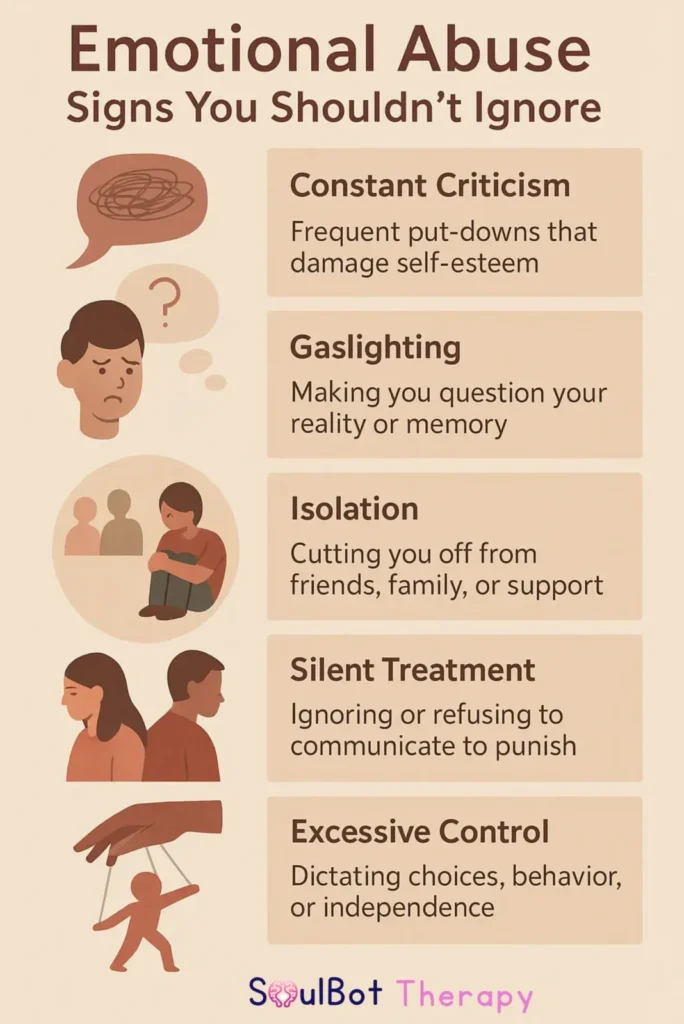
What Are the Signs of Emotional Abuse?
Emotional abuse may not leave visible injuries, but it can still be serious.
Warning signs include:
- Repeated humiliation or name-calling
- Threats to leave, harm you or expose private information
- Controlling money or access to basic needs
- Blaming you for their behaviour
- Making you doubt your memory
- Punishing you with silence or withdrawal
- Pressuring you into sexual activity
- Making you afraid to disagree
The National Domestic Violence Hotline explains that abuse often develops through behaviours designed to gain or maintain power and control.
How Can a Toxic Relationship Affect Mental Health?
Repeated control, criticism or fear can affect how you think and feel.
You may experience:
- anxiety or constant alertness
- low confidence
- sadness or hopelessness
- guilt and self-doubt
- difficulty trusting people
- sleep problems
- feeling disconnected from yourself
- trauma-related symptoms
CDC survey findings associate intimate-partner violence with anxiety, depression and post-traumatic stress symptoms. This does not mean every difficult relationship causes a mental health condition, but ongoing abuse can have serious effects.
What Should You Do If You Notice Toxic Patterns?
1. Name the Behaviour Clearly
Instead of saying, “Something feels wrong,” identify what is happening:
- “My partner checks my phone.”
- “I am insulted during every disagreement.”
- “I am afraid to say no.”
Specific patterns are easier to evaluate than the word “toxic.”
2. Speak to Someone You Trust
Tell a trusted friend, family member, therapist or support organisation what has been happening.
Isolation can make unhealthy behaviour feel normal. An outside perspective can help you see the pattern more clearly.
3. Set Boundaries, Only When It Feels Safe
A boundary might sound like:
“I will end the conversation if I am insulted.”
But boundaries are not guaranteed to change controlling or abusive behaviour.
If you fear retaliation, threats or violence, prioritise safety instead of confronting your partner alone.
4. Keep Important Information Accessible
When safe, keep access to:
- identification documents
- money
- medication
- emergency contacts
- transport
- a trusted place to stay
Avoid storing plans somewhere your partner can access if they monitor your phone or accounts.
5. Seek Specialist Support
A therapist can help you understand the emotional impact and rebuild confidence. A domestic-abuse service can also help with safety planning.
In India, call 112 if you are in immediate danger. Women can contact the Women Helpline at 181 or the NCW 24-hour helpline at 14490.
Can a Toxic Relationship Become Healthy?
Some unhealthy patterns can improve when both partners:
- acknowledge the problem
- take responsibility
- respect boundaries
- communicate differently
- follow through consistently
- seek professional support when needed
Promises alone are not change.
Look for repeated actions over time. If one partner continues controlling, threatening or humiliating the other, the relationship is not becoming safer.
Related: Relationship Growth Checklist: Are You Growing Together or Apart?
Talk It Through With Soululu
When you are emotionally involved, it can be difficult to separate one bad moment from a repeated pattern.
Talk to Soululu to organise your thoughts, reflect on boundaries and prepare for a conversation with someone you trust.
Soululu is not an emergency or domestic-abuse service and cannot replace professional support.
Final Thought
Recognising toxic relationship signs is not about quickly labelling someone.
It is about noticing whether a repeated pattern is reducing your safety, confidence, freedom or sense of self.
You deserve a relationship where disagreement does not require fear, and love does not require losing yourself.