

Gaslighting is a pattern of manipulation that can make you question your own memory, perceptions, or understanding of what happened.
It may sound like “That never happened,” “You’re imagining things,” or “You’re too sensitive” when these responses are repeatedly used to undermine your version of events. The American Psychological Association defines gaslighting as manipulating someone into doubting their perceptions, experiences, or understanding of events.
One disagreement, forgotten conversation, or insensitive comment does not automatically mean someone is gaslighting you. The pattern matters.
What Is Gaslighting?
Gaslighting happens when someone repeatedly distorts, denies, or dismisses another person’s experience in a way that makes them increasingly doubt themselves.
It can happen in romantic relationships, families, friendships, workplaces, and other power dynamics.
The term comes from the 1938 play Gas Light and its later film adaptations, where a husband deliberately manipulates his wife into doubting what she sees and remembers.
Merriam-Webster named gaslighting its 2022 Word of the Year after searches for the term increased dramatically.
What Are the Signs of Gaslighting?
You may be experiencing a gaslighting pattern if you regularly:
- second-guess things you clearly remember
- leave conversations more confused than when they began
- apologise even when you are unsure what you did wrong
- feel as though your reactions are always presented as the problem
- make excuses for the other person’s behaviour
- become anxious before raising concerns
- hide relationship problems from people you trust
- notice that you have become less confident over time
Gaslighting can be especially difficult to recognise because undermining someone’s ability to trust their own perceptions can increase the other person’s power within the relationship.
If several of these patterns feel familiar, our guide to toxic relationship red flags can help you look at the relationship more broadly.
Gaslighting Examples: What Does It Sound Like?
Common examples include:
Denying something happened
“I never said that.”
“You’re making that up.”
Dismissing your feelings
“You’re too sensitive.”
“You’re overreacting again.”
Questioning your memory
“You never remember anything correctly.”
“That’s not how it happened.”
Shifting responsibility
“I only reacted like that because of you.”
“Look what you made me do.”
Using other people against you
“Everyone agrees you’re the problem.”
“Even your friends think you’re overreacting.”
These phrases are not proof of gaslighting by themselves. Look at frequency, context, intent, and the overall pattern.
Read more about what narcissistic gaslighting is.
Gaslighting vs a Normal Disagreement
A normal disagreement allows two people to remember or interpret the same event differently.
Gaslighting is different because one person’s perception is repeatedly undermined.
| Normal conflict | Possible gaslighting pattern |
|---|---|
| “I remember it differently.” | “That never happened. You’re imagining it.” |
| Both people can explain their perspective | Only one person’s version is treated as valid |
| Either person can acknowledge mistakes | Responsibility is repeatedly redirected |
| Conflict can eventually bring clarity | You repeatedly leave doubting yourself |
| Feelings can be discussed | Feelings are routinely dismissed or mocked |
A useful rule: different memories are normal; repeatedly making you distrust your own mind is not.
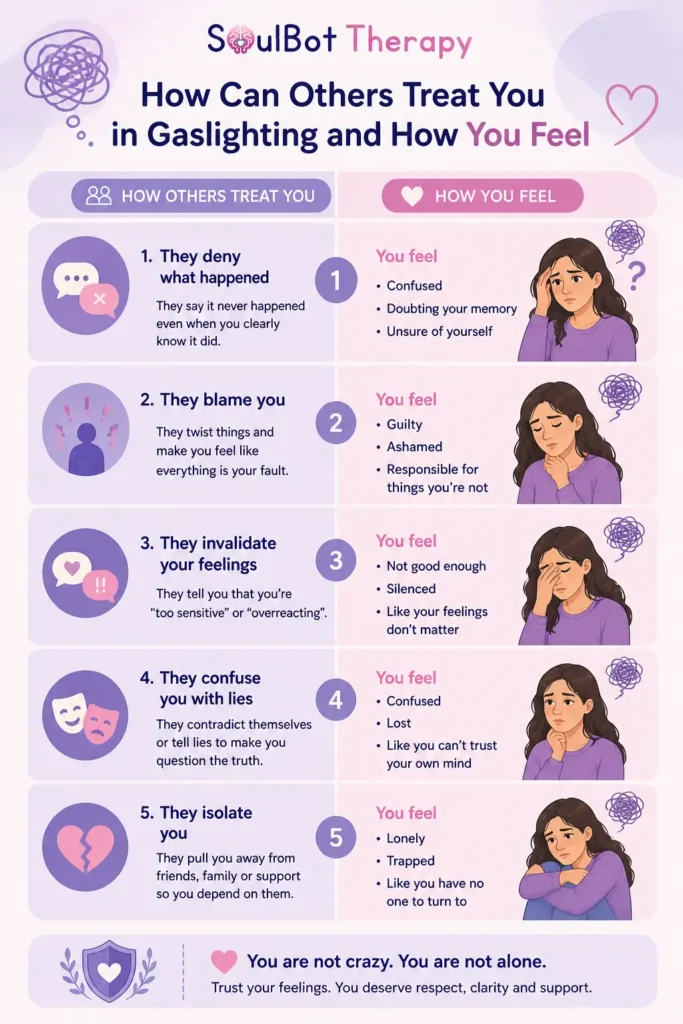
How Can Gaslighting Affect You?
Repeated psychological manipulation may contribute to:
- self-doubt
- lower confidence
- anxiety
- difficulty making decisions
- dependence on the other person’s interpretation
- social withdrawal
- feeling disconnected from your previous sense of self
Psychological abuse more broadly can include humiliation, intimidation, isolation, rejection and excessive control, according to the APA.
If you’re questioning whether emotional openness is healthy in your relationship, you can also take SoulBot’s Emotional Availability Test. It is designed for self-reflection rather than diagnosis.
How Do You Respond to Gaslighting?
You do not have to prove every detail of your experience during an argument.
Try these steps:
1. Record important incidents.
Write down what happened while the memory is fresh.
2. Keep contact with people you trust.
An outside perspective can help when you have begun questioning your own judgment.
3. Avoid endless debates about your reality.
You can say, “I remember this differently, and I’m not going to argue about whether my feelings are valid.”
4. Set boundaries.
It is reasonable to pause conversations that become circular, insulting, or manipulative.
5. Pay attention to patterns.
One argument tells you less than what happens repeatedly over weeks or months.
For more practical responses, read How to Respond to Gaslighting: What Actually Works rather than trying to cover the entire topic again on this page.
If you feel unsafe, controlled, isolated, or afraid of your partner, seek support from a trusted person or an appropriate professional service. The National Domestic Violence Hotline also describes gaslighting as a form of emotional abuse within abusive relationships.
Can You Recover From Gaslighting?
Yes. Recovery often involves rebuilding the ability to trust your own thoughts and decisions.
Helpful steps may include:
- keeping a journal of your experiences
- reconnecting with supportive people
- making small independent decisions
- identifying manipulation patterns
- setting stronger boundaries
- working with a therapist when the experience is significantly affecting your wellbeing
Recovery is less about proving that you were right in every past disagreement and more about regaining confidence in your ability to evaluate your own experiences.
Need a Private Space to Think It Through?
When repeated conversations leave you confused, writing down what happened can make patterns easier to see.
Talk to Soululu about what happened, how it made you feel, and what you want to understand next. You can also use the SoulBot Journal to privately track recurring relationship patterns over time.