Exploring sexuality beyond the straight line. You mostly date the opposite gender. That feels right and natural.
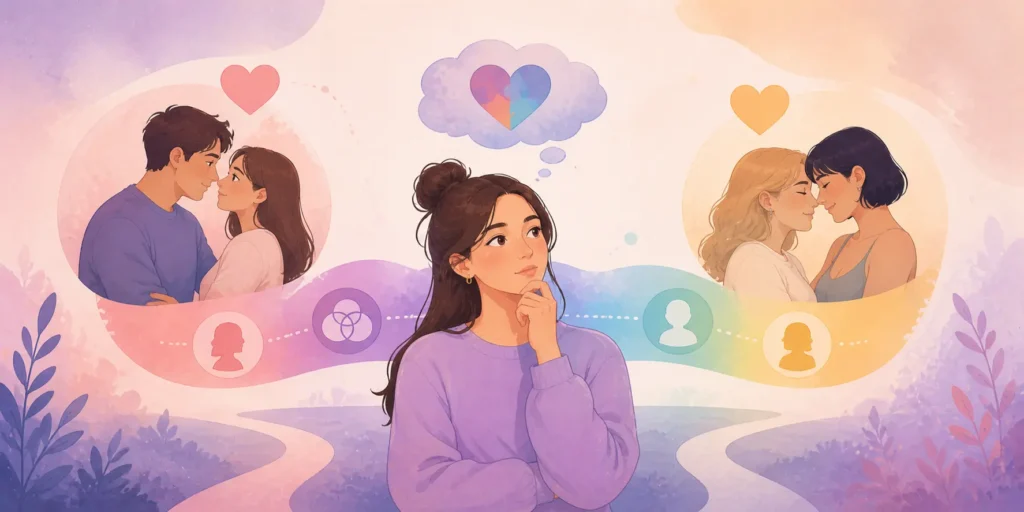
But sometimes, maybe once, maybe a few times, you’ve noticed attraction to someone of the same gender. Not enough to call yourself bisexual. But enough to make you pause and wonder: What does this mean about me?
If that sounds familiar, you might be heteroflexible. And no, that doesn’t mean you’re confused. It means your attraction exists on a spectrum, as most people’s do.
🧠 Take the Sexual Orientation Test to explore where you fall on the spectrum, no labels required.What Does Heteroflexible Mean?
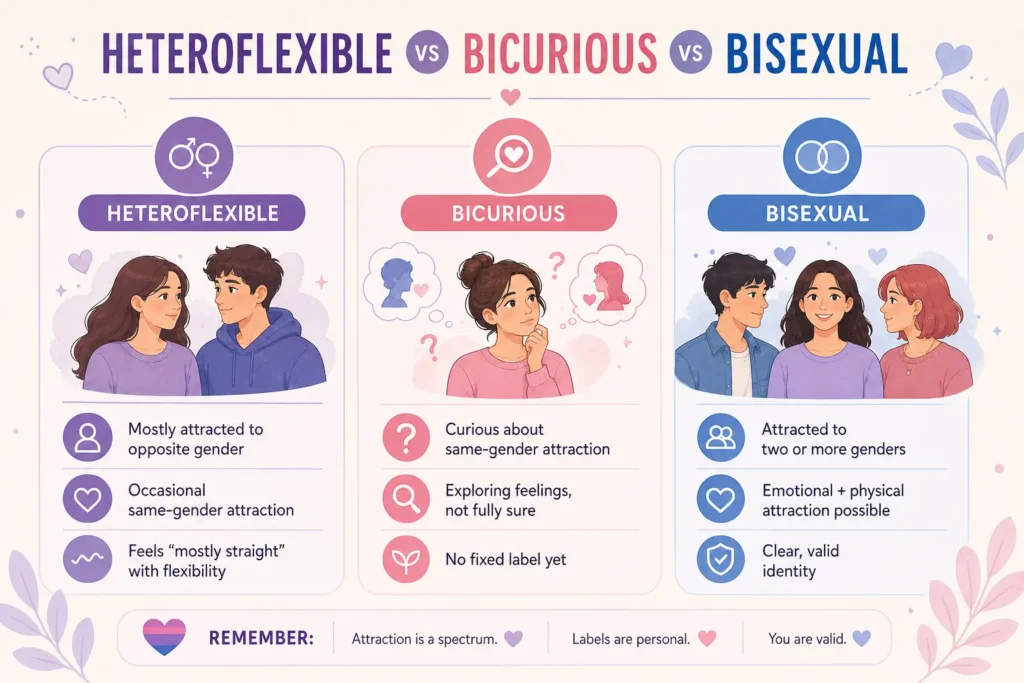
Heteroflexible, meaning, at its simplest: you identify as mostly straight, but you’re open to or have occasionally experienced attraction to people of the same gender.
The term first gained traction in the early 2000s, originally used in college spaces and online forums where people were searching for language that fit somewhere between “completely straight” and “bisexual.”
It describes an experience that has always existed. Now there’s finally a word for it.
Being heteroflexible means:
- Your primary attraction is to the opposite gender.
- You occasionally notice same-gender attraction emotionally, physically, or both.
- That attraction doesn’t feel central enough to your identity to call yourself bisexual.
- You’re not confused, you’re simply honest about the full range of your experience.
Sexuality isn’t a light switch. For many people, it’s a dimmer and heteroflexible describes one of the many settings in between.
Am I Heteroflexible? Signs to Reflect On
Only you can decide what label, if any, fits. These reflections might help: You mostly date or seek romance with the opposite gender.
- You’ve felt attracted to someone of the same gender once or a few times in your life.
- The word “bisexual” doesn’t quite feel like the right fit, but “completely straight” doesn’t either.
- You’re comfortable with your mostly-straight identity, but you don’t want to ignore occasional same-gender feelings.
- You don’t actively seek same-gender experiences, but you’re open to them.
- The idea of a label that says “mostly straight, with some wiggle” actually feels like a relief.
🧠 SoulTip: You don't need to have acted on same-gender attraction to identify as heteroflexible. Sexual orientation is about how you feel, not what you've done. Give yourself permission to name your experience honestly.
Heteroflexible vs Bisexual: What’s the Difference?
This is the most common question, and the honest answer is: the line is blurry, and that’s okay.
| Primary attraction | Mostly opposite gender | Mostly the opposite gender |
| Same-gender attraction | Occasional or rare | More regular or central to identity |
| Identity feel | Mostly straight | Attracted to multiple genders |
| Label preference | Prefers “mostly straight” framing | Comfortable with “bi” identity |
| Can they overlap? | Yes, some people identify as both | Yes |
The key difference isn’t who you’re attracted to, it’s how central that attraction feels to your identity and how you prefer to name your experience.
Some people start identifying as heteroflexible and later shift to bisexual or vice versa. Sexuality isn’t static, and your label can evolve as you do.
Heteroflexible vs Bicurious: Are They the Same?
Not quite.
- Bicurious means you’re questioning or wondering; the attraction is still an open question.
- Heteroflexible is more settled: you recognize the pattern and are comfortable naming it, even if it’s occasional.
Think of bicurious as asking the question. Heteroflexible might be part of the answer.
📖 Want to explore sexuality and identity more deeply? Lisa Diamond's Sexual Fluidity: Understanding Women's Love and Desire is one of the most research-backed books on how attraction shifts across a lifetime.
Is Heteroflexible Part of the LGBTQ+ Community?
Yes, because heteroflexible people experience same-gender attraction, they fall within the LGBTQ+ spectrum.
That said, some heteroflexible people don’t personally identify with the LGBTQ+ label, especially if their same-gender attraction feels minimal or situational. And that’s a personal choice too.
What matters is that you feel supported, seen, and not pressured into any box.
🧠 SoulTip: You don't have to "prove" your sexuality to anyone, not to the LGBTQ+ community, not to straight spaces, not to yourself. If heteroflexible resonates, that's enough.
How Common Is Heteroflexibility?
More common than most people realize.
Research suggests that around 15% of people identify as heteroflexible, more than the number identifying as gay, lesbian, and bisexual combined. And on Feeld, a dating platform, heteroflexible was the fastest-growing sexuality in 2025, with a 193% increase in people choosing the label.
People have always felt this way. The language is just catching up.
What Does Heteroflexible Feel Like Emotionally?
For many people, discovering the word “heteroflexible” brings an emotional sense of relief and validation, reassuring them that their feelings are normal and real.
It’s the relief of not having to choose between two labels that don’t quite fit. It’s permission to say: “I’m mostly straight, and sometimes I’m not, and both things can be true at the same time.”
It’s also okay if the word brings up questions. Questions about your past. About relationships. About how others might see you.
💬 SoulBot's AI companion Soululu is here whenever you want to talk through those feelings without judgment, without labels, at your own pace. Start a conversation with Soululu.
Exploring Your Sexuality Further
If this topic resonates, you might also find these helpful: