
What Are Fluid Relationship Models? (Quick Answer)
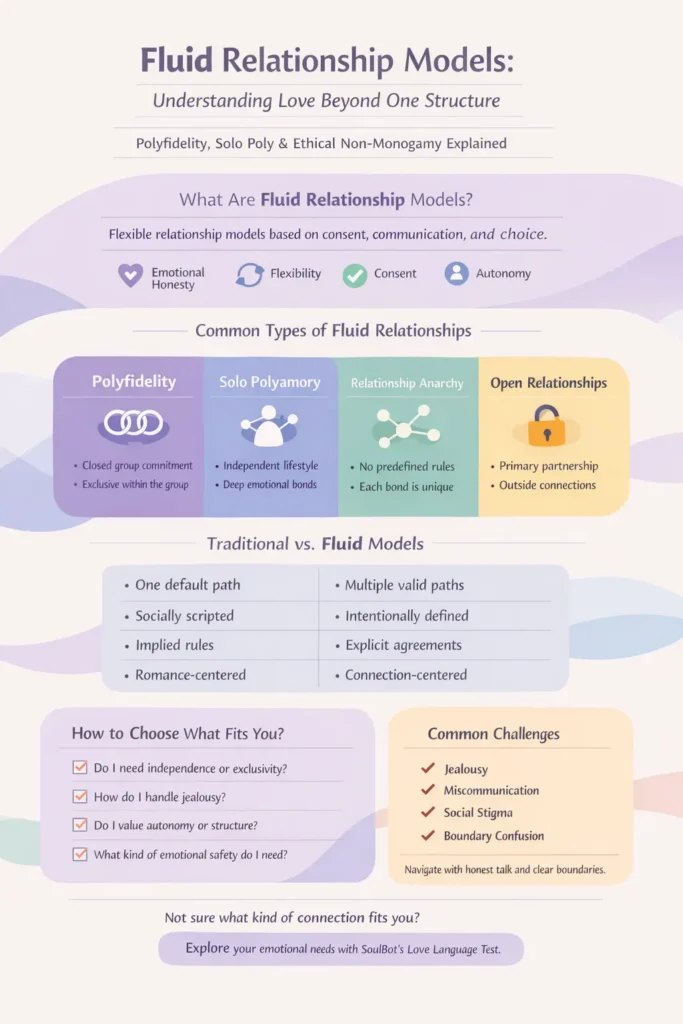
Fluid relationship models are relationship structures that exist outside traditional monogamy defined by the people in them rather than societal defaults.
Common types include:
- Polyfidelity: a closed group of partners exclusive to each other
- Solo polyamory: deep connections without merging lives or finances
- Open relationships: committed partnerships with outside connections
- Relationship anarchy: no predefined hierarchy or rules
- Quads: four-person romantic arrangements
Key principle: ethical non-monogamy requires explicit consent, honest communication, and clear boundaries from all involved.
Fluid relationship models are not about following a one-size-fits-all rulebook. They’re about flexibility, choice, and creating relationships that work for you. Whether that means one partner, multiple partners, or something in between.
🧠 Not sure how you connect emotionally in relationships? Take the free Love Language Test to understand how you give and receive closeness.Why Fluid Relationship Models Matter?
Fluid relationship models allow people to define connection, intimacy, and commitment outside of rigid norms. Instead of forcing yourself into a structure that doesn’t fit, you create one that aligns with your values, lifestyle, and boundaries.
They matter because relationships are deeply personal. Not everyone thrives in monogamy, and not everyone wants complete independence. By exploring the types of ethical non-monogamy, you can discover setups that prioritise relationship autonomy and emotional honesty.
What Is Polyfidelity and How Is It Different From Polyamory?
Polyfidelity is like a closed circle of partners. Everyone in the group is romantically or sexually exclusive with one another, but not with people outside that circle.
While polyamory often allows partners to see others independently, polyfidelity focuses on shared commitment within the group. All partners explicitly agree to the structure and boundaries, which is what makes it ethical.
Who Chooses Solo Polyamory and Why?
Solo polyamory, or solo poly, is about independence. You may have deep, meaningful connections, but you live separately, make your own life decisions, and don’t prioritise merging finances, living spaces, or life plans.
People often choose solo poly for emotional autonomy, valuing freedom without sacrificing intimacy. It works well for those who enjoy deep bonds but want their identity and lifestyle to remain fully their own.
Solo polyamory is not about avoiding commitment; it’s about choosing autonomy while still valuing connection.
🧠SoulFact: According to a 2021 study published in the Frontiers in Psychology, about 4–5% of people in the U.S. are currently in some form of consensual non-monogamous relationship.
What Other Ethical Non-Monogamy Types Should You Know?
Fluid relationship models can also include:
- Relationship anarchy – no predefined rules; connections are shaped organically
- Open relationships – committed partnerships with outside sexual relationships
- Quads – four-person romantic arrangements
- Parallel polyamory – separate relationships that don’t necessarily interact
How Do You Decide Which Fluid Relationship Model Fits You?
Choosing the right model starts with asking yourself:
- How much independence do I need to feel fulfilled?
- Do I value exclusivity or openness more?
- How do I handle jealousy, boundaries, and shared time?
If you prioritise relationship autonomy but still want a firm commitment, polyfidelity might work. If emotional independence matters most, solo poly could be a better fit.
What Challenges Come With These Models and How to Navigate Them?
Every setup comes with its challenges:
- Jealousy – Address it openly and without shame
- Social misunderstanding – Be ready to educate or set boundaries
- Coordination – More people mean more communication
Practising emotional transparency and defining boundaries early helps avoid misunderstandings.
💡SoulFact: Research from the Journal of Sex Research shows that individuals who feel more control over their relationship structure, whether monogamous or non-monogamous, report higher satisfaction and lower psychological distress.
How Soululu Supports You in Exploring Relationship Fluidity?
Exploring non-traditional relationship models raises questions that are genuinely hard to answer alone and often hard to talk about with people in your life who may not understand or who have strong opinions.
Soululu, SoulBot’s AI companion, offers something most resources cannot: a private, non-judgmental space to think out loud about what you actually want.
When you are figuring out what you want, Soululu can help you explore questions like: How much independence do I actually need? What does jealousy feel like for me? What am I afraid of losing if I try something different?
When emotions get complicated: Non-monogamy surfaces feelings quickly, such as jealousy, insecurity, excitement, and guilt. Soululu offers real-time emotional check-ins so you can process what is coming up before it spills over into your relationships.
Every relationship structure still involves who leads, who follows, and how that flexes over time. Understanding your own dominant or submissive leaning through the Dominant or Submissive Personality Quiz can make these dynamics clearer.When you need to have a hard conversation: Defining boundaries, telling a partner you want to explore, or navigating a conflict in a multi-partner dynamic all require careful communication. Soululu can help you think through what you want to say and how.
When you feel isolated, exploring non-traditional relationship models can feel lonely when the people around you do not relate. Soululu is always available, always non-judgmental, and never going to tell you what you should want.
Unlike a static article or a forum thread, Soululu responds to your specific situation, not a generic version of someone exploring non-monogamy.
💬 Check in with Soululu whenever emotions feel unclear, complicated, or hard to put into words.
Final Thought
Fluid relationship models are about conscious choice. Whether you lean toward polyfidelity, solo poly, or another form of ethical non-monogamy, what matters most is that your relationship supports your emotional health and personal growth.
💬 Need help defining your boundaries? SoulBot’s AI-guided journaling can help you get clarity.