

Nobody tells you that the way you learned to love as a child will follow you into every adult relationship.
But it does.
If you grew up with caregiving that felt inconsistent, distant, or unpredictable, you may have developed an insecure attachment style, anxious, avoidant, or somewhere in between. And now, as an adult, those old patterns show up in your relationships in ways that are painful and hard to explain.
Here is what most people do not know: your attachment style is not fixed. It is not destiny.
Security can be learned. Attachment styles can change in adulthood, and this is not an exception or a loophole in attachment theory. It is a central finding of modern attachment research.
This blog is about how to become securely attached step by step, in real life, starting from wherever you are.
💬 Start a conversation with Soululu whenever you need it.
How to Become Securely Attached: Quick Answer
- Understand your current attachment pattern and where it came from
- Build self-awareness around your triggers and reactions.
- Learn to regulate your emotions before acting on them.
- Practise expressing needs directly and clearly.
- Seek out safe, consistent relationships, romantic and otherwise.
- Work with a therapist if patterns feel deeply ingrained.
- Give yourself time. Earned secure attachment is a process, not an event.
🧠 Not sure what your attachment style is? Take the free attachment style test and read our guide on Attachment Styles in Relationships first.
What Does It Mean to Be Securely Attached?
A secure attachment style is the foundation of healthy relationships. It often starts in childhood when caregivers consistently provide safety, support, and affirmation. This early security makes it easier to trust others, regulate emotions, and form strong connections later in life.
But here is the important part: if you did not grow up with this kind of stability, you are not alone, and it is never too late to develop secure attachment.
When you are securely attached, you can:
- Feel close to people without fear of losing yourself.
- Trust that a relationship is stable without needing constant proof.
- Express your needs directly without apologising for having them.
- Handle conflict without it feeling like the end of everything.
- Be alone without it feeling like abandonment.
- Give your partner space without spiralling into anxiety.
Secure attachment supports your journey toward becoming your authentic self. It helps you form close connections without becoming trapped with your partner, and without feeling like you have to be someone you are not.
What Is Earned Secure Attachment?
Earned secure attachment describes a pattern of relating that develops after an insecure star, not because childhood was ideal, but because later experiences reshaped how safety, closeness, and trust are understood.
Coined by developmental psychologist Mary Main through her Adult Attachment Interview research at UC Berkeley, secure attachment describes adults who, despite experiencing significant relational adversity or loss in childhood, demonstrate a coherent and collaborative narrative about their attachment history.
In simple terms, you did not have a secure start. But you worked through it. And now you relate to others from a more grounded, stable place, and that’s how to become securely attached.
🧠 SoulFact: Research using the Adult Attachment Interview suggests that ideal childhoods do not define individuals with earned secure attachment. They are defined by coherence, the ability to reflect on early experiences with balance and integration. It is not the absence of adversity that defines security.
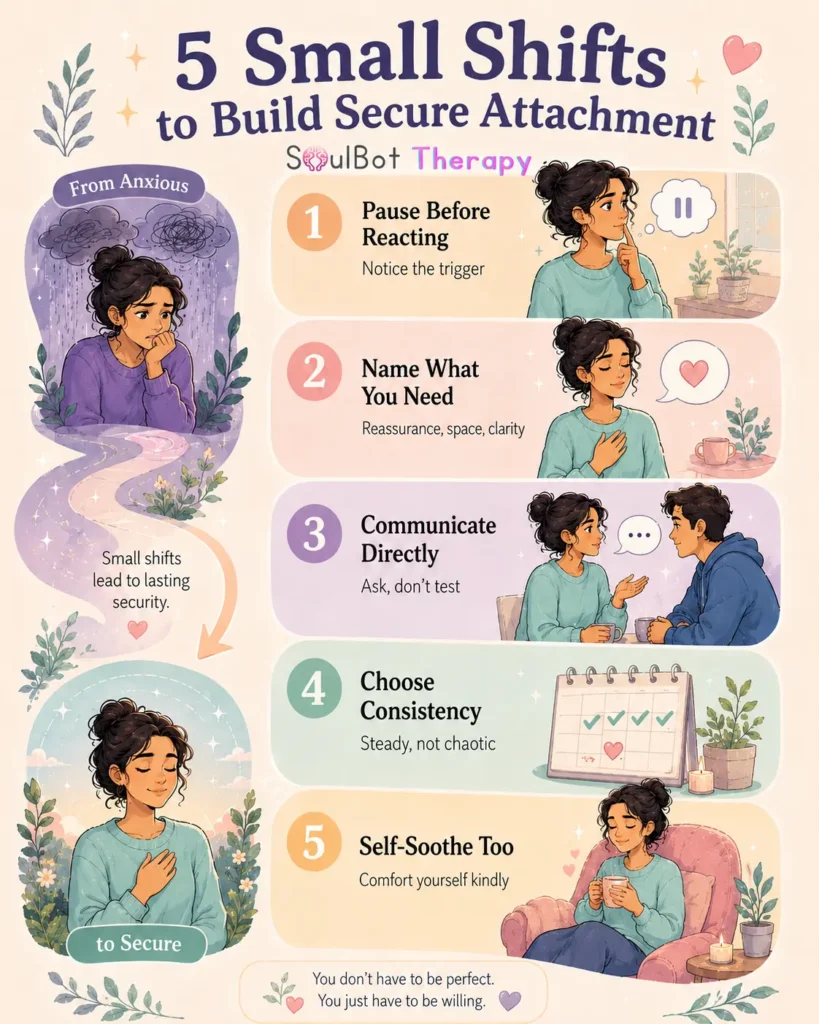
How to Become Securely Attached: 8 Practical Steps
1. Understand Your Current Attachment Style
You cannot change a pattern you cannot see. The first step is getting honest about how you currently show up in relationships.
Do you cling when you feel uncertain? Do you pull away when things get close? Do you swing between the two?
Start by observing your thoughts, feelings, and behaviours in relationships without judgment. Notice patterns. Do you tend to pull away when things get too close? Do you become anxious when your partner needs space? Journaling can be an excellent tool for this process. Try keeping a relationship journal where you record your reactions to various situations. Look for recurring themes or triggers.
Read more: Signs of Anxious Attachment — Triggers, Patterns and How to Heal.
2. Learn to Recognise Your Triggers
Understanding what causes you anxiety in a relationship is the first step toward changing it.
Your triggers are the specific situations that send your attachment system into high alert: a slow reply, a change in tone, a moment of distance. They feel urgent and real because, at some point in your past, they were.
When you can name your trigger “I feel abandoned when my partner goes quiet,” you create a small but powerful gap between the feeling and your reaction. That gap is where change lives.
3. Pause Before You React
When you feel anxious after a delayed text or a disagreement, pause before reacting, practise taking a few deep breaths, journaling your thoughts, or repeating calming affirmations. These mindfulness techniques can also be helpful in romantic relationships during emotionally heightened conversations.
This is not about suppressing feelings. It is about giving yourself enough space to choose your response rather than being driven by the fear underneath it.
🧠 SoulTip: When feeling anxious, place your hands on your belly and connect with your breath. This sends a signal to the brain that you are safe, and it works even when part of you does not believe it yet.
4. Build Your Sense of Self Outside of Relationships
One of the hallmarks of insecure attachment is that your self-worth becomes tied to how others treat you. When they are warm, you feel okay. When they pull away, you collapse.
This looks like: having interests and friendships that are yours alone, spending time with yourself without it feeling like punishment, knowing what you value and what you will not compromise on.
5. Practise Expressing Your Needs Directly
Secure attachment requires communicating in a respectful, open-hearted way. When conflict happens, collaborate with your partner to help each other feel understood and connected, even when you disagree.
“I would really like to talk tonight. Can we make time for that?” is more effective and more honest than hinting and hoping and feeling resentful when the hint is missed.
6. Surround Yourself With Securely Attached People
It might feel uncomfortable at first to have a relationship with someone who has a secure attachment. This can help you understand what a stable and safe relationship feels like. Also, try to build friendships with people who have high self-esteem, good boundaries, and who are securely attached.
Security is partly learned through experience. Being around people who relate to you in a consistent, trustworthy way gives your nervous system new data proof that closeness does not have to mean unpredictability.
7. Act Against Your Attachment Instincts Carefully
If you have an anxious attachment style, try taking small steps toward becoming more independent. If you have an avoidant attachment style, try letting down your guard and initiating intimacy.
This does not mean forcing yourself into discomfort for its own sake. It means gently challenging the behaviours that reinforce your insecure patterns and noticing that the feared outcome often does not materialise. Each small act of counter-instinctive behaviour builds new evidence that security is possible.
8. Work With a Therapist
Therapy can help you understand past experiences and how they affect your relationships. A therapist can also help you identify things that trigger you and recognise when your reaction is unhelpful, so you can work on better ways to respond to conflicts and relate to your partner.
Approaches that work particularly well for attachment healing include:
- Emotionally Focused Therapy (EFT) works directly with attachment patterns in relationships.
- Schema Therapy addresses the deep beliefs formed in childhood.
- Internal Family Systems (IFS) helps you understand the different parts of yourself that drive attachment behaviour.
- ACT (Acceptance and Commitment Therapy) is particularly helpful for the process of earning secure attachment as an adult.
What Secure Attachment Actually Feels Like?
People often assume that becoming securely attached means never feeling anxious, never needing reassurance, never having hard moments in relationships.
That is not what it looks like.
Earned secure attachment is not about reaching a finish line. It is about building enough emotional safety to stay present in relationships even when things are imperfect.
It feels like:
- Being able to have a difficult conversation without it feeling catastrophic
- Trusting that conflict can be repaired.
- Feeling okay when your partner needs space, not perfect, but okay
- Knowing that your needs are valid without needing someone else to confirm that
- Being able to receive love without immediately waiting for it to be taken away
It is not the absence of adversity that defines security. It is the capacity to rupture and repair without self-abandonment or blame.
📖 Want to go deeper? Amir Levine and Rachel Heller’s Attached: The New Science of Adult Attachment and How It Can Help You Find and Keep Love is the most widely recommended starting point for understanding and changing your attachment patterns.How Long Does It Take to Become Securely Attached?
There is no honest single answer to how to become securely attached.
Changing your attachment style as an adult is possible, but for those on the extreme ends of anxious, avoidant, or disorganised attachment, instinctive thoughts, feelings, and automatic responses may persist for some time. But your attachment style is not destiny.
For most people, meaningful change is visible within months of consistent therapy and intentional practice. Big, stable change, the kind where secure responses become your default, often takes a few years.
That is not discouraging. It is honest. And it is worth every step.
🧠 SoulTip: You do not have to be fully healed to have good relationships. You just have to be honest about your patterns and willing to keep working on them. That willingness is itself a form of security.
How SoulBot Can Help
The work of becoming securely attached happens in the spaces between therapy sessions, in the moments when anxiety spikes, when a trigger fires, when you need somewhere to process what you are feeling before you act on it.
Soululu, SoulBot’s AI companion, is available in those moments. A private, judgment-free space to think through what is coming up, whether that is a reaction to a relationship situation, a pattern you noticed, or simply a feeling you need to put somewhere.
💬 Start a conversation with Soululu whenever you need it.
🧠 Exploring your relationship patterns starts with understanding how you connect. Take the free Love Language Test to learn more about how you give and receive closeness.