
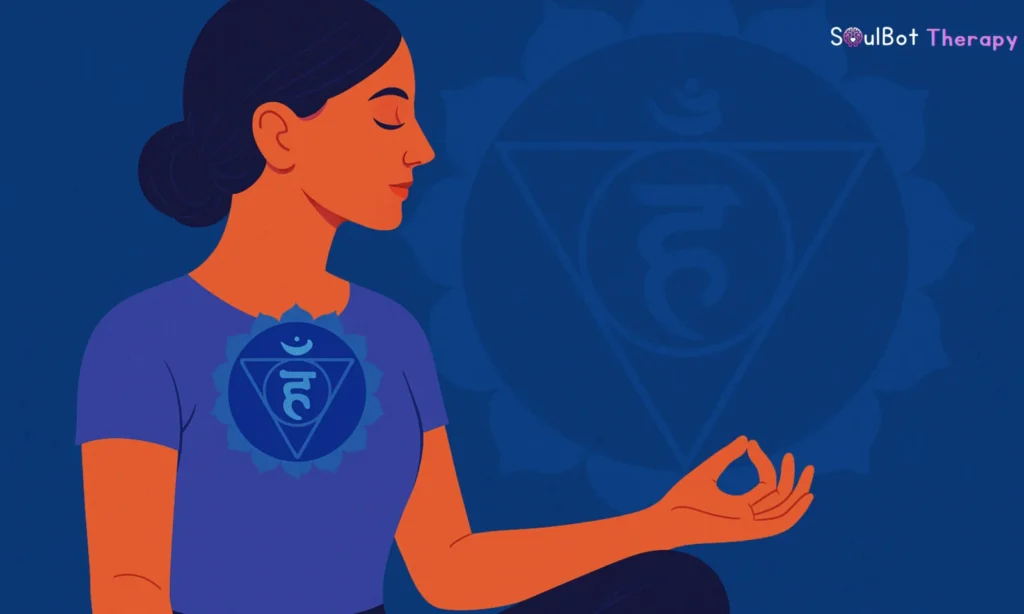
The Vishuddhi chakra, commonly called the throat chakra, is associated in some yoga and tantric traditions with the throat, sound, communication, and purification.
Today, people often use the throat chakra as a spiritual framework for reflecting on questions such as:
- Am I saying what I really mean?
- Do I hold back because I fear conflict or judgment?
- Can I listen without immediately defending myself?
- Do my words match my values?
Vishuddhi can be useful for self-reflection, but a “blocked throat chakra” is not a medical diagnosis, and physical symptoms such as persistent throat pain or thyroid problems should not automatically be attributed to chakra imbalance.
What Is the Vishuddhi Chakra?
Vishuddhi, also written Viśuddha, is traditionally located around the throat.
Classical descriptions vary between traditions, but the Shat-Cakra-Nirupana describes Vishuddhi as a sixteen-petalled lotus at the throat associated with ākāśa, often translated as space or ether, and the seed syllable HAM.
Common modern associations include:
| Vishuddhi symbolism | Traditional association |
|---|---|
| Location | Throat |
| Element | Ākāśa or space |
| Seed mantra | HAM |
| Lotus | 16 petals |
| Theme | Purification, sound, and expression |
These are elements of a spiritual tradition rather than scientifically measurable structures in the human body.
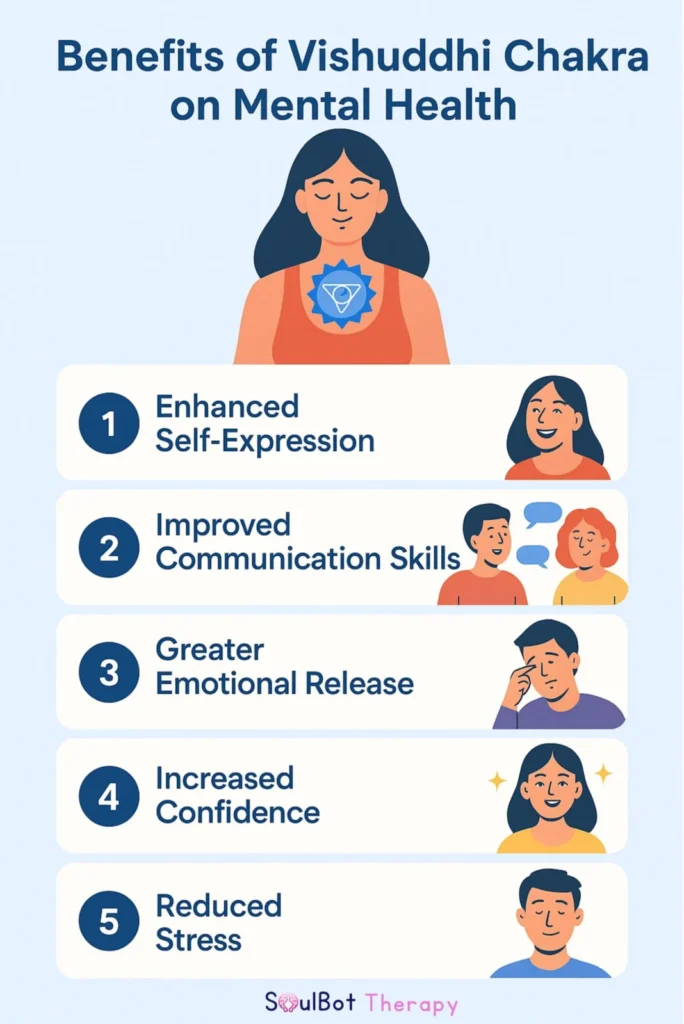
What Does the Throat Chakra Represent Emotionally?
In modern chakra practice, Vishuddhi is commonly connected with authentic expression.
That can include:
- Expressing feelings clearly
- Asking for what you need
- Setting boundaries
- Speaking honestly without becoming unnecessarily harsh
- Sharing creative ideas
- Listening carefully to other people
- Knowing when silence is more useful than speaking
A useful way to understand it is:
Healthy expression is not saying everything you think. It is communicating what matters in a way that respects both yourself and other people.
What Are the Signs of a “Blocked” Throat Chakra?
There is no clinical test for a blocked Vishuddhi chakra.
Instead of treating the idea literally, use it as a reflection prompt if you repeatedly notice patterns such as:
- Struggling to say no
- Hiding feelings to avoid conflict
- Agreeing when you actually disagree
- Over-explaining yourself
- Feeling afraid of being misunderstood
- Finding difficult conversations overwhelming
- Holding resentment because you did not communicate a need
- Speaking impulsively and regretting it later
These experiences can have many psychological and social causes. They are not proof of blocked energy.
Similarly, hoarseness, throat pain, difficulty swallowing or thyroid symptoms need appropriate medical evaluation rather than chakra treatment.
Does Science Support Chakras?
Science has not established chakras as anatomical structures or demonstrated that illness results from blocked chakra energy.
Research has, however, examined some practices commonly used alongside chakra work, particularly yoga, breathing, and meditation.
The U.S. National Center for Complementary and Integrative Health notes that yoga may support stress management and some aspects of mental and emotional well-being, although results vary and yoga should not be treated as a replacement for established treatment when one is needed.
The important distinction is:
Evidence that yoga or meditation may support well-being is not evidence that a specific chakra has been medically “opened” or “healed.”
How Can You Work With Vishuddhi in a Practical Way?
You do not need to believe in literal energy blockages to use the symbolism constructively.
1. Practice One Honest Sentence
Notice something you normally avoid saying.
Try:
- “I don’t have the capacity for that today.”
- “That comment bothered me.”
- “I need more time to think.”
- “I see this differently.”
Start with low-risk situations rather than forcing yourself into your hardest conversation immediately.
2. Journal What You Did Not Say
Write:
- What happened?
- What did I want to say?
- Why didn’t I say it?
- What would a respectful version sound like?
This turns “finding your voice” into something concrete.
3. Practice Listening
Communication is not only expression.
During your next conversation, notice whether you are:
- listening
- preparing your response
- trying to prove your point
- assuming what the other person means
A useful Vishuddhi practice can be speaking and making enough space to hear.
4. Use Breath Before Difficult Conversations
Before responding, when you feel activated:
- Pause.
- Take a slow, comfortable breath.
- Identify what you actually want the person to understand.
- Respond to that instead of the first impulse.
Yoga traditions also include breathing practices such as pranayama. Research suggests that yoga, as a broader practice, may help with stress and emotional well-being, although evidence varies by practice and condition.

5. Use the HAM Mantra as a Spiritual Practice
Some Vishuddhi practices involve repeating or chanting HAM while focusing attention around the throat.
You can use this as meditation if it is meaningful to you.
There is no need to claim that chanting physically removes toxins, cures thyroid problems, or medically changes the throat chakra.
If you often hold back what you feel, struggle to communicate your needs, or find emotional conversations difficult, it may be worth exploring your emotional intelligence.
👉 Take the Free Emotional Intelligence Test
Reflect on how you recognise, understand, manage, and communicate emotions.
Quick self-check · Instant result · Not a diagnosis
Try the SoulBot Truth–Fear–Expression Check
When your words feel stuck, ask:
TRUTH
What do I actually think, feel, or need?
FEAR
What am I afraid will happen if I say it?
EXPRESSION
How can I communicate it clearly and respectfully?
Example:
Truth:
“I need some time alone.”
Fear:
“They’ll think I don’t care.”
Expression:
“I care about you. I also need some quiet time tonight, so let’s talk tomorrow.”
That is more useful than simply deciding your chakra is “blocked.”
Talk to Soululu When You Don’t Know What to Say
Soululu can help you organize difficult thoughts before a conversation.
Use it to explore:
- What am I trying to communicate?
- What am I scared of saying?
- Am I setting a boundary or avoiding a conversation?
- How can I say this more clearly?
- What outcome can I control?
Soululu supports emotional reflection and communication planning. It does not diagnose or heal chakra imbalances.
Final Thought
Vishuddhi is best understood as a spiritual symbol of expression, sound, and communication, not a medical explanation for emotional or physical symptoms.
If the idea resonates with you, use it as a question:
Am I communicating what is true for me in a way that is clear, thoughtful and respectful?
That question can be useful whether you view chakras spiritually, symbolically, or simply as a framework for self-reflection.