

People use these terms all the time: “He’s a psychopath”, “She’s such a sociopath.”
But what do they actually mean?
If you’ve been searching sociopath vs psychopath, you’re probably trying to understand:
- Are they the same thing?
- What’s the real difference?
- And how does this show up in real life?
Let’s break it down simply without labels, fear, or confusion.
Are Sociopath and Psychopath Official Diagnoses?
Before comparing these, here’s something important:
👉 Neither “sociopath” nor “psychopath” is an official clinical diagnosis.
Mental health professionals usually refer to antisocial personality disorder (ASPD) instead. These terms are commonly used to describe patterns of behaviour, not formal diagnoses.
What Is the Difference Between a Sociopath and a Psychopath?
When people compare sociopath vs psychopath, they’re usually talking about differences in behaviour and emotional patterns.
Here’s the simplest way to understand it:
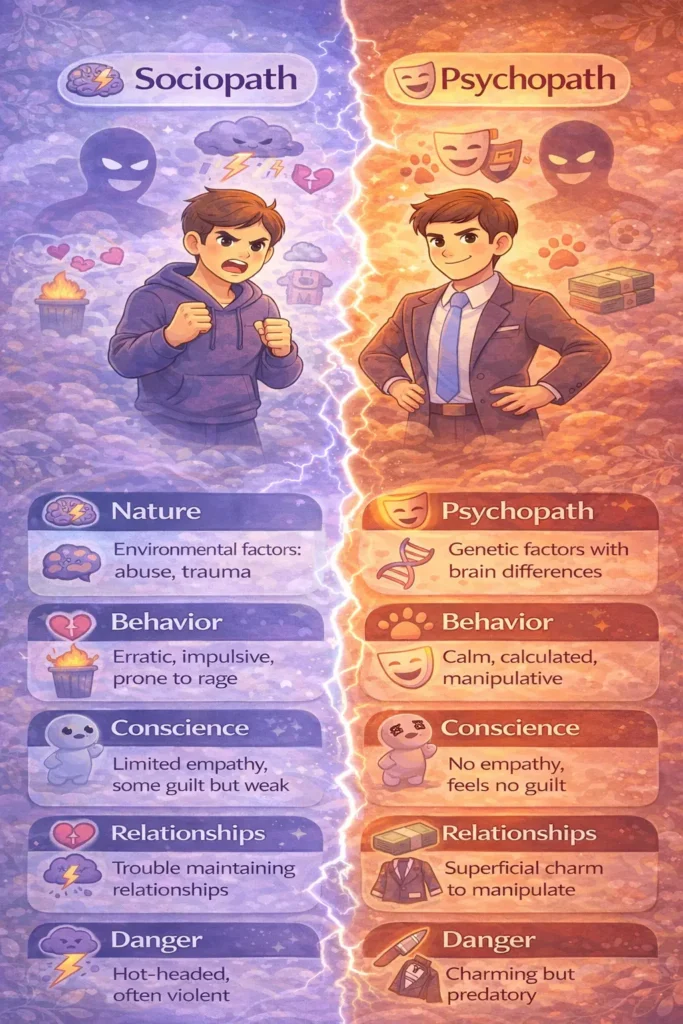
- Sociopath → More impulsive, emotionally reactive
- Psychopath → More controlled, emotionally detached
Both may show similar traits, but the way those traits appear can feel very different.
Talk to Soululu, your AI mental health companion, and process your thoughts in a safe, judgment-free space.
Sociopath vs Psychopath Differences (At a Glance)
| Traits | Sociopath | Psychopath |
| Emotional response | Reactive, intense | Cold, detached |
| Impulsivity | High | Low |
| Planning | Poor planning | Highly calculated |
| Empathy | Limited but present at times | Very low or absent |
| Behavior | Erratic, unpredictable | Controlled, strategic |
| Relationships | Chaotic, unstable | Superficial, manipulative |
This quick breakdown helps clarify sociopath vs psychopath differences in real-world behaviour.
Sociopath Traits vs Psychopath Traits
🔹 Common Sociopath Traits
- Impulsive decisions
- Emotional outbursts
- Difficulty maintaining relationships
- Prone to anger or frustration
- May feel some guilt or attachment
🔹 Common Psychopath Traits
- Lack of emotional connection
- Superficial charm
- Manipulative behavior
- Calculated actions
- Little to no remorse
These sociopath traits vs psychopath traits often overlap, but the intensity and consistency differ.
Are Psychopaths Born and Sociopaths Made?
You might have heard this before.
While discussing sociopath vs psychopath, people often say:
👉 Psychopaths are born
👉 Sociopaths are made
There’s some truth, but it’s not that simple.
- Psychopathy is often linked to biological or neurological factors.
- Sociopathic traits are often associated with environment, trauma, or upbringing.
But in reality:
👉 Both biology and environment play a role.
💜 SoulTip: Clarity comes when you trust your experience, not just definitions. If something consistently feels wrong, that feeling matters.
Sociopath vs Psychopath in Relationships
This is where the difference becomes more noticeable.
Sociopath in relationships:
- Emotionally reactive
- Unpredictable behavior
- Intense but unstable connections
Psychopath in relationships:
- Emotionally distant
- Highly manipulative
- Strategic control
In both cases, you may experience:
- Confusion
- Emotional imbalance
- Lack of genuine empathy
👉 You may also relate to:
What Is Narcissistic Abuse? Signs, Effects & Recovery
Can Sociopaths or Psychopaths Feel Empathy or Love?
This is one of the most searched questions around sociopath vs psychopath.
The answer isn’t black and white.
- Sociopaths may experience limited or inconsistent empathy.
- Psychopaths typically show very low emotional connection.
But:
👉 Avoid thinking in extremes; human behaviour exists on a spectrum.
When Labels Matter Less Than Behaviour?
Here’s something important. If you’re trying to understand sociopath vs psychopath, ask yourself:
👉 “How does this person make me feel?”
Instead of focusing only on labels, focus on:
- Repeated patterns
- Emotional impact
- Your sense of safety
Because:
👉 Behaviour matters more than definitions
How to Protect Yourself If You Notice These Traits?
If someone shows consistent patterns linked to sociopath vs psychopath traits, here’s what helps:
1. Observe Patterns Over Time
Don’t rely on isolated incidents.
2. Set Clear Boundaries
Protect your emotional energy.
3. Avoid Over-Explaining
You don’t need to justify your feelings constantly.
4. Seek Outside Perspective
Talking to someone you trust can restore clarity.
5. Prioritise Emotional Safety
Your well-being comes first.
Tools That Help You Stay Grounded
When things feel confusing, structure helps.
You can try:
These serve as practical tools for emotional regulation when navigating difficult dynamics.
(Use them as support, not a replacement for therapy.)
💜SoulTip: You don’t need to label someone to recognise harm. Even without a diagnosis, repeated emotional harm is enough reason to take it seriously.
🧠 In a Nutshell
If you’ve been comparing sociopath vs psychopath, here’s the simple truth:
👉 Both describe patterns of behaviour, not official diagnoses
👉 Sociopaths tend to be more reactive
👉 Psychopaths tend to be more controlled and detached
👉 And what matters most is how these patterns affect you
You don’t need perfect clarity to take your feelings seriously.
🔗 Try This SoulBot Test. If this made you reflect on your relationship patterns:
👉 Take the Emotional Availability Test
It can help you understand:
- Emotional patterns
- Attachment tendencies
- Relationship behaviors
Talk to Soululu, your AI mental health companion, and process your thoughts in a safe, judgment-free space.