

You walk into a room and immediately feel like everyone else belongs more than you do.
Achieve something good and immediately find a reason it does not count. You constantly compare yourself to others, and you always come up short.
If this sounds familiar, you might be dealing with an inferiority complex. And the first thing to know is: it is not a personality flaw. It is a learned pattern that can be unlearned.
Inferiority Complex: Quick Answer
- A persistent feeling of being less capable, worthy, or deserving than others.
- Goes beyond normal self-doubt; it is chronic and affects daily life.
- Signs include constant comparison, people-pleasing, and fear of failure.
- Rooted in childhood criticism, social comparison, and past experiences.
- Can be overcome with self-awareness, therapy, and consistent practice.
💬 Feeling like you are never enough? Talk to Soululu in a private, judgment-free space to work through it.
What Is an Inferiority Complex?
The concept of the inferiority complex was introduced by psychologist Alfred Adler in 1907. It refers to a pervasive feeling of inadequacy, weakness, and insecurity in which people believe their accomplishments are never enough compared to those of others.
Today, psychologists view it as a cluster of thoughts, emotions, and behaviours that keep people stuck in comparison and avoidance, even when they are capable.
The difference between normal insecurity and an inferiority complex is consistency. Everyone doubts themselves sometimes. An inferiority complex makes you doubt the permanent background noise of your life.
🧠 SoulFact: An inferiority complex can cast a shadow over every part of your life, from relationships to career, often in ways you do not immediately notice. But it is not permanent. With the right mindset and tools, it can change.
Signs of an Inferiority Complex
You compare yourself to everyone and always end up losing.
If you frequently compare yourself to others and consistently feel inadequate, this is one of the clearest signs of an inferiority complex. Social media makes this worse: a highlight reel that your inner critic uses as evidence against you.
You dismiss your own achievements
Good things happen. You find a reason they do not count. The promotion was luck. The compliment was polite. You cannot let yourself receive anything fully.
You people-please constantly
Seeking approval from others becomes a way of managing the feeling that you are not enough on your own. You say yes when you mean no. Measure your worth by how others respond to you.
You avoid challenges out of fear of failure
Might avoid stepping up for new challenges or doubt your skills, keeping yourself in situations that feel safe but limit your growth.
You overcompensate or withdraw completely
Sometimes feeling inferior makes people act as if they are better than everyone else, through bragging or excessive competitiveness. This behaviour is usually just armour used to protect a person who feels very small inside. Others go the opposite way, becoming invisible to avoid any risk of judgment.
You take feedback as a personal attack
Well-meaning constructive feedback feels like a personal attack. You respond with anger, defensiveness, or spiral into shame.
🧠 SoulTip: Recognising these signs in yourself is not self-criticism. It is self-awareness, and that is the first step toward something different.
What Causes an Inferiority Complex?
Common causes include growing up in an overly critical or highly competitive environment, constantly comparing yourself to others on social media, setting unreachable goals that reinforce feelings of inadequacy, and past failures, abusive relationships, or rejection that deeply impacted your self-image.
In short: your environment taught you that you were not enough. And your brain believed it.
Inferiority Complex vs Low Self-Esteem
These are closely related but not identical:
| Inferiority Complex | Low Self-Esteem |
| Defined by comparison to others | Defined by a negative self-view overall |
| “I am less than them.” | “I am not good enough.” |
| Often drives overcompensation | More likely to drive withdrawal |
| Rooted in social comparison | Rooted in self-perception |
Both affect relationships, work, and mental health, and both respond to similar approaches.
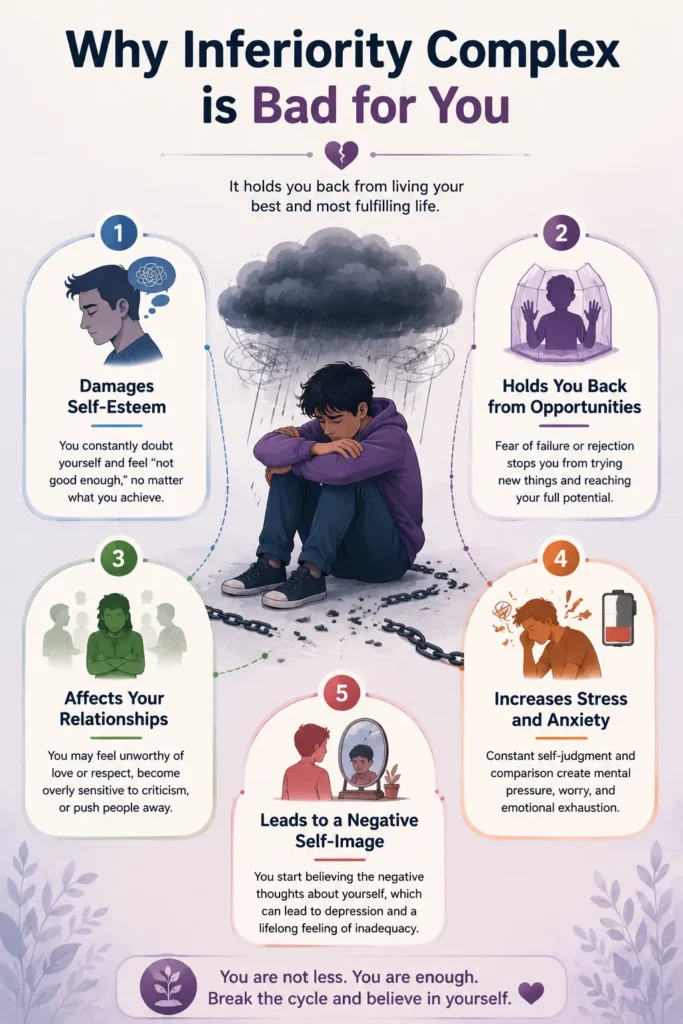
How to Overcome an Inferiority Complex
1. Notice the comparison habit
You cannot stop something you cannot see. Start catching yourself mid-comparison on social media, in conversations, in your own head. Name it: “I am comparing again.” That pause matters.
2. Challenge negative self-talk
The more you repeat negative thoughts, the more you reinforce them. Your brain is always forming new neural connections, and constant negative self-talk builds a cycle. CBT and cognitive restructuring can help retrain this pattern.
3. Celebrate small wins deliberately
Set realistic goals and celebrate small achievements to build confidence gradually. Not grand gestures, just noticing when you did something well and letting yourself receive it.
4. Stop outsourcing your worth
Your value does not live in other people’s opinions of you. Building an internal sense of worth through values, actions, and self-compassion is more stable than anything external can provide.
5. Work with a therapist
Therapy, particularly CBT, is among the most effective approaches for addressing the deep-rooted patterns underlying an inferiority complex. A therapist can help you identify where the beliefs came from and build new ones.
How SoulBot Can Help?
Processing the belief that you are not enough is slow, quiet work. Soululu offers a private, consistent space to reflect without judgment whenever the comparison spiral starts or the self-doubt gets loud.
💬 Start a conversation with Soululu whenever you need it.
🧠 Understanding your emotional patterns is the first step. Take the free Emotional Intelligence Test to learn more about how you respond to yourself and others.