
Self-confidence grows when you repeatedly do things that matter, see yourself cope, and collect evidence that you can handle challenges. It does not mean feeling fearless, being extroverted, or believing you will succeed at everything.
Psychology often describes a closely related idea as self-efficacy: your belief that you can carry out a particular task or handle a situation. Past successful experiences are one of the strongest sources of that belief.
What Is Self-Confidence?
Self-confidence is your belief that you can handle a situation, learn what you need, or recover if something goes wrong.
It is different from self-esteem.
| Self-confidence | Self-esteem |
|---|---|
| “I think I can handle this.” | “I still have worth if I struggle.” |
| Can change by situation | More about your overall view of yourself |
| Often grows through experience | Relates more broadly to self-worth |
You can be confident at work and insecure in relationships—or have healthy self-worth while feeling nervous about doing something new.
For the deeper distinction, read SoulBot’s guide to building self-esteem without toxic positivity. How to Build Self-Esteem Without Toxic Positivity
Does “Fake It Till You Make It” Build Confidence?
Sometimes acting confident can help you get through a difficult moment. But pretending alone does not necessarily create lasting confidence.
In one study, repeating very positive self-statements actually made some participants with low self-esteem feel worse rather than better. That does not mean positive self-talk is useless; it suggests that statements work better when they feel believable and are supported by experience.
Instead of:
“I am amazing at this.”
try:
“I’m nervous, but I can take the next step.”
That gives your brain something realistic to test.
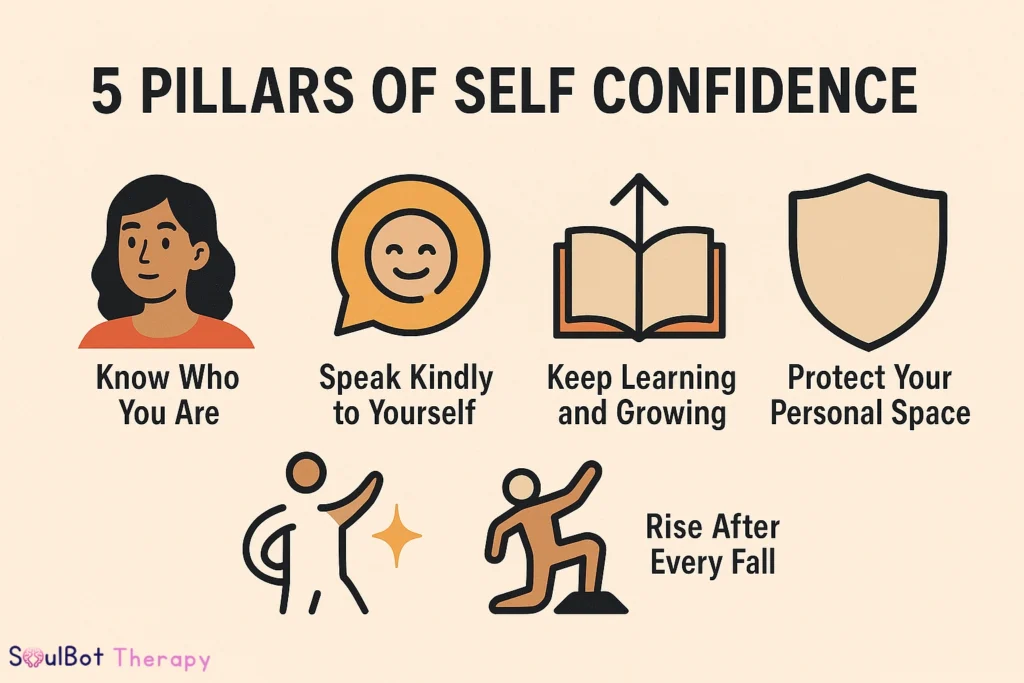
5 Ways to Build Real Self-Confidence
1. Build confidence through small wins
Do not wait until you feel confident.
Pick something slightly uncomfortable but manageable:
Speak once in a meeting. Make the phone call. Share your idea. Try the class. Ask the question.
Then notice what happened.
APA’s overview of self-efficacy explains that successful mastery experiences can strengthen belief in your ability to handle similar challenges in the future.
Confidence often follows action not the other way around.
2. Practice the skill you want confidence in
Confidence is usually specific.
- If you want confidence speaking publicly, practice speaking.
- If you want confidence setting boundaries, practice saying no.
- If you want confidence at work, improve the skill you feel unsure about.
You do not need confidence in “everything.” Build it where you actually need it.
3. Stop using perfection as the standard
A confident person can still:
make mistakes, feel nervous, ask for help, change their mind, or have an awkward moment.
Try replacing:
“I need to get this right.”
with:
“I need to be able to recover if it goes wrong.”
That shift builds self-trust instead of performance pressure.
4. Keep boundaries even when they feel uncomfortable
Confidence also grows when your actions show that your time, needs, and opinions matter.
Start small:
- “No, I can’t do that today.”
- “I need some time to think.”
- “I don’t agree.”
If saying no consistently makes you feel guilty or anxious, your self-esteem may also be involved. SoulBot’s low self-esteem self-check explores patterns such as over-apologising, needing reassurance and struggling to set boundaries. Do I Have Low Self-Esteem? 10 Signs for a Quick Self-Check
5. Use fair self-talk, not forced positivity
Confidence is difficult to build if every mistake becomes:
“I’m terrible at this.”
Try making your interpretation more accurate:
“That did not go well, but now I know what to practise.”
“I felt nervous and still did it.”
“One mistake doesn’t tell me what I’m capable of.”
The goal is not to convince yourself that you’re perfect. It is to stop treating every setback as evidence that you’re incapable.
What Usually Lowers Self-Confidence?
Comparison, avoiding difficult situations, relying completely on other people’s approval, harsh self-criticism and expecting perfection can all keep self-doubt going.
Social comparison can be especially misleading because you compare your internal uncertainty with someone else’s visible result.
If comparison regularly leaves you feeling “less than” other people, read Inferiority Complex: Signs, Causes and How to Overcome It. Inferiority Complex Guide
A Simple Confidence Exercise
Choose one situation where you want more confidence.
Then ask yourself:
What is one action small enough that I can do it this week?
Do it once.
Afterward, write down:
- What did I expect would happen?
- What actually happened?
- What did I handle better than I expected?
Repeat.
That gives you something more useful than an affirmation: evidence.
Want to Understand Your Confidence More Deeply?
Confidence and self-esteem are related, but they are not identical.
If you constantly doubt your decisions, dismiss achievements, need reassurance or feel that mistakes reduce your worth, explore SoulBot’s Low Self-Esteem Self-Check. Take the Low Self-Esteem Self-Check
You can also talk to Soululu about the situations where you feel least confident and identify the patterns behind your self-doubt.