You block them. You miss them. They text. You feel relief. And suddenly, you’re back in it.
An anxious-avoidant relationship isn’t just confusing it’s chemically gripping. It can feel intense, magnetic, almost impossible to detach from, even when it hurts.
That’s because this dynamic doesn’t just activate emotions. It activates your nervous system.
👉 Curious where you land? Take the Emotional Availability Test to understand your attachment responses.
What Is an Anxious-Avoidant Relationship?
An anxious-avoidant relationship happens when two attachment styles collide, a framework first developed by psychologist John Bowlby and later expanded by researchers like Mary Ainsworth through attachment theory:
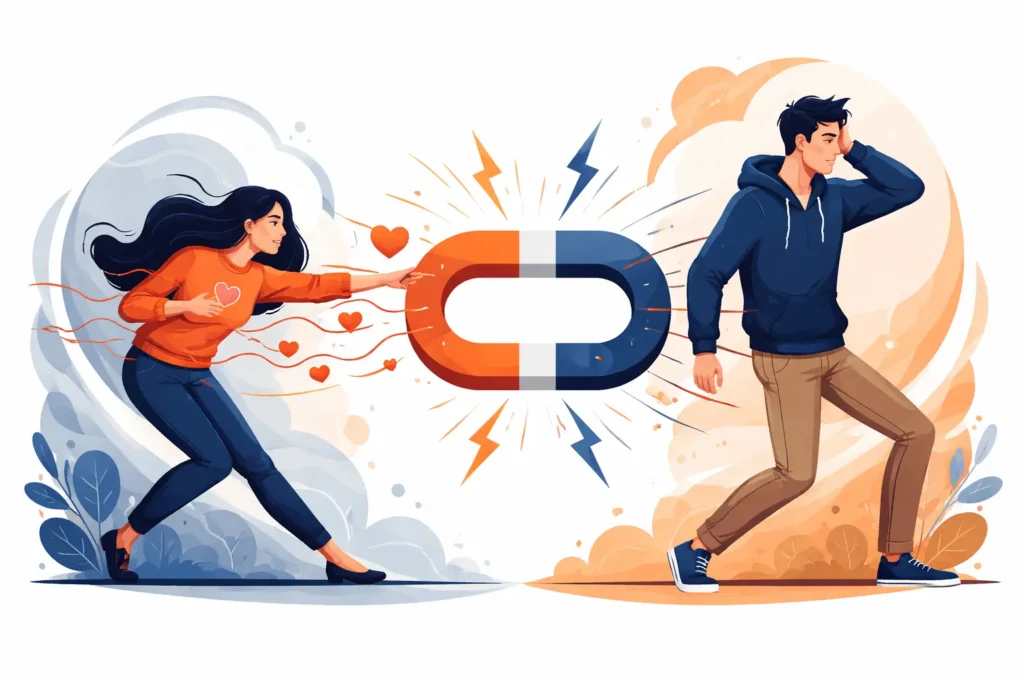
- The anxious partner seeks closeness, reassurance, and emotional consistency.
- The avoidant partner seeks space, independence, and emotional self-protection.
The more the anxious partner moves closer, the more the avoidant partner tends to pull back. The more the avoidant partner withdraws, the more the anxious partner tends to panic and pursue.
This creates a push-pull loop that reinforces both people’s deepest fears:
- Anxious fear: “I’m going to be abandoned.”
- Avoidant fear: “I’m going to be overwhelmed.”
Neither response is a character flaw both are protective patterns, often shaped by early relationships. But together, they create instability.
Why This Dynamic Feels So Addictive
If you’ve seen “anxious-avoidant trap” trending on social media, there’s a real mechanism behind it: intermittent reinforcement.
The concept comes from behavioral psychologist B.F. Skinner’s research on reinforcement schedules. Skinner found that when a reward is delivered unpredictably rather than every time, the resulting behavior becomes far more resistant to fading more so than behavior reinforced consistently. In his experiments, subjects rewarded on an unpredictable schedule kept responding longer and more persistently than those rewarded every single time.
Applied to relationships, the pattern looks like this:
- Emotional distance creates anxiety.
- Reconnection creates relief.
- Relief is experienced as a reward.
- The brain starts linking unpredictability with intensity.
- Because the “win” is uncertain, the pursuit of it can intensify the same mechanism that makes variable-reward systems like slot machines difficult to walk away from.
That emotional high after a fight and make-up isn’t proof of love it’s your nervous system settling after a perceived threat. When connection is unpredictable, the pursuit of it can escalate, and what we chase hardest often feels the most valuable, even when it isn’t the healthiest.
🧘♀️ SoulFact: Unpredictable reward schedules are a well-documented driver of persistent, hard-to-quit behavior, the same underlying mechanism studied in research on compulsive and addictive behavior patterns.
Why Love Feels Intense But Not Safe
In a secure relationship, connection tends to feel steady. In an anxious-avoidant relationship, it often feels different:
- Love feels urgent.
- Silence feels threatening.
- Calm feels suspicious.
- Distance feels unbearable.
It’s easy to mistake anxiety for chemistry. That fluttery, can’t-look-away feeling can be excitement or it can be hypervigilance. When emotional unpredictability is high, the body tends to stay on alert, and intensity gets confused with intimacy.
Signs You Might Be in the Pattern
You may recognize this dynamic if:
- You feel anxious when they pull away.
- You feel relief, not resolution, when they return.
- Arguments seem to lead to temporary closeness rather than real repair.
- You overanalyze texts and tone.
- You feel pulled toward their attention even when it’s inconsistent.
- Calm periods feel “boring” rather than safe.
- You stay for potential, not for consistency.
An anxious-avoidant relationship can often feel like love with instability built in.
Why “Just Leave” Doesn’t Work
Friends mean well: “Just leave.” “You deserve better.” “This is unhealthy.”
Logically, you may already know that. But attachment patterns are held in the nervous system as much as in conscious thought, which is part of why insight alone doesn’t always break the cycle regulation and new relational experience tend to matter as much as awareness.
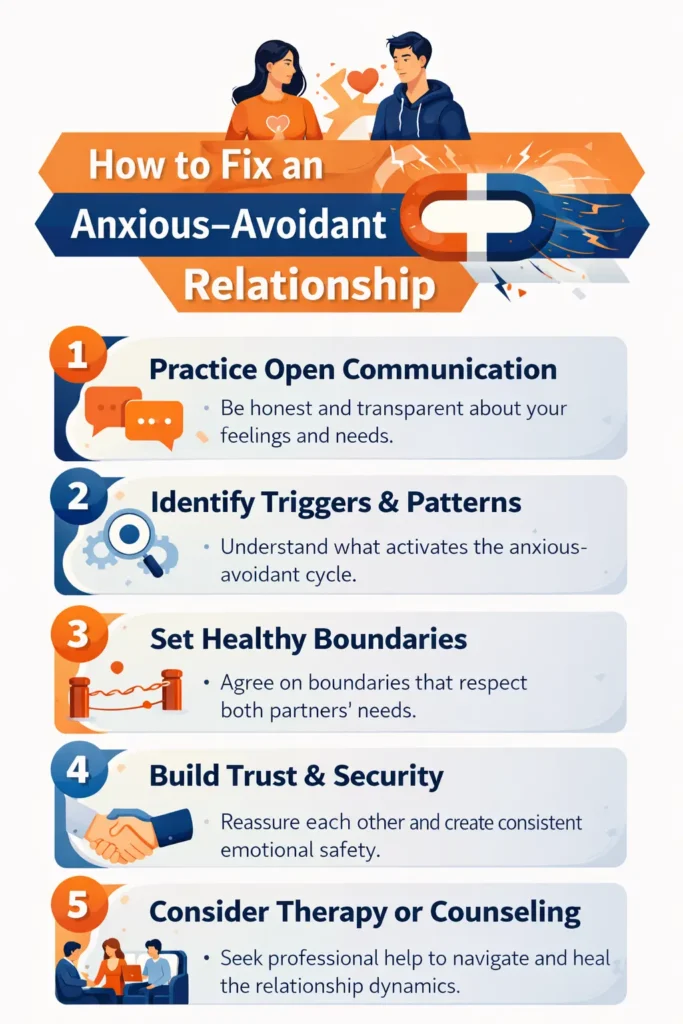
Can an Anxious-Avoidant Relationship Be Fixed?
Sometimes, but generally only when:
- Both partners understand their attachment patterns.
- Both are willing to tolerate discomfort during change.
- The anxious partner works on self-regulation instead of pursuit.
- The avoidant partner works on staying emotionally accessible instead of withdrawing.
- Consistency starts to replace unpredictability, even if it feels less “intense” at first.
If only one partner is doing this work, the cycle tends to continue. A relationship like this shifts when safety becomes the shared goal, not intensity.
How to Start Breaking the Pattern
- Learn your attachment style — self-awareness is the entry point, not the endpoint.
- Regulate before you reach out — a short pause (even a few minutes of grounding) can interrupt the automatic pursue-or-withdraw response.
- Track the pattern, don’t just feel it — note when relief, not resolution, is what’s actually happening after a reconnection.
- Notice if calm feels unfamiliar — that discomfort is often a sign your nervous system is used to instability, not a sign something is wrong with the relationship.
- Choose emotional safety over emotional highs — even when the highs feel more “real.”
It Doesn’t Mean You’re Broken
An anxious-avoidant dynamic doesn’t mean something is wrong with you. It usually means your nervous system learned connection through unpredictability, and now reads intensity as a signal of safety.
The highs can feel powerful. The relief can feel real. But emotional stability shouldn’t have to feel rare or hard-won, a healthy connection is consistent, not dramatic.
Understanding why this pattern feels addictive is often the first step toward not blaming yourself for staying, and building the regulation needed to choose differently next time.
💬 Want to explore your own attachment pattern in more depth? Talk to Soululu for grounding tools, reflection prompts, and real-time support the next time a hot-and-cold cycle gets triggered.
Related Reads
- What Is a Queerplatonic Relationship?
- Healthy Relationship Signs: Am I in a Healthy Relationship?
- How to Overcome Resentment in Relationships
Reviewed by:
Samya Counselling Psychologist on 04/09/2026