
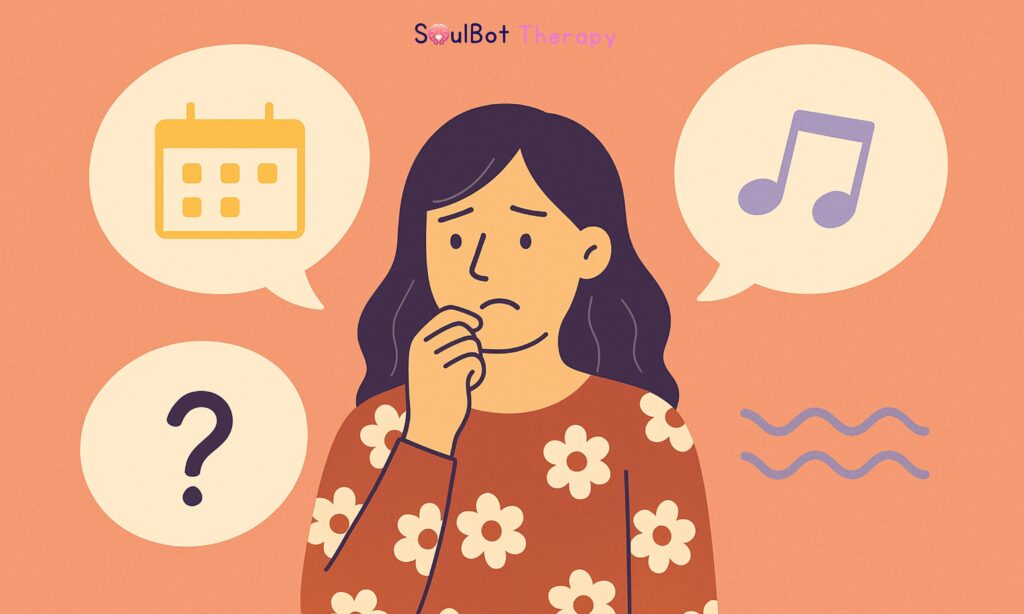
Pre-social anxiety is anticipatory stress that occurs hours or days before a social event. It involves racing thoughts, physical symptoms such as chest tightness and sweaty palms, and behavioural urges, such as cancelling plans even when no actual threat is present.
This pattern goes beyond ordinary nerves. Over time, it can quietly undermine your confidence and willingness to participate in social situations, setting pre-social anxiety apart from more fleeting nervousness.
Who Experiences Pre-Social Anxiety?
You are not alone. The National Institute of Mental Health (NIMH) reports that social anxiety disorder affects approximately 7% of U.S. adults, making it one of the most common anxiety conditions. Many more experience subclinical pre-event anxiety that never gets named or treated.
Common signs you may have pre-social anxiety:
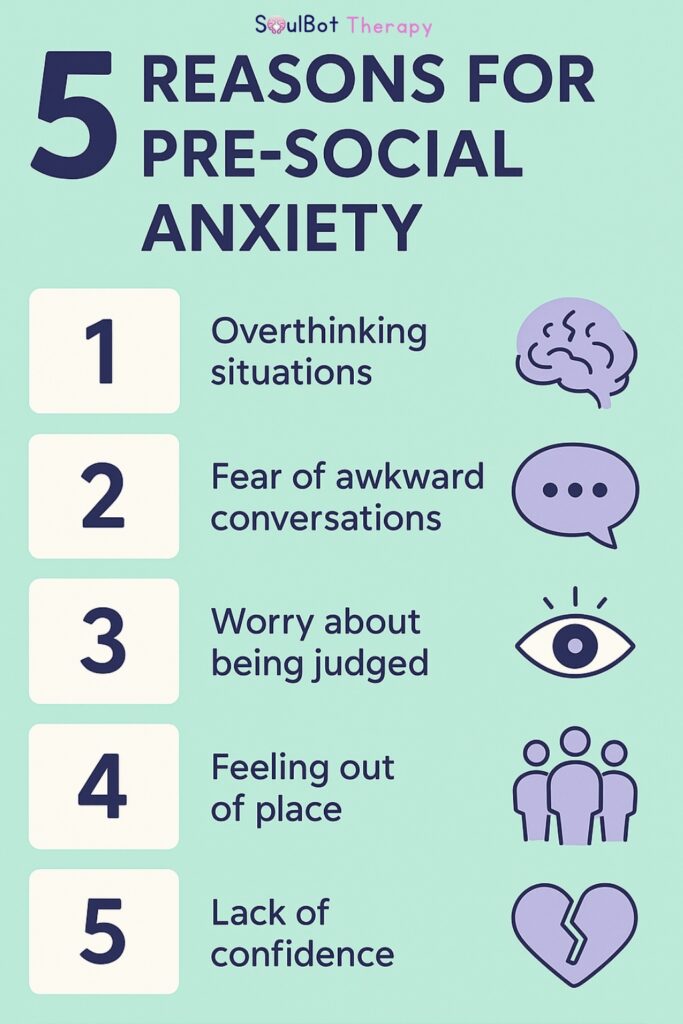
- Heart racing hours before a dinner or party
- Rehearsing conversations or apologies in advance
- Changing outfits multiple times, still feeling “wrong”
- Crafting excuses to cancel, then feeling guilty for doing so
- Stomach dropping at the thought of walking into a crowded room.
Expert insight: This response is your brain’s threat-detection system misfiring. It perceives social judgment as danger and tries to protect you from it. The anxiety is real. The danger usually isn’t.
Pre-Social Anxiety vs Normal Nervousness: What’s the Difference?
| Feature | Normal Nervousness | Pre-Social Anxiety |
| Timing | Minutes before the event | Hours or days before |
| Intensity | Mild, manageable | Overwhelming, intrusive |
| Thoughts | “I hope it goes well.” | Catastrophic worst-case scenarios |
| Behavior | Shows up anyway | Strong urge to cancel or avoid |
| After effect | Fades quickly | May persist even after the event |
3 Types of Pre-Social Anxiety Symptoms to Recognise
1. Mental Symptoms
- Racing thoughts about rejection or embarrassment
- Mental rehearsal of worst-case scenarios
- Catastrophic thinking (“Everyone will think I’m awkward”)
- Difficulty concentrating on anything else before the event
2. Physical Symptoms
- Chest tightness or rapid heartbeat
- Nausea or stomach discomfort
- Sweaty palms or muscle tension
- Shortness of breath
3. Behavioural Symptoms
- Urge to cancel at the last minute.
- Over-preparing or scripting conversations
- Seeking excessive reassurance from others
- Checking your appearance repeatedly
How to Calm Pre-Social Anxiety Before Events?
These techniques are grounded in Cognitive Behavioural Therapy (CBT) and research on nervous system regulation.
Strategy 1: Name It to Tame It (Cognitive Labelling)
How it works: Write down exactly what you fear will happen. Rate your anxiety from 1-10. Then ask: “What’s the worst that could realistically happen and how would I handle it?”
Labelling emotions activates the prefrontal cortex and reduces amygdala reactivity, the brain’s alarm system. Research published in Psychological Science shows that affect labelling measurably reduces emotional distress.
Try this now: Finish the sentence “I’m afraid that at this event, _______ will happen, and if it does, I will _______.”
Strategy 2: Grounding Exercises for Social Anxiety
Grounding interrupts the anxiety spiral by redirecting attention to the present moment.
The 5-4-3-2-1 Technique:
- Name 5 things you can see
- Name 4 things you can physically touch
- Name 3 things you can hear
- Name 2 things you can smell
- Name 1 thing you can taste.
Box Breathing (used by Navy SEALs and therapists alike):
- Inhale for 4 counts
- Hold for 4 counts
- Exhale for 4 counts
- Hold for 4 counts
- Repeat 4–6 cycles
📊 SoulFact: Cognitive therapy research shows grounding exercises can reduce pre-event anxiety by up to 40% when practised consistently.
Strategy 3: Prepare Without Over-Scripting
Over-preparation creates performance pressure. Under-preparation fuels panic. The goal is structured confidence, not memorised scripts.
Do this instead:
- Prepare 2–3 genuine questions you’re actually curious about (“How’s the new job going?” / “What have you been up to lately?”)
- Have one recent personal experience ready to share if the conversation stalls
- Set an intention for how you want to show up, curious, kind, present, rather than what you want to say.
Avoid: Memorising jokes, rehearsing exact responses, or scripting entire conversations. This increases anxiety when reality diverges from the script.
Strategy 4: Regulate Your Nervous System (Pre-Event Ritual)
Your nervous system needs a signal that it’s safe. Build a 15–20 minute pre-event wind-down ritual using any of these:
- 🎵 Calming music: slow tempo, 60 BPM range
- 🌿 Aromatherapy: lavender and bergamot are clinically associated with reduced anxiety
- 🤲 Gentle stretching or progressive muscle relaxation
- 💧 Cold water on wrists and face activates the dive reflex and slows heart rate
- 📵 Phone-free time for 10 minutes before leaving
Strategy 5: Visualise Realistic Success (Not Perfection)
Anxious brains rehearse failure. Redirect that mental energy deliberately.
Instead of imagining you’ll be witty and charming, visualise:
- Someone smiling when you arrive
- One natural, comfortable conversation
- Leaving feeling proud, you showed up even imperfectly.
This technique, called mental contrasting, is supported by research from NYU psychologist Gabriele Oettingen, who found that visualising both the goal and the realistic path to it significantly improves follow-through.
In-the-Moment Coping Tools (Once You’re There)
Even with preparation, anxiety can spike mid-event. Here’s what works:
| Situation | Coping Tool |
| Overwhelmed by the crowd | Strategic bathroom break to reset and breathe |
| Don’t know what to say | Ask one person a genuine question and listen fully |
| Feeling frozen | Notice 3 physical details in the room (grounds you instantly) |
| Spiraling thoughts | Remind yourself: “I don’t need to impress. I just need to be present.” |
🧘♀️SoulFact: The National Institute of Mental Health reports that social anxiety affects nearly 7% of adults, with many experiencing significant anticipatory anxiety. You're not alone.
The Bottom Line: You Don’t Have to White-Knuckle Your Way Through This
Pre-social anxiety is not a personality flaw. It’s a learned fear response, and learned responses can be unlearned.
The goal isn’t to become a different person who loves parties. It’s to stop being held hostage by fear of a moment that hasn’t happened yet and to show up as yourself, anxiety and all, knowing you are worthy of connection exactly as you are.
Managing pre-social anxiety is a skill. Skills improve with practice.
🧠 Want to understand how you naturally connect? Take our Love Language Test. Understanding your connection style can reduce social anxiety by focusing on authentic interaction instead of performance.

Content is intended for informational purposes only and does not constitute medical advice. If you are experiencing severe anxiety, please consult a licensed mental health professional.