

MBTI Explained: Quick Answer
The Myers-Briggs Type Indicator (MBTI) categorises personality into 16 types based on four dimensions: how you gain energy, process information, make decisions, and structure your life.
The four dimensions:
- E vs I– Extraversion vs Introversion: How you recharge
- S vs N– Sensing vs Intuition: How you process information
- T vs F– Thinking vs Feeling: How you make decisions
- J vs P – Judging vs Perceiving:How you approach structure
Important caveat: MBTI reflects preferences, not fixed traits. It is a self-reflection tool, not a clinical diagnosis. Over 2 million people take it annually but academic psychologists generally prefer the Big Five as the more scientifically validated model.
Let’s break down what your MBTI personality type really means in real life, real emotions, and real relationships.
🧠 Want to discover your actual personality type? Take the MBTI Personality Test now.What Personality Type Really Means?
The Myers-Briggs Type Indicator (MBTI) is based on psychologist Carl Jung’s theory that we all have distinct ways of perceiving the world and making decisions.
It categorises personalities into 16 Myers-Briggs personality types, using four key pairs of traits:
| Dimension | Traits | What It Reflects |
|---|---|---|
| Energy | Extroversion (E) vs Introversion (I) | How you recharge- through people or solitude |
| Information | Sensing (S) vs Intuition (N) | How you process information- facts or ideas |
| Decisions | Thinking (T) vs Feeling (F) | How do you make choices- logic or emotion |
| Lifestyle | Judging (J) vs Perceiving (P) | How you approach life-structure or spontaneity |
📊 SoulFact: According to Verywell Mind, over 2 million people take the MBTI each year, making it one of the most widely used psychological tools globally.
Common Myths About MBTI (That Limit Its Value)
MBTI often gets dismissed or misused because of a few common misunderstandings.
- Myth 1: MBTI puts you in a box
Reality: MBTI highlights preferences, not fixed behaviour. You still grow, adapt, and change. - Myth 2: One personality type is better than another
Reality: Every type has strengths and blind spots. Growth comes from awareness, not comparison. - Myth 3: MBTI predicts success or failure
Reality: Emotional intelligence, self-regulation, and context matter far more than type alone.
A 2018 review published in the European Journal of Personality found that while MBTI has limited test-retest reliability, with up to 50% of people receiving a different type when retested five weeks later, it remains useful as a self-reflection framework when users understand its limitations. The authors concluded that personality frameworks are most valuable when used to prompt discussion and awareness, not to assign fixed categories.
How Are the 16 Myers-Briggs Personality Types Explained?
Here’s a quick overview of what each group tends to value:
- Analysts (INTJ, INTP, ENTJ, ENTP): Strategic, logical, innovative.
- Diplomats (INFJ, INFP, ENFJ, ENFP): Empathetic, idealistic, driven by meaning.
- Sentinels (ISTJ, ISFJ, ESTJ, ESFJ): Responsible, loyal, practical.
- Explorers (ISTP, ISFP, ESTP, ESFP): Adaptable, creative, spontaneous.
Each type has its own strengths, blind spots, and emotional needs, which is where the real growth begins.
What’s the Difference Between an Introvert and an Extrovert in MBTI?
You’ve probably heard people say “I’m such an introvert,” but MBTI takes it deeper.
- Introverts gain energy from alone time and reflection.
- Extroverts recharge through connection and external activity.
Neither is better; it’s about knowing when your energy drains or thrives.
💡 Example: An INFP might need solitude after socializing, while an ENFJ might feel low without regular human interaction.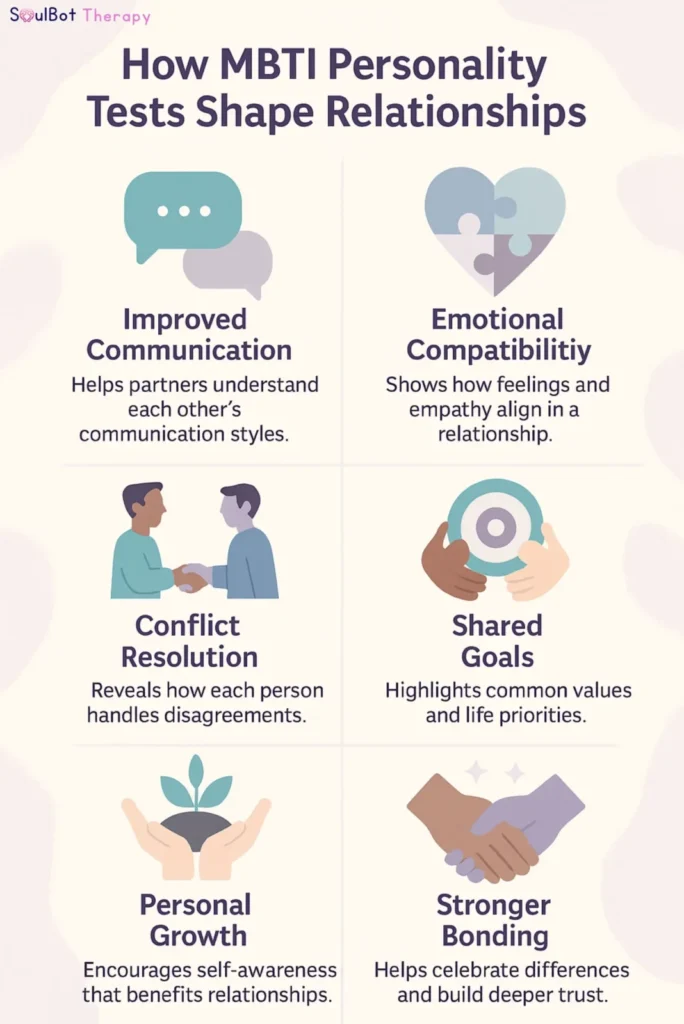
How Do MBTI Personality Types Shape Relationships?
Understanding your MBTI type can significantly impact your relationships. It helps explain why you communicate the way you do, or why certain people feel more easily connected with. Beyond communication styles, MBTI also reflects emotional needs in relationships.
For example
- Intuitive (N) types often seek meaning and depth
- Sensing (S) types feel safer with consistency and practical reassurance
- Feeling (F) types prioritise emotional validation
- Thinking (T) types may show care through problem-solving instead of emotional language
Understanding these differences reduces misinterpretation and replaces frustration with empathy. This awareness can strengthen empathy, not just romance, but friendships and families, too.
💡 Related SoulBot Read: How Personality Tests Help You Understand Relationships
How MBTI Affects Emotional Regulation?
Your MBTI type can influence how you respond to emotional stress, not whether you feel emotions.
Research in Personality and Individual Differences found that Feeling types score significantly higher on measures of emotional expressivity, while Thinking types show greater emotional suppression under stress patterns consistent with MBTI predictions, but also independently observable in Big Five agreeableness and emotional stability scores.
- Introverted types (I) may withdraw to regulate emotions internally.
- Extroverted types (E) may process emotions by talking them out.
- Thinking types (T) often suppress emotions to stay logical.
- Feeling types (F) may experience emotions more intensely and express them openly.
None of these responses is wrong.
Problems arise when you don’t understand your default pattern and mistake it for a flaw.
This is where emotional intelligence bridges the gap between personality and healthy coping.
Read more: Signs of Anxious Attachment
Can MBTI Help With Career and Personal Growth?
Yes, when used responsibly. Knowing your type can guide you toward environments that match your natural rhythm.
- ENTPs often thrive in creative problem-solving roles.
- ISFJs excel in structured, supportive positions.
- INTJs shine in strategy and innovation.
It’s not about limits, it’s about alignment. Your MBTI is explained as a self-awareness tool that highlights where you’ll likely feel energised, not boxed in.
📊 SoulFact: The APA notes that while MBTI isn’t diagnostic, it can promote self-awareness and career satisfaction when used for reflection rather than labeling.
Using MBTI to Communicate Better (Real-Life Use Cases)
Here’s how MBTI becomes practical, not theoretical:
- In conflict:
Thinking types may need clarity and logic; Feeling types need emotional validation first. - In stress:
Judging (J) types calm down with structure; Perceiving (P) types need flexibility. - In communication:
Introverts prefer reflection time; Extroverts need immediate dialogue.
MBTI doesn’t tell you what to say; it helps you understand how to say it so the other person actually hears you.
What Are the Limits of the MBTI Personality Test?
Let’s be honest, MBTI isn’t flawless. Personality isn’t static; it evolves with experience and emotional maturity.
Limitations include:
- Lack of clinical validation for mental health diagnosis.
- Over-identification (“I’m an introvert, so I can’t…”).
- Results can change depending on mood or self-perception.
Think of MBTI as a mirror, not a rulebook. It reflects patterns, not your entire identity.
How Soululu Helps You Apply Your MBTI Insights?
Knowing your MBTI type is the starting point. Knowing what to do with it in a real argument, a real relationship, a real moment of stress is where most people get stuck.
Soululu, SoulBot’s AI companion, bridges that gap.
What that looks like in practice:
When your type clashes with someone else’s An INFP and an ESTJ are going to experience conflict differently. Soululu can help you understand what is actually happening beneath the surface and how to communicate across the gap.
When you want to understand your emotional patterns, why do you shut down under stress? Why do you need more reassurance than others? Your MBTI preferences are one lens through which Soululu helps you explore what they mean for you specifically.
When you are not sure what type you are, MBTI results can shift depending on mood and self-perception. Soululu can help you reflect on your actual patterns over time rather than locking yourself into one result.
When you want to grow beyond your default, understanding your type is not about staying in your lane. It is about knowing your starting point so you can consciously expand from it. Soululu offers reflection prompts and emotional check-ins that support growth.
Unlike a static test result, Soululu responds to who you are right now, not a four-letter snapshot from one afternoon.
💬 Chat with Soululu to explore how your personality type shapes your emotions, relationships, and growth privately, anytime.💬 Final Thought
Understanding your MBTI type isn’t about fitting into a box; it’s about unlocking patterns that shape how you connect, work, and grow. When paired with emotional intelligence, this self-awareness becomes one of the most powerful tools for personal and relational growth.
🧠 Want to understand your personality beyond surface traits?
Take the MBTI Personality Test to explore how your type influences emotions, communication, and relationships.
Reviewed by the SoulBot Mental Wellness Team
This content is designed for self-awareness and emotional growth, not diagnosis or clinical classification.