
If you’ve just learned you’re an ISTJ, you may be wondering what those four letters actually reveal about you.
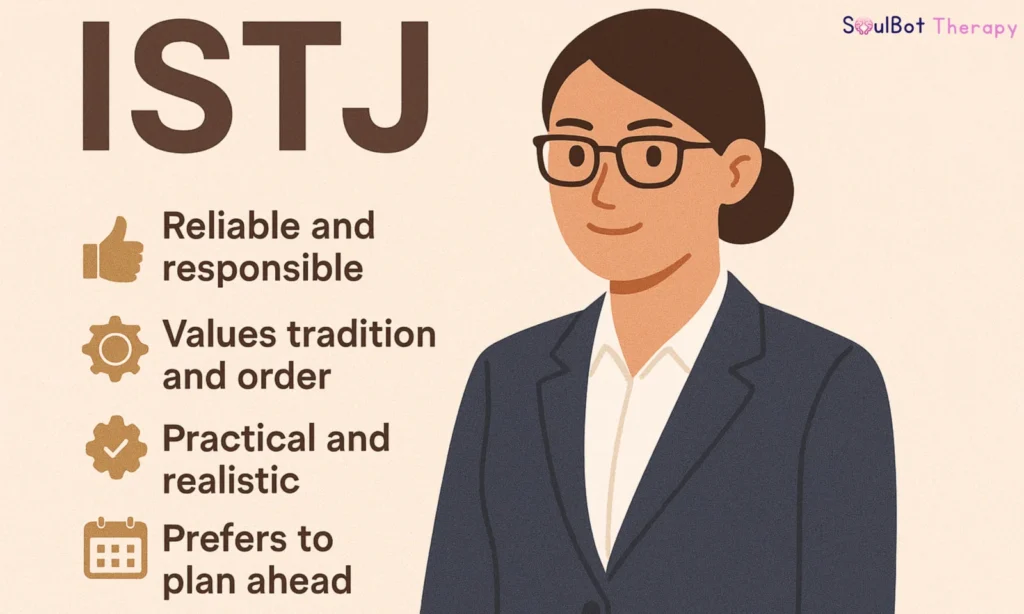
ISTJs are often described as logical, practical, organised, and disciplined. But the deeper ISTJ meaning is about reliability: you tend to notice details, value responsibility, and follow through when other people are counting on you.
“Logistician” is a popular online nickname for the ISTJ personality type, not a clinical or diagnostic label.
🧠 Take the Free Personality Type Test to explore your preferences, strengths, and communication style.ISTJ Meaning: Quick Answer
ISTJ stands for Introverted, Sensing, Thinking, and Judging.
People with an ISTJ personality type commonly prefer:
- quiet time to recharge
- facts and practical information
- logical decision-making
- structure, planning, and clear expectations
ISTJ describes personality preferences, not intelligence, ability, character, or mental health.
ISTJ Meaning: What the Four Letters Represent
- I — Introverted: You usually recharge through solitude or quiet environments.
- S — Sensing: You focus on facts, details, and what can be observed in the present.
- T — Thinking: You tend to consider logic and consistency when making decisions.
- J — Judging: You generally prefer plans, structure, and clear expectations.
These are preferences, not strict rules. An ISTJ can still be sociable, creative, emotionally aware, or spontaneous.
Core ISTJ Traits
Here’s what defines an ISTJ personality type:
- Practical and realistic
- Detail-oriented and thorough
- Reliable and consistent
- Calm under pressure
- Honest and direct
- Loyal to commitments
- High sense of personal responsibility
- Structured decision-making
- Deeply observant
ISTJs are often the people others trust most because you’re stable, steady, and predictable in the best way.
ISTJ Strengths and Weaknesses
Every personality has both, and ISTJs shine through their consistency.
⭐ ISTJ Strengths
- Strong work ethic
- Unmatched reliability
- Excellent memory
- Logical and level-headed
- Truth-focused communication
- Good at planning and execution
- Loyal, steady, and protective
⚠️ ISTJ Weaknesses
- Difficulty expressing emotions
- Resistant to sudden change
- Can appear rigid or inflexible
- Trouble with abstract ideas
- May struggle with emotional communication
- Tendency to overwork
ISTJs aren’t cold; you simply express care through action, not emotional layers.
🧠 SoulFact: The ISTJ's second most-used cognitive function, Extraverted Thinking (Te), is their primary tool for dealing with the outside world.
ISTJ-A vs ISTJ-T: What’s the Difference?
ISTJ-A: Assertive
People using this label may describe themselves as:
- More confident under pressure
- Less affected by criticism
- More independent in decision-making
- Less likely to second-guess themselves
ISTJ-T: Turbulent
People using this label may describe themselves as:
- More sensitive to feedback
- More self-critical
- More perfectionistic
- More likely to review decisions carefully
Important: Assertive and Turbulent are not part of the official four-letter Myers-Briggs framework. Both labels still share the core ISTJ preferences.
Is ISTJ a Common Personality Type?
Yes. ISTJ is generally considered one of the more common personality types.
Published estimates vary by country, population, and assessment sample. MBTIonline reports that approximately 15.9% of its global sample identifies as ISTJ, so avoid presenting one percentage as universally applicable.
Being common does not mean every ISTJ behaves the same way. Life experience, culture, values, and emotional development also shape personality.
ISTJ Compatibility and Relationships
ISTJs often value:
- Loyalty
- Honesty
- Consistency
- Long-term commitment
- Respect for personal space
- Clear communication
They may show love by keeping promises, solving practical problems, remembering responsibilities, and being present when support is needed.
There is no single “best match” for an ISTJ. Compatibility depends more on shared values, communication, emotional maturity, and mutual respect than on four-letter personality combinations.
Famous ISTJ Characters & Celebrities
Here are well-known ISTJs (popular keyword):
Fictional ISTJs
- Brienne of Tarth (Game of Thrones)
- Hermione Granger (argued but commonly typed)
- Captain America (MCU)
Real-Life ISTJs
- Angela Merkel
- Warren Buffet
- George Washington
- Natalie Portman
These typings are interpretations, not verified psychological assessments. They are best treated as examples for discussion rather than confirmed facts.
🧠 SoulFact: In MBTI type dynamics, ISTJs are associated with dominant Introverted Sensing (Si), which compares present information with past experience, and auxiliary Extraverted Thinking (Te), which helps organise decisions and tasks logically.
ISTJ Communication & Work Style
Communication
ISTJs are:
- direct
- honest
- logical
- calm
- reserved emotionally
You speak with clarity and purpose, no fluff.
Work Style
You work best when:
- Tasks are clear
- expectations are realistic
- systems are stable
- goals are structured
You excel in roles requiring precision, reliability, and accountability.
How ISTJs Can Grow Without Changing Who They Are
Growth for an ISTJ may involve:
- Explaining feelings instead of expecting actions to speak for themselves
- Allowing small changes without assuming the whole plan will fail
- Asking for help before reaching burnout
- Listening to emotional concerns before offering solutions
- Leaving room for flexibility when circumstances change
You do not need to become a different personality. The goal is to use your natural strengths without letting structure turn into rigidity.
How Can Soululu Support ISTJ Growth?
Soululu can help you reflect on:
- Emotional patterns
- Communication habits
- Difficulty adapting to change
- Stress and over-responsibility
- Boundaries and relationship needs
💬 Talk to Soululu when you need a quiet space to organise your thoughts before a difficult conversation.
🧠 Take the Free Personality Type Test to explore whether ISTJ fits your natural preferences.