
Quick Answer: How Do You Overcome Rejection in Love?
To overcome rejection in love, focus on accepting what happened without turning it into a judgment about your worth.
Start with four steps:
- Feel the loss instead of pretending it does not hurt.
- Reduce behaviors that reopen the wound, such as repeatedly checking their profile or seeking explanations.
- Separate rejection from self-worth — someone not choosing a relationship with you does not determine your value.
- Rebuild parts of your life that became centered around that person.
Healing from romantic rejection is rarely instant. The goal is not to erase the person from your memory. It is to reach a point where the rejection no longer controls your thoughts, behavior, or sense of self.
Why Does Rejection in Love Hurt So Much?
Romantic rejection combines several losses at once.
You may lose:
- The person;
- Emotional closeness;
- Routines you shared;
- Plans you imagined;
- Reassurance and belonging;
- Part of the identity you built around the relationship.
There is also evidence explaining why rejection can feel physically painful.
A well-known brain-imaging study of people who had recently experienced an unwanted breakup found that thinking about an ex-partner activated some brain regions also involved in physical pain.
However, emotional rejection and physical injury are not neurologically identical. Later research found distinct neural patterns for physical pain and social rejection despite some overlapping brain activity.
So saying:
“Heartbreak hurts like physical pain”
is a useful description of the intensity.
It does not mean your brain treats a breakup exactly like a physical injury.
Why Can’t I Stop Thinking About the Person Who Rejected Me?
Sometimes the hardest part is not the rejection itself. It is the mental replay afterward:
- “What did I do wrong?”
- “What if I had acted differently?”
- “Will they change their mind?”
- “Was any of it real?”
This is rumination repeatedly returning to distressing thoughts without reaching a useful resolution.
Try distinguishing reflection from rumination.
| Reflection | Rumination |
|---|---|
| What can I learn from this? | Why wasn’t I enough? |
| What would I want differently next time? | What if I replay every conversation? |
| Which boundary did I ignore? | How do I make them reconsider? |
| What do I need now? | What are they doing right now? |
Reflection eventually gives you somewhere to go.
Rumination keeps bringing you back to the same question.
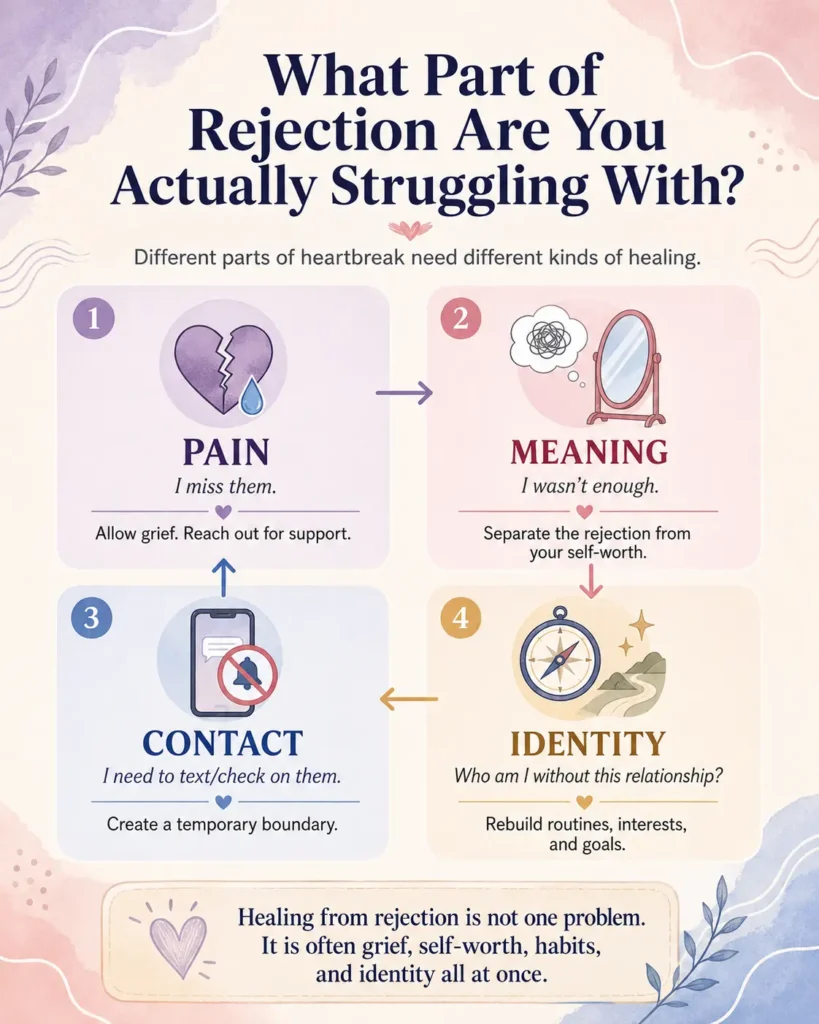
The SoulBot Rejection Recovery Map
When rejection feels overwhelming, identify which part is hurting most.
1. PAIN — “I miss them”
You are grieving the connection.
What helps
Allow the disappointment without rushing yourself into:
“I should be over this.”
Breakups can bring sadness, anger, loneliness, guilt, relief, confusion, or numbness, and there is no single correct emotional response.
Try:
“This hurts because this relationship mattered to me.”
That is different from:
“This hurts because I am unlovable.”
2. MEANING — “What does this say about me?”
This is where rejection often becomes a self-worth problem.
You may start thinking:
- I wasn’t attractive enough.
- I’m difficult to love.
- Everyone eventually leaves.
- I’ll never find anyone else.
Pause there.
Use the Rejection–Meaning Split
Write:
What happened:
“They did not want to continue the relationship.”
What my mind says it means:
“I wasn’t good enough.”
Those are not the same statement.
A person can reject a relationship for reasons of compatibility, timing, attraction, readiness, circumstances, priorities, or countless others.
You do not need to turn their decision into your identity.
3. CONTACT — “I keep checking”
After rejection, you may repeatedly:
- Reread messages;
- Check whether they viewed your story;
- Monitor who they follow;
- Find reasons to text;
- Ask mutual friends about them.
These behaviors can create a brief sense of connection while repeatedly bringing your attention back to the rejection.
Try a contact boundary
Instead of declaring:
“I will never think about them again.”
Choose something concrete:
“For the next seven days, I will not check their social media.”
Mute, unfollow, archive, or create distance if that helps you stop reopening the same emotional loop.
This is not punishment.
It is a boundary for your recovery.
4. IDENTITY — “Who am I without this relationship?”
This part is often missed in generic heartbreak advice.
Research following people after romantic separation found that difficulty reorganising one’s self-concept after a breakup was associated with poorer psychological well-being.
Ask yourself:
Before this relationship, what was mine?
- friendships;
- interests;
- routines;
- ambitions;
- places;
- music;
- hobbies;
- goals.
What disappeared while I was in it?
Choose one thing to bring back.
Recovery is not only:
“Stop missing them.”
It is also:
“Start becoming recognisable to yourself again.”
How to Move On After Romantic Rejection
1. Stop Trying to Get the Perfect Explanation
Sometimes you will receive closure.
Sometimes you will receive:
- “I’m just not ready.”
- “I don’t feel the same.”
- “It’s not working for me.”
And sometimes you receive almost nothing. You can spend months searching for an explanation detailed enough to remove the pain. It may never exist.
Ask:
“Do I need more information, or am I hoping for an answer that makes the rejection disappear?”
Closure can sometimes mean accepting the information you already have.
2. Don’t Use Their Attention to Repair the Rejection
A common rejection loop looks like:
They reject you
↓
You feel unwanted
↓
You seek reassurance from them
↓
They respond
↓
You temporarily feel better
↓
You need reassurance again
The person connected to the wound may not always be the one responsible for regulating it.
Turn toward:
- Trusted friends;
- Family;
- Your own routines;
- Journaling;
- Professional support.
3. Practice Self-Compassion Instead of Forced Confidence
You do not have to jump from:
“I’m devastated.”
to:
“I’m amazing and they lost me.”
A more believable response is:
“I’m hurting, and being rejected does not make me defective.”
Research has linked greater self-compassion with healthier interpersonal functioning, and studies of separation have found it associated with better emotional recovery.
4. Rebuild Your Week, Not Your Entire Life
Heartbreak creates empty spaces.
- Friday night was theirs.
- Your commute included their calls.
- Your phone used to light up with their name.
- Those spaces become triggers.
- Replace them deliberately.
Choose:
- One person to reconnect with.
- One place to go.
- One activity that belongs only to you.
You don’t need to reinvent yourself immediately.
You need new experiences that aren’t centered on the rejected relationship.
Is Rejection Triggering an Attachment Pattern?
Sometimes the intensity of rejection is connected not only to the current person but also to fears such as:
- Being abandoned;
- Not being enough;
- Needing constant reassurance;
- Panicking when someone becomes distant;
- Finding uncertainty almost unbearable.
If that sounds familiar, the Free Attachment Style Test can help you reflect on how you respond to closeness, distance, reassurance, and relationship uncertainty.
Quick self-check · Instant result · Not a diagnosis
👉 Take the Free Attachment Style Test
Related: Fear of Losing Someone: Why It Hurts and How to Cope
What Not to Do After Rejection
Avoid turning healing into another way to stay attached.
Don’t immediately force friendship
Friendship may be possible later.
But if every conversation secretly makes you hope they will reconsider, distance may be healthier first.
Don’t compare yourself with whoever comes next
Their next relationship does not explain your value.
Don’t try to make them jealous
It keeps your behavior organized around their attention.
Don’t rush into another relationship just to feel wanted
Connection may temporarily numb rejection without resolving what happened.
Don’t give yourself a deadline
There is no scientifically established number of days after which you “should” be over someone.
How Do You Know You’re Healing From Rejection?
Healing does not necessarily mean you never think about them.
Look for smaller changes:
- You check their social media less;
- Memories don’t ruin the entire day;
- You stop rehearsing imaginary conversations;
- You can acknowledge both the good and bad parts of the relationship;
- You begin planning things without imagining them there;
- Your self-worth feels less connected to their opinion;
- Curiosity about your own future begins to return.
Progress can be uneven.
A difficult day does not mean you are back at the beginning.
Try the SoulBot 5-Minute Rejection Check-In
When you feel the urge to contact them, ask:
1. What happened just before this feeling?
2. What am I feeling — sadness, loneliness, rejection, jealousy, fear?
3. What am I hoping contact will give me?
4. Will that relief probably last?
5. What else could meet that need tonight?
This turns:
“I need to text them.”
into:
“I need comfort, reassurance, connection, or certainty.”
Once you know the actual need, you have more than one way to respond.
When Should You Seek Help After Rejection?
Most romantic rejection is painful without being a mental-health disorder.
Consider professional support when the distress:
- remains overwhelming;
- seriously affects sleep or appetite;
- makes work or study difficult;
- causes persistent anxiety or low mood;
- leads to severe isolation;
- keeps you trapped in obsessive checking or contact;
- feels impossible to manage alone.
Relationship breakup is recognized as a significant life stressor, and prolonged difficulty coping deserves support rather than dismissal as “just heartbreak.”
Want Professional Support After Heartbreak?
A therapist can help you explore:
- Why does this rejection feel so powerful;
- Attachment and abandonment fears;
- Rumination and self-blame;
- Boundaries with an ex;
- Rebuilding confidence and identity;
- Relationship patterns you do not want to repeat.
Talk to Soululu When You Want to Text Them Again
Before reopening the conversation, use Soululu to explore:
- What triggered me?
- What am I hoping they will say?
- Do I want connection or reassurance?
- What would contacting them change?
- What does taking care of myself look like tonight?
Soululu supports emotional reflection. It does not provide psychotherapy or replace care from a qualified mental-health professional.
Final Thought
Rejection says:
“This connection wasn’t chosen or continued.”
Your hurt mind may translate it into:
“I wasn’t worth choosing.”
Those sentences are not the same.
Healing from rejection is partly grieving another person. But it is also slowly separating their decision from your identity and helping you build a life that feels like yours again.