

Quick Answer: How Does Couples Therapy Work?
Couples therapy helps partners understand repeated relationship patterns, communicate more clearly and handle conflict without blaming each other.
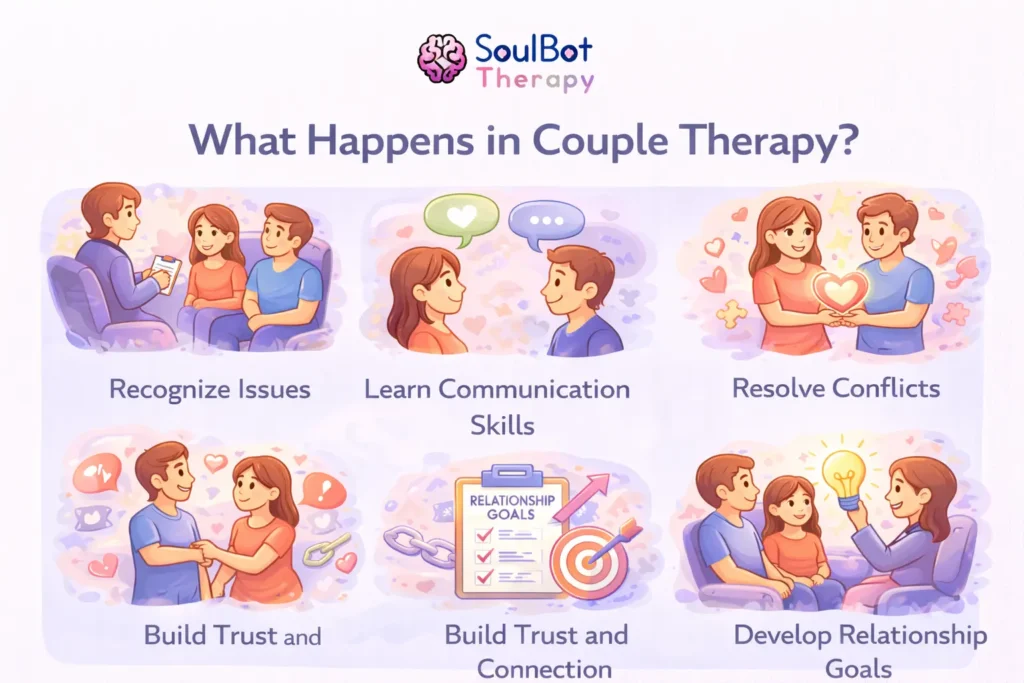
A therapist usually:
- learns about your relationship history and current concerns;
- listens to both perspectives;
- identifies the cycle keeping you stuck;
- helps you practise healthier responses;
- creates clear relationship goals with you.
The aim is not to decide who is right. It is to understand what happens between you and what both partners can do differently.
What Is Couples Therapy?
Couples therapy is a form of psychotherapy focused on the relationship rather than treating one partner as “the problem.”
It can help with:
- repeated arguments;
- emotional distance;
- trust after betrayal;
- communication difficulties;
- intimacy concerns;
- parenting or financial disagreements;
- major life changes;
- deciding whether to continue the relationship.
You do not have to be married to attend. Dating, engaged, married, separated, queer and non-monogamous partners may all seek couples therapy.
Marriage and family therapists are trained to examine how relationship patterns affect both individuals rather than viewing each person in isolation.
What Happens in the First Couples Therapy Session?
The first session is usually an assessment, not an attempt to fix the entire relationship.
The therapist may ask:
- What brought you to therapy now?
- How did your relationship begin?
- When did the current problems start?
- What happens during a typical disagreement?
- What does each partner want to change?
- Are there concerns involving safety, addiction or mental health?
Some therapists meet both partners together throughout the assessment. Others may include short individual meetings before creating a treatment plan. The exact process depends on the therapist’s approach and confidentiality policy.
What should you prepare?
You do not need a perfect explanation.
Before the session, think about:
- the main pattern that keeps repeating;
- how that pattern affects you;
- what you hope will feel different after therapy.
Try not to prepare a case proving why your partner is wrong. Bring examples, but stay open to examining your own reactions too.
What Do Couples Work on During Therapy?
1. Repeated Conflict Cycles
A therapist may help you notice a pattern such as:
One partner asks for reassurance → the other feels criticised and withdraws → the first partner becomes more anxious and pushes harder.
The problem is no longer simply “you are needy” or “you never communicate.” The couple can see the cycle both people are caught in.
2. Clearer Communication
You may practise:
- describing behaviour without insults;
- stating needs directly;
- listening without interrupting;
- checking what you understood;
- taking a timed break when emotions become overwhelming.
Related: Conflict Resolution in Relationships: Strategies That Work
3. Trust and Emotional Safety
After lying, betrayal or repeated disappointment, therapy may focus on:
- honest disclosure;
- accountability;
- understanding the impact of what happened;
- agreeing on boundaries;
- rebuilding reliability through consistent actions.
Forgiveness is not forced, and trust is not restored through one apology.
Take the Free Emotional Availability Test to reflect on your emotional awareness, expression, responsiveness and relationship openness.
15 questions · Instant result · For self-reflection only
4. Emotional and Physical Intimacy
Partners may discuss affection, sex, emotional distance, rejection or differences in how they express care.
The therapist helps make these conversations clearer and less blaming.
Sometimes partners care deeply but express love in ways the other person does not easily recognise.
The Free Love Language Test can help you explore how you prefer to give and receive affection, attention and emotional support.
5. Shared Decisions
Therapy can also address practical tension involving:
- money;
- household responsibilities;
- parenting;
- family involvement;
- work-life balance;
- future plans.
The goal is usually a workable agreement, not identical opinions.
What Are the Ground Rules for Couples Therapy?
A therapist will explain their own policies, but healthy sessions usually require:
- no threats or humiliation;
- one person speaking at a time;
- honest participation;
- responsibility for personal behaviour;
- willingness to hear another perspective;
- respect for agreed boundaries.
Confidentiality in couples therapy can be more complex than individual therapy because more than one person is involved. Ask the therapist how private disclosures, individual sessions and therapy records are handled before beginning.
Does Couples Therapy Actually Work?
It can help, but results are not guaranteed.
A recent systematic review found that couples interventions generally improved relationship distress, communication and satisfaction. However, results varied across studies, and the researchers noted differences in therapy types and study quality.
Therapy is more likely to be useful when both partners:
- attend consistently;
- speak honestly;
- practise skills outside sessions;
- accept responsibility;
- are willing to change behaviour, not only explain it.
Therapy can also help couples make a clearer and more respectful decision about separation when staying together is no longer the shared goal.
When Should You Consider Couples Therapy?
Consider speaking with a couples therapist if:
- the same argument keeps returning;
- conversations quickly become defensive;
- emotional or physical intimacy has reduced;
- trust has been damaged;
- resentment is building;
- a life transition is creating distance;
- you are unsure whether to stay together;
- you want support before the relationship reaches crisis.
You do not need to wait until the relationship feels broken.
Related: Relationship Growth Checklist: Are You Growing Together or Apart?
When Couples Therapy May Not Be Safe
Ordinary conflict and abuse are not the same.
Joint counselling may be unsafe when one partner uses:
- Threats or intimidation;
- Physical or sexual violence;
- Financial control;
- Monitoring;
- Isolation;
- Fear to control the other person.
The National Domestic Violence Hotline does not recommend standard couples counselling with an abusive partner because the power imbalance can make honest participation unsafe. Seek individual and specialist domestic-abuse support instead.
How to Choose a Couples Therapist
Ask potential therapists:
- Are you licensed to provide psychotherapy where I live?
- How much experience do you have with couples?
- Which therapy approach do you use?
- How do you handle confidentiality and individual disclosures?
- Do you have experience with our specific concern?
- What happens if one partner wants to leave?
The therapist should make space for both partners without ignoring harmful behaviour.
Talk to Soululu Before Your First Session
It can be difficult to explain your relationship when several feelings are mixed together.
Talk to Soululu to reflect on:
- what keeps happening during conflict;
- what you feel but struggle to express;
- what you need from your partner;
- what you want to discuss in therapy;
- one calm way to start the conversation.
Soululu supports emotional reflection and preparation. It does not provide couples therapy or replace a licensed professional.
Final Thought
Couples therapy is not a courtroom, and the therapist is not a judge.
It is a structured space to understand your relationship patterns, practise healthier responses and decide what both partners are willing to change.
You do not need to arrive with all the answers. You only need enough honesty to begin.