

Conflict Resolution in Relationships: 5 Steps That Actually Work

Last Updated: July 21, 2026
Conflict Resolution in Relationships
Table of Contents

Quick Answer: How Do You Resolve Conflict in a Relationship?

Healthy conflict resolution means discussing one problem without attacking, humiliating or silencing each other.

Use this five-step process:

  1. Pause if either person feels overwhelmed.
  2. Explain the problem without blame.
  3. Say what you feel and need.
  4. Listen and repeat what you understood.
  5. Agree on one specific next step.

Conflict is normal. Repeated threats, control, insults or fear are not normal disagreements.

👉 Take the SoulBot social Anxiety test to reflect on how you recognise, understand and manage emotions.

What Causes Conflict in Relationships?

Relationship conflict commonly starts when partners have different needs, expectations or ways of communicating.

Frequent triggers include:

  • Money and spending
  • Household responsibilities
  • Time and attention
  • Family involvement
  • Physical or emotional intimacy
  • Different communication styles
  • Jealousy or trust concerns
  • Unresolved past arguments

The visible argument is not always the real problem.

A fight about dishes may actually be about feeling unsupported. A disagreement about texting may be about reassurance or personal space.

Before trying to solve the issue, ask:

“What does this problem mean to each of us?”

How to Resolve Conflict in a Relationship

1. Pause Before the Argument Escalates

If you are shouting, shaking, shutting down or unable to listen, pause the conversation.

Say:

“I want to resolve this, but I’m too overwhelmed right now. Can we continue in 20 minutes?”

Use the break to calm down, not prepare a stronger attack. The Gottman Institute recommends taking a short break when conflict becomes emotionally overwhelming and returning once both partners can listen again.

Always agree on when you will return. Walking away without explanation can feel like punishment.

2. Start Softly, Without Blame

The beginning of a difficult conversation often shapes what happens next.

Avoid:

“You never care about what I need.”

Try:

“I felt unimportant when our plans changed without a conversation. Can we talk about how to handle this next time?”

A useful structure is:

“I feel ___ when ___ happens. I need ___.”

A soft start-up allows you to raise a problem without turning your partner into the problem.

3. Discuss One Issue at a Time

Do not add five old arguments to the current one.

Focus on:

  • What happened
  • How it affected you
  • What needs to change now

Avoid words such as “always” and “never” unless they are genuinely accurate.

Clear boundaries can also prevent repeated conflict. Read How to Set Healthy Relationship Boundaries.

4. Listen to Understand, Not to Prepare Your Reply

After one partner speaks, the other should explain what they heard.

Try:

“What I’m hearing is that you felt ignored when I checked my phone during dinner. Is that right?”

Validation does not mean agreeing with every detail. It means showing that the other person’s emotional experience makes sense from their perspective.

If opening up feels difficult, read Why Some People Struggle to Open Up.

5. Agree on One Clear Change

“Communicate better” is too vague.

Choose a specific action:

  • Put phones away during dinner
  • Discuss purchases above a decided amount
  • Divide one household task differently
  • Send a message when plans change
  • Schedule a weekly 20-minute check-in

Healthy couples do not need to solve everything in one conversation. Regular check-ins help partners discuss concerns before they become larger arguments.
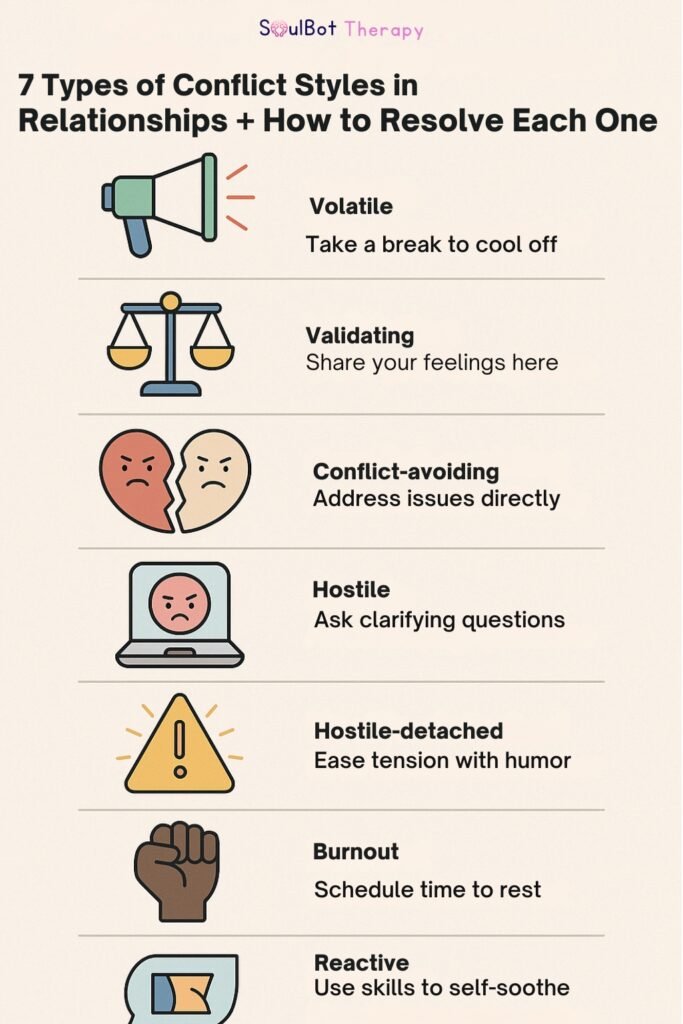
types of conflict relationship style

What if You Keep Fighting About the Same Thing?

Some relationship problems can be solved. Others come from lasting differences in personality, priorities or lifestyle.

Gottman’s research suggests that around 69% of marital conflicts are recurring or “perpetual.” The goal is not always to eliminate the disagreement. It may be to understand the deeper need and manage the difference respectfully.

For example, one partner may value planning while the other values flexibility. Neither preference must disappear, but both people need a workable compromise.

Use the Relationship Growth Checklist to assess whether disagreements lead to understanding or repeated emotional distance.

Common Conflict Resolution Mistakes

MistakeTry this instead
Blaming or insultingDescribe the behaviour and its impact
InterruptingLet each person finish
Bringing up old argumentsDiscuss one current issue
Giving the silent treatmentRequest a timed break
Apologising without changeAgree on a specific action
Trying to “win”Focus on solving the shared problem

Conflict or Abuse: Know the Difference

Conflict resolution strategies work only when both partners can speak freely and safely.

The issue may be abuse rather than normal conflict when there are repeated:

  • Threats or intimidation
  • Humiliation
  • Physical or sexual violence
  • Control over money, clothing or friendships
  • Phone or location monitoring
  • Fear of disagreeing

Abuse involves power and control. Better communication alone does not make an abusive situation safe.

Try the SoulBot Conflict Reset

Before your next difficult conversation, answer three questions:

  1. What happened without adding assumptions?
  2. What did I feel or need?
  3. What clear request can I make now?

Talk to Soululu to organise your thoughts, prepare a calm message or reflect on repeated conflict patterns.

Soululu supports self-reflection. It does not replace couples therapy, professional mental health care or emergency support.

Final Thought

Healthy conflict resolution is not about avoiding disagreements.

It is about staying respectful, listening properly and leaving the conversation with a clear next step.

You and your partner are not opponents. The repeated problem is what you need to solve together.

Sources

FAQ

Frequently Asked Questions

Pause if emotions are high, discuss one issue without blame, listen to each other’s perspective and agree on one practical change.
Use a soft start-up, stay on one topic, listen without interrupting, take timed breaks and create a specific agreement.
Yes. Healthy couples disagree. What matters is whether both people remain respectful, feel safe and make genuine repair attempts.
A break of around 15–30 minutes may help both people calm down. Agree on a return time so the pause does not become avoidance or silent treatment.
State the issue calmly and explain what you need. You cannot force someone to communicate. Consider professional support if refusal, stonewalling or repeated disrespect continues.

About the Author:

Picture of Sonali Shastri

Sonali Shastri

Sonali Shastri is the Co-founder of SoulBot Therapy and a passionate writer dedicated to helping individuals navigate their emotional and spiritual journey. With a background in psychology-based writing and storytelling, she specializes in creating content that blends empathy with impact. Her work focuses on mental wellness, self-discovery, and breaking the stigma around emotional health through honest, relatable narratives.

More Blog Posts

You May Look Fine, But It Feels Heavy Inside

Ready to explore your full SoulMap?

🟢The Grounded Socializer

Social Moments Feel Mostly Manageable

Ready to explore your full SoulMap?

🟡The Quiet Overthinker

You Show Up, But Your Mind Replays It

Ready to explore your full SoulMap?

🟠The Cautious Connector

Connection Matters, But It Can Feel Hard

Ready to explore your full SoulMap?

Your emotional compass wants love, but stays cautious.

Ready to explore your full SoulMap?

Avoidant Attachment
Independent, With Boundaries

Your emotional compass values space and self-reliance.

Ready to explore your full SoulMap?

Anxious Attachment
Deep, But Seeking Reassurance

Your emotional world is intense and connection-driven.

Ready to explore your full SoulMap?

Secure Attachment – Calm & Connected

Your emotional compass feels steady and safe.


Ready to explore your full SoulMap?

The Storm Mind (Severe Anxiety)

Intense, overwhelming, and hard to control at times.

Ready to explore your full SoulMap?

The Overthinker (Moderate Anxiety)

Your mind is active, often running ahead of you.

Ready to explore your full SoulMap?

The Gentle Worrier (Mild Anxiety)

Occasional overthinking, but still in control.
You feel stress at times, but it doesn’t take over your day.

Ready to explore your full SoulMap?

Moderately Emotionally Available- Opening, With Caution

Your emotional compass shows growth, with a few guarded zones.

Ready to explore your full SoulMap?

Your emotional compass points toward openness and connection.

Ready to explore your full SoulMap?

Your emotional compass leans toward self-protection right now.

Ready to explore your full SoulMap?

Submissive Personality

Gentle and supportive. You bring calm energy and emotional depth to every space.

Ready to explore your full SoulMap?

Balanced Personality

Grounded and fair-minded. You value harmony, empathy, and shared understanding.

Ready to explore your full SoulMap?

Dominant Personality

Driven and decisive. You lead naturally, think fast, and act with purpose.

Ready to explore your full SoulMap?

Homosexual —
True North, Same-Gender

Your love compass points to people of the same gender.

Ready to explore your full SoulMap?

Restless and always in motion. May talk fast, act quickly, or jump between ideas. 

Ready to explore your full SoulMap?

High Likelihood
ADHD Combined Type (ADHD-C)

Shows both inattentive and hyperactive traits where focus shifts, energy spikes, and motivation come in waves.

Ready to explore your full SoulMap?

Low Likelihood
ADHD Inattentive Type (ADHD-I)

Often loses focus and misses details, with drifting thoughts that leave tasks unfinished.

Ready to explore your full SoulMap?

🔧 The Virtuoso - ISTP

Hands-On Expert

Ready to explore your full SoulMap?

📋 The Logistician - ISTJ

Steady Rock

Ready to explore your full SoulMap?

🌻 The Adventurer - ISFP

Gentle Spirit

Ready to explore your full SoulMap?

🛡️ The Defender - ISFJ

Caring Guardian

Ready to explore your full SoulMap?

🤔 The Logician - INTP

Curious Explorer

Ready to explore your full SoulMap?

🏛️ The Architect - INTJ

Strategic Mastermind

Ready to explore your full SoulMap?

🦄 The Mediator - INFP

Gentle Idealist

Ready to explore your full SoulMap?

🔮 The Advocate - INFJ

Quiet Visionary

Ready to explore your full SoulMap?

🚀 The Entrepreneur - ESTP

Action Hero

Ready to explore your full SoulMap?

📊 The Executive - ESTJ

Results Driven

Ready to explore your full SoulMap?

🎭 The Entertainer - ESFP

Life of the Party

Ready to explore your full SoulMap?

🤗 The Consul - ESFJ

Heart of Gold

Ready to explore your full SoulMap?

🧠 The Debater - ENTP

Mental Gymnast

Ready to explore your full SoulMap?

👑 The Commander - ENTJ

Strategic Powerhouse

Ready to explore your full SoulMap?

🎨 The Campaigner - ENFP

Creative Visionary

Ready to explore your full SoulMap?

🌟 The Protagonist - ENFJ

Natural Born Leader

Ready to explore your full SoulMap?

🤗 Physical Touch

Hugs Over Hype

Ready to explore your full SoulMap?

🕰 Quality Time

Presence Over Presents

Ready to explore your full SoulMap?

🎁 Receiving Gifts

Thoughtful Tokens, Big Feelings

Ready to explore your full SoulMap?

🤝 Acts of Service

Love in Action

Ready to explore your full SoulMap?

Words of Affirmation

You Speak from the Heart

Ready to explore your full SoulMap?

Gay, Lesbian, or
Queer and Proud

Your love compass points to the same gender

Ready to explore your full SoulMap?

Bisexual -
Go with the Flowy

Your love compass swings in the middle

Ready to explore your full SoulMap?

Heteroflexible —
Some Wiggle in the Compass

You’ve got a touch of bi-curiosity

Ready to explore your full SoulMap?

Hetero -
Straight Up Honest

Your love compass points to the opposite sex.

Ready to explore your full SoulMap?