
Ever wondered why you naturally take charge in some relationships while preferring someone else to lead in others?
Your dominant or submissive personality isn’t about being stronger, weaker, controlling, or passive. It’s about how you naturally communicate, make decisions, express trust, and feel emotionally safe.
Most people aren’t completely dominant or submissive. Instead, they fall somewhere on a spectrum, and that can change depending on the relationship, environment, and level of emotional security.
👉 Take the Dominant or Submissive Personality Test to discover your natural relationship style.
What Is a Dominant or Submissive Personality?
A dominant personality usually feels comfortable leading, making decisions, and taking responsibility.
A submissive personality often feels more comfortable supporting, adapting, and building trust through cooperation.
Neither personality is better than the other.
Healthy dominance is about leadership without control.
Healthy submission is about trust without losing yourself.
Most people naturally show both dominant and submissive traits depending on the situation and the people around them.
What Does Dominant and Submissive Personality Mean?
Dominance and submission are personality tendencies, not fixed identities.
They describe how you naturally respond to responsibility, communication, conflict, and emotional connection.
For example:
A dominant personality may feel more comfortable:
- taking initiative
- making decisions
- solving problems
- creating structure
- protecting loved ones
A submissive personality may naturally prefer:
- collaboration
- emotional harmony
- supporting others
- adapting when needed
- building trust through connection
These tendencies are not the same as BDSM or sexual preferences, although some people may experience overlap. In this article, we’re talking about everyday relationship dynamics and personality styles.
SoulFact: Personality psychologists view dominance and submission as behavioural tendencies rather than permanent labels. They can be influenced by temperament, life experiences, confidence, attachment style, and emotional safety.
Can You Be Both Dominant and Submissive?
Yes. In fact, most people are.
One of the biggest myths is that you must choose one personality forever. Real life doesn’t work that way.
You might be:
- confident and decisive at work, but gentle and adaptable in your relationship
- the leader in your family, but happy letting your partner plan vacations
- dominant during stressful situations, but more submissive when you feel emotionally safe
Your personality isn’t fixed.
It changes with:
- trust
- confidence
- emotional safety
- life experiences
- the people around you
The healthiest people aren’t permanently dominant or submissive. They’re emotionally flexible.
👉 If you’re unsure where you naturally fall, our Dominant or Submissive Personality Test helps you understand your default relationship style and emotional patterns.
Dominant Personality Traits
People with a dominant personality often enjoy taking responsibility—not because they want control, but because they feel comfortable creating direction.
You may have a dominant personality if you:
- Naturally take the lead in conversations or decisions
- Enjoy solving problems instead of waiting for others
- Stay calm during stressful situations
- Value independence and self-reliance
- Protect the people you care about
- Become frustrated when plans lack direction
- Prefer taking action rather than waiting
Many dominant personalities show love through actions rather than words.
Instead of saying “I care,” they might fix a problem, organise a plan, or make life easier for someone they love.
Strengths of a Dominant Personality
- Confident decision-making
- Reliability
- Practical problem-solving
- Resilience under pressure
- Leadership
- Strong sense of responsibility
Challenges
Without emotional awareness, dominant personalities may:
- Struggle to ask for help
- Become overly controlling
- Find it difficult to express vulnerability
- Unintentionally dismiss other people’s opinions
Healthy dominance creates safety. Unhealthy dominance creates control.
Submissive Personality Traits
Being submissive doesn’t mean being weak.
It means you often find comfort in cooperation, emotional connection, and mutual trust. Many submissive personalities naturally focus on maintaining harmony instead of controlling situations.
You may have a submissive personality if you:
- enjoy supporting people you love
- avoid unnecessary conflict
- easily adapt to changing situations
- prefer shared decision-making
- feel happiest when relationships are emotionally stable
- express love through care and empathy
- naturally consider other people’s needs
Submissive personalities often notice emotions that others miss. Their emotional awareness allows them to create comfort and connection within relationships.
Strengths of a Submissive Personality
- empathy
- patience
- emotional intelligence
- flexibility
- compassion
- loyalty
Challenges
Without healthy boundaries, submissive personalities may:
- struggle to say no
- become people-pleasers
- ignore their own needs
- stay in unhealthy relationships for too long
Healthy submission is based on trust.
Unhealthy submission sacrifices self-worth.
Dominant vs Submissive Personality: What’s the Difference?
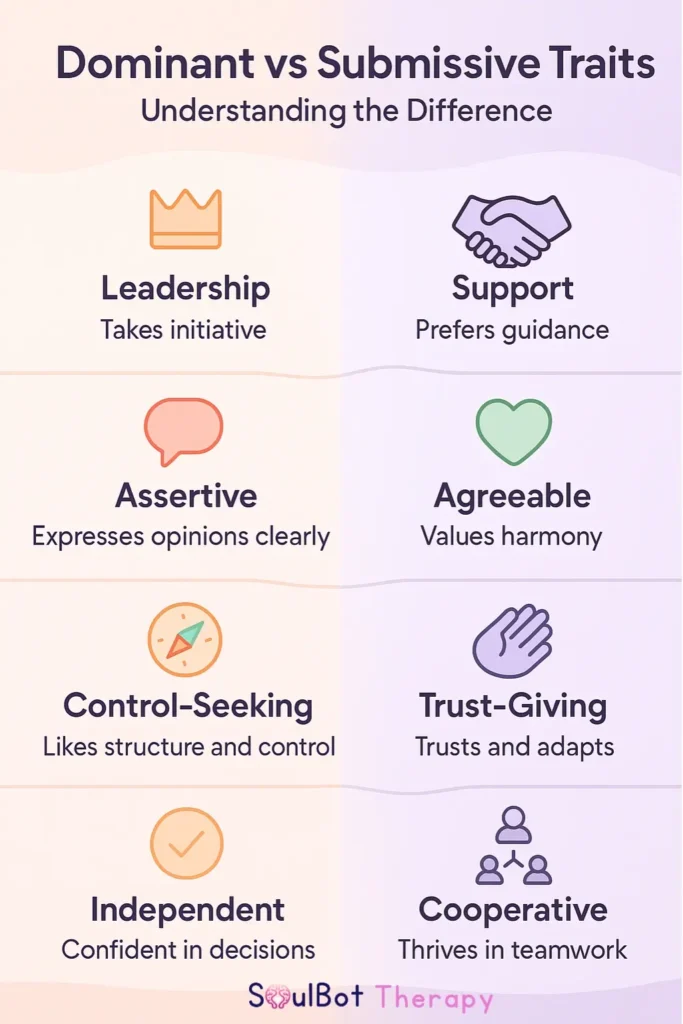
| Dominant Personality | Submissive Personality |
| Enjoys leading naturally | Enjoys supporting naturally |
| Comfortable making decisions | Comfortable collaborating |
| Shows care through actions | Shows care through emotional support |
| Values independence | Values emotional connection |
| Takes initiative | Builds harmony |
| Can become controlling without empathy | Can become people-pleasing without boundaries |
Neither personality is “better.” Healthy relationships aren’t about who leads.
They’re about respecting each other’s emotional needs while sharing power in a way that feels balanced for both partners.
Real-Life Examples
Sometimes personality traits are easier to recognise in everyday situations.
Example 1: Planning a Trip
A dominant personality might naturally research hotels, book flights, and organise the itinerary.
A submissive personality may enjoy discussing ideas, supporting plans, and ensuring everyone feels included.
Both contribute differently, and both roles are equally valuable.
Example 2: During Conflict
A dominant personality may immediately look for solutions.
A submissive personality may first focus on reducing tension and protecting the emotional connection.
Healthy relationships need both practical problem-solving and emotional understanding.
Is It Better to Be Dominant or Submissive?
Neither is better.
A healthy relationship isn’t about who leads. It’s about whether both people feel heard, respected, and safe.
- A healthy dominant person leads without controlling.
- A healthy submissive person trusts without losing their own voice.
The goal isn’t to change your personality. It’s to build a balanced relationship.
How Does Your Personality Affect Relationships?
Your personality influences how you communicate, handle conflict, and express love.
A dominant personality may:
- take initiative
- solve problems quickly
- enjoy planning
- protect loved ones
A submissive personality may:
- offer emotional support
- avoid unnecessary conflict
- adapt easily
- help others feel comfortable
Both styles work well when there is mutual respect and open communication.
Can a Dominant or Submissive Personality Change?
Yes. Your personality style can change with life experiences, healthy relationships, confidence, or therapy.
For example:
- Someone who was once submissive may become more confident after setting healthy boundaries.
- Someone who always needed control may learn to trust others more over time.
Growth doesn’t mean becoming a different person. It means becoming a healthier version of yourself.
Common Myths About Dominant and Submissive Personalities
❌ Myth: Dominant people are controlling.
Reality: Healthy dominant people lead with confidence, not control.
❌ Myth: Submissive people are weak.
Reality: Healthy submission is built on trust, empathy, and emotional strength.
❌ Myth: You have to choose one forever.
Reality: Most people naturally show both traits depending on the relationship and situation.
How SoulBot Can Help
Understanding your personality is the first step toward healthier relationships.
With SoulBot, you can:
- understand your emotional patterns
- improve communication
- build healthier boundaries
- reflect on your relationships without judgment
Final Thought
Being dominant or submissive doesn’t define your worth. They’re simply different ways of connecting with others.
The healthiest relationships aren’t built on power; they’re built on trust, respect, communication, and understanding each other’s emotional needs.
Whether you naturally lead, support, or switch between the two, self-awareness helps you build stronger, healthier relationships.
💬 Chat with Soululu whenever you need support, clarity, or someone to help you understand your emotions.