

Have you ever ignored a bad feeling in a relationship because you hoped things would get better?
Most people don’t recognise relationship red flags immediately. They often appear as small behaviours that slowly become patterns, making you question yourself instead of the relationship.
The sooner you recognise unhealthy relationship behaviours, the easier it becomes to protect your emotional well-being.
In this guide, you’ll learn:
- What relationship red flags really are
- The biggest warning signs to watch for
- When a relationship can be repaired
- When it’s time to walk away
- What healthy relationships look like instead
👉 Not sure whether you’re noticing normal conflicts or serious warning signs? Take SoulBot’s Attachment Style Quiz to understand your relationship patterns.
What Are Relationship Red Flags?
Relationship red flags are behaviours that consistently make you feel unsafe, unheard, controlled, or emotionally drained.
One disagreement doesn’t automatically mean your relationship is unhealthy.
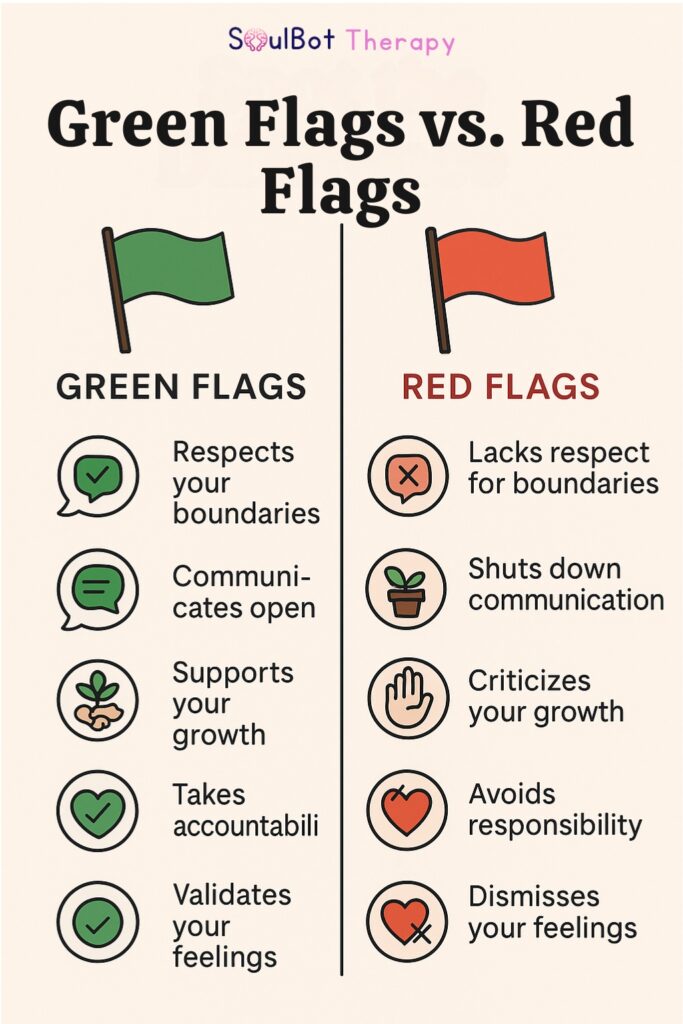
The problem begins when unhealthy behaviours become repeated patterns rather than isolated moments. Healthy relationships involve respect, accountability, communication, and emotional safety. Red flags slowly remove those foundations.
Quick Answer: What Are the Biggest Relationship Red Flags?
Some of the most common relationship red flags include:
- Constant criticism
- Emotional manipulation
- Gaslighting
- Lack of trust
- Controlling behavior
- Ignoring boundaries
- Isolation from family or friends
- Refusing accountability
- Making you question your self-worth
If several of these happen regularly, it’s worth paying attention.
9 Relationship Red Flags You Should Never Ignore
1. You Constantly Walk on Eggshells
Do you carefully think before speaking because you’re afraid your partner will become angry, distant, or upset?
Healthy relationships allow you to express yourself without fear. Living in constant anxiety is emotional control, not emotional safety.
2. They Make You Feel Guilty for Having Needs
Do you feel guilty for asking for time, affection, reassurance, or support?
Emotional manipulation often sounds like:
- “After everything I’ve done for you…”
- “You’re too needy.”
- “You’re making a big deal out of nothing.”
Healthy partners discuss needs instead of making you feel guilty for having them.
3. They Slowly Isolate You
One of the biggest relationship red flags is losing your support system.
This might look like:
- Criticising your friends
- Making you cancel family plans
- Wanting all your free time
- Making you feel guilty for spending time with others
Isolation often develops gradually, making it difficult to notice.
4. You’re Always the One Apologising
Healthy relationships involve accountability from both partners.
If every disagreement ends with you apologising even when you weren’t at fault, you may be carrying emotional responsibility that isn’t yours.
5. They Dismiss Your Feelings
Statements like:
- “You’re overreacting.”
- “You’re too sensitive.”
- “That never happened.”It
can make you question your emotions.
Feeling heard doesn’t mean your partner always agrees. It means they respect your experience.
6. You’re Afraid to Set Boundaries
Boundaries protect relationships. If saying “no” results in:
- anger
- silent treatment
- guilt
- punishment
Your boundaries aren’t being respected. Healthy love welcomes honest communication.
7. They Keep Bringing Up Your Past
Healthy conflict focuses on solving today’s problem.
Toxic conflict repeatedly weaponises yesterday’s mistakes. If every disagreement becomes a history lesson, emotional healing becomes almost impossible.
8. You Start Questioning Your Own Reality
Gaslighting is one of the most damaging relationship red flags.
Examples include:
- “That never happened.”
- “You’re imagining things.”
- “You’re remembering it wrong.”
Over time, gaslighting can reduce confidence in your own memories and emotions.
9. You Feel Drained More Than Loved
Perhaps the simplest question is:
How do you usually feel after spending time together?
Do you feel:
- calm?
- supported?
- respected?
Or do you leave feeling:
- anxious?
- emotionally exhausted?
- confused?
- guilty?
Your nervous system often notices unhealthy relationships before your mind does.
Why Do People Ignore Relationship Red Flags?
Many people stay despite obvious warning signs because of:
- Hope they’ll change
- Fear of being alone
- Financial dependence
- Children
- Trauma bonding
- Low self-esteem
- Believing “love requires sacrifice”
These experiences don’t make you weak. They make you human.
Can Relationship Red Flags Be Fixed?
Sometimes. Small relationship issues can improve when both partners:
- communicate openly
- accept responsibility
- respect boundaries
- consistently change their behaviour
However, repeated emotional abuse, manipulation, coercion, or gaslighting should never be ignored or excused.
Real change requires consistent action not promises.
What Should You Do If You Notice Relationship Red Flags?
If several of these signs feel familiar:
Reflect honestly
Journal how you feel after interactions instead of focusing only on your partner’s intentions.
Talk to someone you trust
Friends, therapists, or support groups often notice patterns we can’t see ourselves.
Rebuild your support system
Reconnect with people who help you feel safe and valued.
Learn what healthy love looks like
Sometimes we can’t recognise unhealthy relationships because we’ve never experienced healthy ones.
👉 Related Read: Relationship Green Flags: 7 Signs You’re Building It Right
Wondering Whether You’re Ignoring Red Flags?
Take SoulBot’s Love Language Test to understand whether your relationship is built on trust, respect, and emotional safety or whether you’re overlooking patterns that deserve attention.
Need Someone to Talk To?
If you’re feeling confused, emotionally drained, or unsure what to do next, you don’t have to figure everything out alone.
💬 Chat with Soululu, SoulBot’s AI mental health companion, for judgment-free guidance, emotional reflection, and support whenever you need it.
Final Thoughts
Relationship red flags don’t always begin with obvious abuse.
More often, they begin with small moments that repeatedly make you feel less safe, less confident, and less like yourself.
Healthy relationships should help you grow, not make you question your worth. Trust your intuition. Your emotional safety matters.