
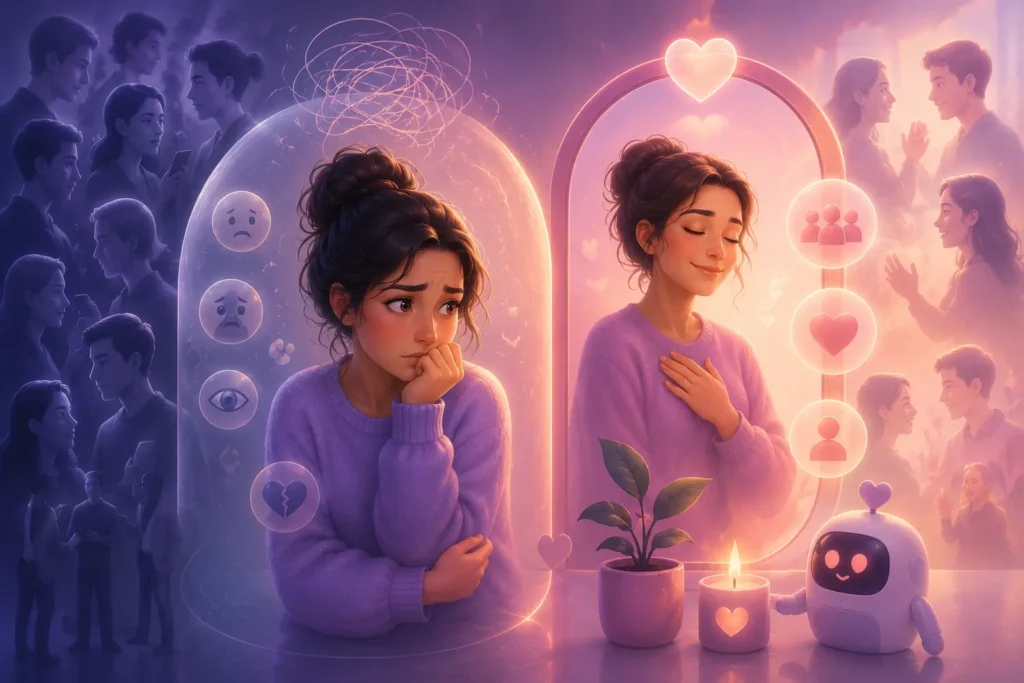
You cancel plans and feel relief, only to be immediately struck by guilt. In groups, you feel like everyone is watching, like you are somehow more visible and more at risk than anyone else in the room.
If this sounds familiar, you might be experiencing signs of social anxiety.
And the first thing to understand is this: social anxiety is not shyness. It is a condition in which everyday interactions cause significant worry and self-consciousness because you fear being judged negatively by others, and it affects far more people than most realise.
Signs of Social Anxiety: Quick Answer
- Intense fear of being judged, embarrassed, or humiliated in social situations
- Physical symptoms, such as blushing, sweating, trembling, and a racing heart, are triggered by social settings.
- Avoiding situations out of fear, not preference
- Replaying social interactions long after they happen
- Anxiety that starts days or weeks before a social event
- Knowing the fear is disproportionate, but not being able to stop it.
💬 Does this feel familiar? Talk to Soululu, a private, judgment-free space to process what you are feeling, anytime.What Is Social Anxiety?
Social anxiety disorder, also called social phobia, is one of the most common mental health conditions. It involves an intense fear of social situations in which you might be judged, embarrassed, or humiliated.
Unlike general shyness, social anxiety disorder causes significant distress and can interfere with daily activities such as work, school, and relationships.
The key difference between normal nervousness and social anxiety is impact. Most people have some anxiety about social situations, but social anxiety goes beyond typical nervousness and shyness. In social anxiety disorder, fear and anxiety lead to avoidance that can disrupt your life.
🧠 SoulFact: Social anxiety disorder affects approximately 7% of adults, making it one of the most prevalent anxiety disorders worldwide. If you relate to what you are reading, you are not alone, and you are not strange.
Emotional Signs of Social Anxiety
These are the internal experiences, the ones nobody else can see, but you carry everywhere:
Intense fear of being judged
The most prominent emotional sign of social anxiety is an excessive fear of being judged or evaluated negatively by others. This is not occasional self-consciousness. It is a persistent, underlying belief that people are watching, assessing, and finding you lacking.
Anticipatory anxiety, dreading things weeks in advance.
Fear may begin days or even weeks before a social event. You spend more time dreading something than actually doing it. By the time the event arrives, you are already exhausted from the anxiety it created.
Extreme self-consciousness
A constant feeling of being the centre of attention with negative connotations. In a room full of people, you feel like a spotlight is on you specifically. Even in ordinary conversations, you feel hyper-aware of how you come across.
Fear of embarrassment or humiliation
You are afraid you will act in a way that is embarrassing or humiliating. You worry you will be perceived as anxious, weird, uncultured, or boring. The fear of making a mistake in front of others feels far bigger than the actual consequence of making one.
Difficulty being present
Your mind is running a constant commentary during social interactions, monitoring what you said, predicting how it was received, and editing what you are about to say. Being fully present in a conversation is almost impossible.
Replaying interactions afterwards
After a social situation, you spend significant time analysing your performance and identifying flaws in your interactions. This post-event processing is one of the most exhausting parts of social anxiety; the event ends, but the anxiety does not.
🧠 SoulTip: Recognising the signs of social anxiety is the first step. If you identify with several of these, have an honest conversation about how you are feeling with someone you trust, whether that is a friend, a therapist, or a private space like Soululu.
Physical Signs of Social Anxiety
Social anxiety is not just in your head. It shows up in your body and often in ways that feel deeply embarrassing, which makes the anxiety worse:
- Blushing is one of the most distressing physical reactions for people with social anxiety, precisely because it is visible to others.
- Sweating or trembling: these symptoms often intensify under social scrutiny, so the harder you try to control them, the worse they get.
- Rapid heartbeat, feeling as if the heart is pounding out of the chest during conversations, presentations, or any moment of perceived evaluation.
- Gastrointestinal discomfort, nausea, or upset stomach is frequently reported before or during social situations.
- Voice trembling or going blank, your mind going blank, your voice shaking, or struggling to find words mid-conversation.
- Dizziness or lightheadedness is a less commonly discussed but real physical symptom that can occur during high-anxiety social moments.
The body’s physical response to social anxiety is the stress response, the same one that fires in genuinely dangerous situations. Your nervous system does not distinguish between a lion and a room full of people; you feel judged.
Behavioural Signs of Social Anxiety
These are the patterns in what you do or avoid doing:
- Cancelling plans at the last minute
You agreed to go. You wanted to go. But as the time gets closer, the anxiety builds until staying home feels like the only option. The relief you feel after cancelling is real but brief. The avoidance cycle then starts again.
- Staying quiet to avoid drawing attention
In meetings, in groups, in conversations, you hold back. Not because you have nothing to say, but because the fear of saying the wrong thing or being judged for saying something feels too high.
- Over-preparing for social situations
Scripting what you are going to say before a phone call. Rehearsing conversations. Planning exit strategies. The preparation feels necessary, but it is exhausting and never fully removes the anxiety.
- Relying on safety behaviours
Safety behaviours are things you do to feel safer in social situations, such as staying near a trusted person, only speaking when spoken to, holding a drink to have something to do with your hands, and checking your phone. They feel helpful in the moment, but maintain the anxiety long-term.
- Avoiding eye contact
Difficulty making eye contact is one of the most commonly reported behavioural signs of social anxiety.
Social Anxiety vs Shyness vs Introversion
These three are frequently confused, and they are genuinely different:
| Features | Shyness | Introversion | Social Anxiety |
| What it is | Discomfort in new situations | Preference for less social stimulation | Fear of judgment and negative evaluation |
| Goes away over time | Usually yes | N/A, it is a personality trait | Not without effort or support |
| Causes avoidance | Sometimes | Rarely, just a preference | Consistently |
| Affects daily functioning | Rarely | No | Often yes |
| Feels like a problem | Sometimes | Usually no | Usually yes |
| Root | Temperament | Personality | Anxiety and fear |
Many people with social anxiety disorder are also introverted or shy, but not all shy or introverted people have social anxiety. The difference is the level of fear and the degree to which it disrupts daily life.
What Causes Social Anxiety?
Social anxiety likely involves a combination of genetic, environmental, and neurological factors.
Brain chemistry and structure
An overactive amygdala, the part of the brain that controls fear response, may play a role in social anxiety disorder. People with social anxiety may have a threat-detection system that is more sensitive than average.
Childhood and learned behaviour
Social anxiety disorder may be a learned behaviour; some people may develop the condition after an unpleasant or embarrassing social situation. There may also be an association between social anxiety disorder and parents who model anxious behaviour in social situations or are more controlling or overprotective of their children.
Past experiences
Previous bullying, humiliation, or rejection can significantly increase the risk of developing social anxiety. Being mocked, excluded, or embarrassed in social settings, especially in childhood or adolescence, teaches the nervous system that social situations are dangerous.
Family history
There is a higher incidence of social anxiety disorder in individuals with first-degree relatives affected by other panic and anxiety disorders.
🧠 SoulFact: Research analysing real-world social anxiety experiences found that “fear of being judged negatively” was the highest-frequency emotional symptom reported, appearing more consistently than any other sign.
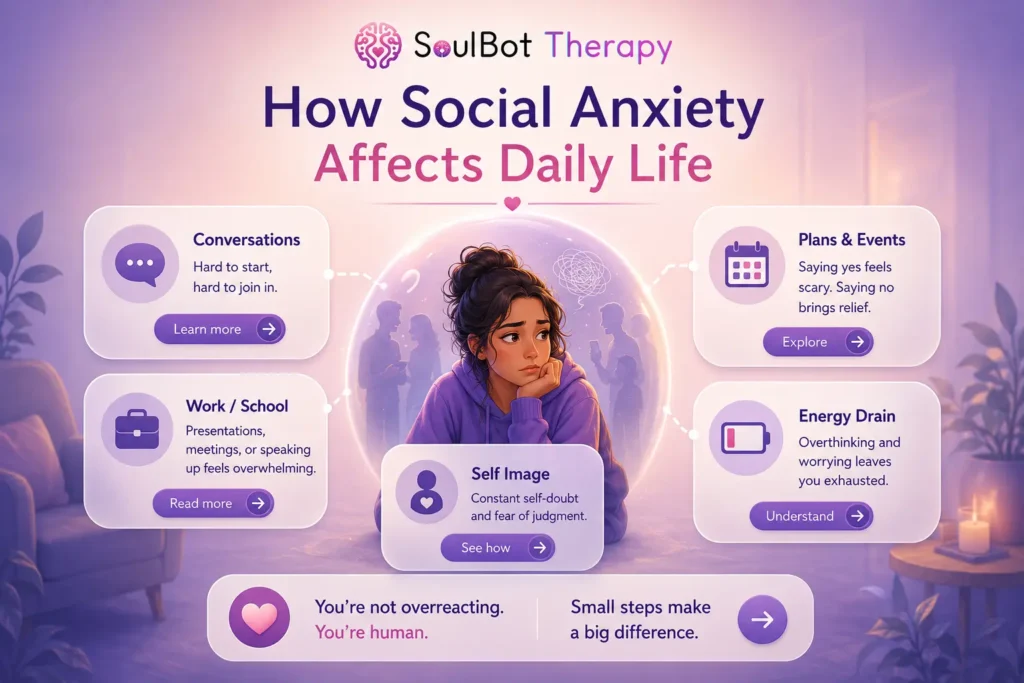
How Social Anxiety Affects Daily Life?
The symptoms of social anxiety disorder can significantly disrupt work and social life, resulting in a lack of social support, low achievement at work, reduced quality of relationships, and a reduced quality of life.
In practice, this looks like:
- Turning down promotions or opportunities that involve public speaking or visibility
- Struggling to make or keep friendships because social situations feel too costly
- Feeling deeply lonely while simultaneously avoiding the situations that could relieve that loneliness
- Dating feels impossible, the fear of judgment, and the idea that vulnerability feels dangerous.
- Exhaustion from the constant effort of managing anxiety in situations others find effortless.
Social anxiety disorder is associated with other mental health concerns, including low self-esteem, depression, and substance misuse. This is why it is worth taking seriously not as a personality quirk, but as something that deserves real support.
Want to go deeper? Gillian Butler’s Overcoming Social Anxiety and Shyness is one of the most practical, CBT-based guides for understanding and managing social anxiety in everyday life.Social Anxiety vs Relationship Anxiety
Social anxiety disorder refers to fear specifically in social situations, while relationship anxiety is specifically about fear within romantic relationships. Relationship anxiety and social anxiety often overlap.
But they share common roots: fear of judgment, fear of rejection, hypervigilance to others’ reactions, and self-consciousness that gets in the way of genuine connection.
Many people with social anxiety also experience relationship anxiety, the same fears that make group settings feel threatening, make intimacy feel risky, too.
Read more: What Is Relationship Anxiety? Signs, Causes, and How to Deal With It?
Can Social Anxiety Be Treated?
Yes, completely and genuinely yes.
With appropriate treatment, it is possible to significantly reduce the symptoms of social anxiety disorder, which can greatly improve quality of life.
The most effective approaches include:
- Cognitive Behavioural Therapy (CBT): the most well-researched treatment for social anxiety, helping you identify and challenge the thoughts that fuel the fear and gradually reduce avoidance behaviours.
- Exposure therapy: gradually facing feared situations in a safe, supported way, building evidence that the feared outcome does not happen or that you can handle it if it does.
- Medication: SSRIs and SNRIs are often prescribed for social anxiety disorder and can be effective, particularly in combination with therapy.
- Mindfulness and self-compassion: reducing the self-critical commentary that social anxiety feeds on.
Read more: Pre-Social Anxiety: How to Calm Nervousness Before Social EventsHow SoulBot Can Help?
Social anxiety can make reaching out for support feel like exactly the kind of social situation you are trying to avoid.
Soululu removes that barrier. It is private, available at any time, and completely free of the judgment that social anxiety makes you fear. Whether you want to process how a social situation went, work through what you are feeling, or just have somewhere to put the anxiety, Soululu is there.
💬 Start a conversation with Soululu whenever you are ready.
🧠 Want to understand your anxiety patterns better? Take the free Emotional Intelligence Test to learn how you process and respond to emotions