
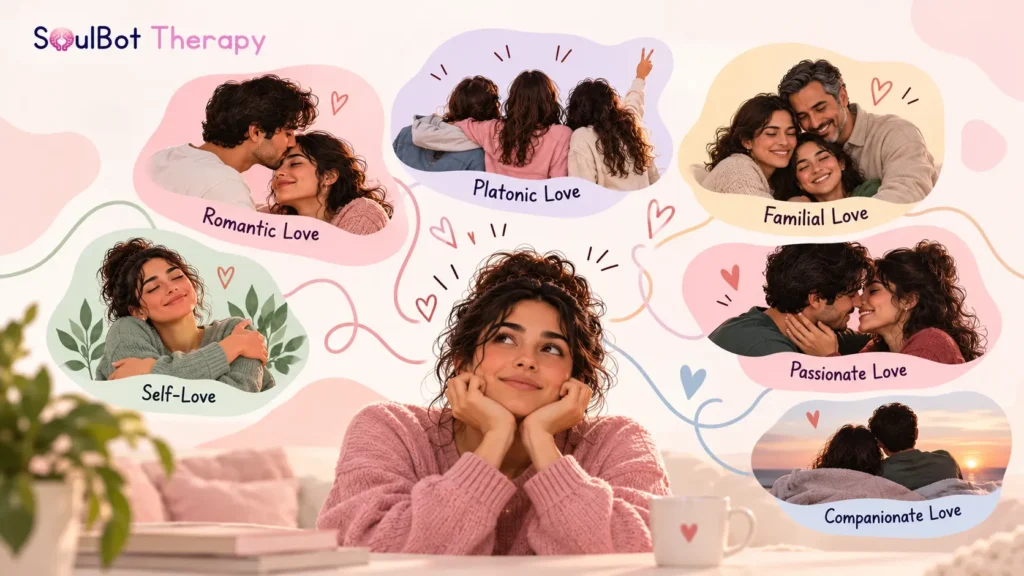
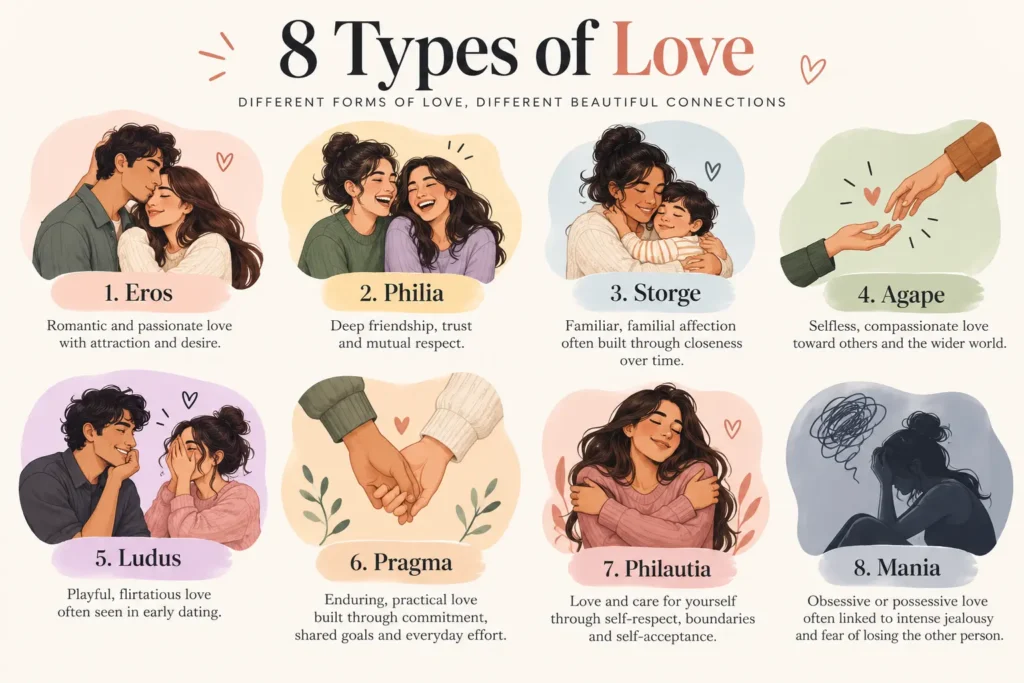
Love can describe many different kinds of connection, from romantic attraction and lifelong friendship to family bonds and your relationship with yourself. Though there is no single, universally accepted list of “types of love, ” one popular framework uses eight Greek-derived terms: Eros, Philia, Storge, Agape, Ludus, Pragma, Philautia, and Mania.
Here’s what each one means in everyday life.
What Are the 8 Types of Love?
| Type of love | Simple meaning | Often seen in |
|---|---|---|
| Eros | Romantic and passionate love | Romantic relationships |
| Philia | Deep friendship and trust | Close friendships |
| Storge | Familiar, familial affection | Families |
| Agape | Compassionate, selfless care | Humanity and community |
| Ludus | Playful, flirtatious love | Dating and early romance |
| Pragma | Enduring, practical love | Long-term partnerships |
| Philautia | Love and care for yourself | Your relationship with yourself |
| Mania | Possessive or obsessive love | Unhealthy relationship patterns |
1. Eros: Romantic Love
Eros describes passionate or romantic attraction.
It can include desire, excitement, physical attraction, and a desire for emotional or physical closeness with another person.
Eros can be powerful, especially early in a relationship, but attraction alone does not tell you whether the relationship is healthy or sustainable.
If you’re trying to tell intense attraction from unhealthy intensity, read Love Bombing vs Genuine Love.
2. Philia: Friendship Love
Philia is the love found in close friendship.
It grows through:
- Trust
- Shared experiences
- Mutual respect
- Loyalty
- Feeling understood
A romantic partner can also become someone you experience Philia with. Many long-term relationships contain both friendship and romantic attraction.
3. Storge: Familial Love
Storge refers to the familiar affection often associated with family relationships.
You might experience it toward:
- Parents
- Siblings
- Children
- Extended family
- People who feel like chosen family
Storge often develops through familiarity and long-term attachment rather than romantic attraction.
Family love can be deep while still requiring healthy boundaries.
4. Agape: Compassionate Love
Agape describes broad, selfless, or compassionate care.
Rather than focusing on romantic attraction, it describes concern for another person’s well-being or care extended to a community or humanity more generally.
Agape shouldn’t be confused with endless self-sacrifice.
Caring about someone does not require ignoring your own needs or boundaries.
5. Ludus: Playful Love
Ludus is playful, flirtatious love.
Think:
- Flirting
- Teasing
- Butterflies
- Playful dates
- Enjoying the excitement of attraction
It often appears during early dating.
Ludus isn’t automatically shallow. It simply describes the lighter, playful side of attraction rather than deep commitment.
6. Pragma: Enduring Love
Pragma describes love built to last.
It can develop when two people keep choosing the relationship through everyday life, not only when things feel exciting.
Pragma may involve:
- commitment
- compromise
- shared goals
- reliability
- accepting imperfections
- building a life together
It is often associated with long-term partnerships where love becomes less about constant intensity and more about consistency.
7. Philautia: Self-Love
Philautia refers to your relationship with yourself. Healthy self-love does not mean believing you’re better than everyone else.
It can mean:
- Respecting your needs
- Setting boundaries
- Caring for yourself
- Accepting imperfections
- Not making your worth completely dependent on someone else’s approval
Your relationship with yourself can also influence how you approach closeness, boundaries, and reassurance in other relationships.
8. Mania: Obsessive or Possessive Love
Mania describes love characterized by obsession, possessiveness, or intense jealousy.
It may look like:
- Constantly needing reassurance
- Becoming consumed by the relationship
- Extreme jealousy
- Fearing abandonment
- Trying to control a partner
Intensity is not automatically proof of deeper love.
If a relationship repeatedly involves control, manipulation, or fear, focus on the behavior rather than romanticizing the intensity.
Can You Experience More Than One Type of Love at Once?
Yes. These categories aren’t boxes every relationship must fit neatly into.
A long-term romantic relationship might contain:
Eros — attraction
Philia — friendship
Pragma — enduring commitment
A relationship may also change over time.
Early Ludus may develop into Eros, while years of shared experience may strengthen Philia and Pragma.
This is why asking “Which type of love do I have?” may be less useful than asking:
What forms of connection are actually present in this relationship?
What Does Psychology Say About Types of Love?
Psychology uses several different models of love.
One influential model is psychologist Robert Sternberg’s Triangular Theory of Love. Instead of the Greek-derived categories above, Sternberg explains romantic love through three components:
- Intimacy — emotional closeness and connection
- Passion — attraction and desire
- Commitment — choosing to maintain the relationship
Different combinations of these three components can produce different relationship experiences.
For example, intimacy without passion or commitment may resemble friendship, while intimacy plus commitment is often described as companionate love.
The important distinction is:
The eight love styles describe different ways we talk about love. Sternberg’s model explains romantic relationships through different combinations of intimacy, passion, and commitment.
They are related ideas, but they are not the same framework.
Which Type of Love Is the Strongest?
No single type of love is automatically strongest.
- Passion may feel intense.
- Friendship may feel secure.
- Long-term commitment may feel steady.
- Self-love may help you protect your boundaries.
What matters more is whether the relationship includes respect, safety, reciprocity, and the forms of closeness that matter to the people involved.
How Do You Prefer to Give and Receive Love?
The type of love you experience and the way you express affection are different questions.
SoulBot’s Love Language Test can help you reflect on how you prefer to give and receive care through affection, time, words, support, and other forms of connection.
If you’re trying to understand what a particular relationship means to you, you can also talk it through with Soululu and explore what you’re feeling without having to label it immediately.