

The Psychology of Laziness: What’s Actually Going On?

Last Updated: July 19, 2026
Psychology of Laziness
Table of Contents

Quick Answer: What Causes Laziness?

What we call laziness is often caused by low energy, poor sleep, overwhelm, fear of failure, unclear goals or emotional avoidance.

It does not always mean you lack discipline. You may want to act but feel unable to start because the task feels stressful, confusing or unrewarding.

Before calling yourself lazy, ask:

  • Am I physically tired?
  • Am I avoiding an uncomfortable feeling?
  • Is the task too big or unclear?
  • Do I care about the goal?

Find the barrier first. Then choose the right solution.

What Does Psychology Say About Laziness?

Psychology looks beyond the label “lazy” and examines what is stopping a person from acting.

The real issue may be:

  • low motivation
  • mental or physical fatigue
  • procrastination
  • anxiety
  • perfectionism
  • fear of failure
  • lack of purpose
  • difficulty planning the next step

Calling yourself lazy describes what you are not doing. It does not explain why.

What Are the Main Causes of Laziness?

1. Low Physical or Mental Energy

Poor sleep, long working hours, stress, and emotional exhaustion can make even simple tasks feel overwhelming.

Sleep loss can affect attention, working memory and decision-making, making it harder to begin or complete tasks.

Before pushing yourself harder, check whether you genuinely need rest.

Related: Why Do I Feel Tired All the Time?

2. The Task Feels Overwhelming

“Complete the project” feels intimidating because it has no clear starting point.

“Open the document and write the first heading” feels manageable. You may not be avoiding effort. You may need a smaller and clearer next step.

3. You Are Avoiding an Emotion

Sometimes you are not avoiding the task itself. You are avoiding the emotion attached to it.

That emotion may be:

  • boredom
  • uncertainty
  • fear of failure
  • fear of criticism
  • embarrassment
  • self-doubt

Research suggests that procrastination can provide temporary relief from unpleasant task-related emotions, even though it creates more stress later.

4. You Do Not Expect Your Effort to Work

Motivation falls when you believe:

  • “I’ll probably fail.”
  • “I’m not good enough.”
  • “It won’t make a difference.”
  • “I have already fallen too far behind.”

A major review of procrastination research identified task unpleasantness and low confidence in one’s ability as important predictors of delay.

5. The Goal Does Not Feel Meaningful

It is harder to work toward a goal that feels forced, unclear or disconnected from what you value.

Ask:

Why does completing this matter to me?

Not every task will become enjoyable. But knowing its purpose can make the effort feel worthwhile.

6. Anxiety or Depression May Be Involved

Anxiety can make you avoid calls, emails, applications or decisions because you fear making a mistake.

Depression can involve low energy, reduced interest and difficulty concentrating. These symptoms may look like laziness from the outside, but they require understanding rather than criticism.

You can use SoulBot’s free anxiety test to reflect on your current patterns. It is a self-assessment, not a diagnosis.

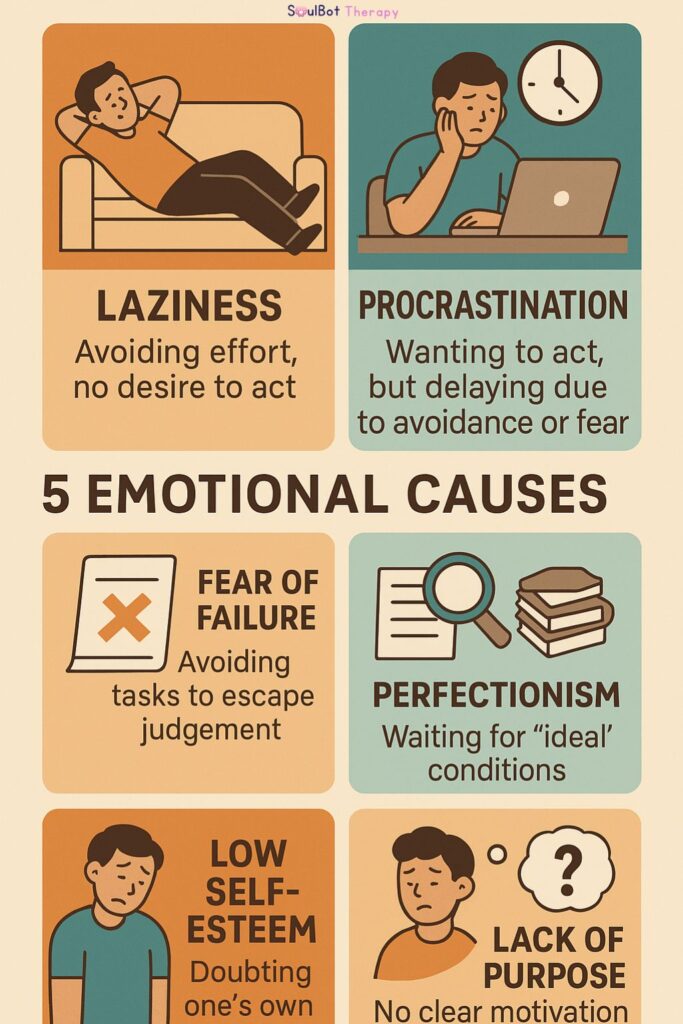
Procrastination vs Laziness: What Is the Difference?

ProcrastinationLaziness
Delaying a task you intend to completeA general reluctance to put effort
Often involves stress or guiltMay involve little interest in the task
Commonly linked to fear or discomfortMay reflect low energy or low value
You usually care about the outcomeThe outcome may not feel important

Many people who call themselves lazy are actually procrastinating because a task feels uncomfortable or overwhelming.

Related: Self-Sabotage: Why We Do It and How to Stop
psychology of laziness

Research suggests procrastination can become a form of short-term mood repair: avoiding an uncomfortable task brings temporary relief, even when it creates more stress later.

How to Overcome Laziness?

1. Use the Energy–Emotion–Clarity Check

Ask yourself:

  • Energy: Do I need rest?
  • Emotion: What feeling am I avoiding?
  • Clarity: Do I know the next step?

A productivity trick will not fix exhaustion. Rest will not fix unclear instructions.

2. Make the First Step Smaller

Replace:

“I need to finish everything.”

With:

“I will work on this for five minutes.”

Starting is often harder than continuing.

3. Remove One Distraction

Put your phone in another room, close unused tabs or prepare what you need before starting.

Do not depend entirely on motivation. Make the task easier to begin.

4. Stop Waiting to Feel Ready

Motivation does not always arrive before action. Sometimes it appears after you begin and see progress.

5. Rest Without Guilt When You Need It

Rest is useful when it restores your energy.

Avoidance usually leaves you more anxious about the same task. Plan your break, take it fully and decide when you will check in again.

When Is It More Than Laziness?

Consider speaking with a doctor or mental health professional if low energy or motivation:

  • lasts for two weeks or longer
  • affects work, studies or relationships
  • makes basic care feel difficult
  • continues even after proper rest
  • comes with persistent sadness or hopelessness
  • causes you to lose interest in things you normally enjoy

You may need support, not a stricter routine.

A Quick Soululu Check-In

The next time you think, “I’m lazy,” pause and ask:

Am I tired, afraid, overwhelmed or unclear?

Talk to Soululu to reflect on what is blocking you and identify one realistic next step. Soululu supports self-reflection. It does not diagnose conditions or replace professional care.

Final Thought

Laziness is a label. It is rarely the full reason.

Check your energy, emotions and expectations. Once you understand the real barrier, you can respond with rest, support, clarity or one small action.


FAQ

Frequently Asked Questions

Common causes include low energy, poor sleep, overwhelm, unclear goals, emotional avoidance, fear of failure and tasks that feel unrewarding.
No. Laziness is not a mental health diagnosis. However, persistent low energy or motivation may be connected to depression, anxiety, sleep problems or physical health conditions.
Yes. Anxiety may cause avoidance and overthinking, while depression may cause low energy, reduced interest and concentration problems.
Procrastination means delaying something you intend to do, often because it feels uncomfortable. Laziness is a broader label for avoiding effort or lacking interest.
Therapeutic laziness is an informal phrase for intentional, guilt-free rest. It can be helpful when rest restores your energy, but it is not a clinical treatment or diagnosis.

About the Author:

Picture of Sonali Shastri

Sonali Shastri

Sonali Shastri is the Co-founder of SoulBot Therapy and a passionate writer dedicated to helping individuals navigate their emotional and spiritual journey. With a background in psychology-based writing and storytelling, she specializes in creating content that blends empathy with impact. Her work focuses on mental wellness, self-discovery, and breaking the stigma around emotional health through honest, relatable narratives.

More Blog Posts

You May Look Fine, But It Feels Heavy Inside

Ready to explore your full SoulMap?

🟢The Grounded Socializer

Social Moments Feel Mostly Manageable

Ready to explore your full SoulMap?

🟡The Quiet Overthinker

You Show Up, But Your Mind Replays It

Ready to explore your full SoulMap?

🟠The Cautious Connector

Connection Matters, But It Can Feel Hard

Ready to explore your full SoulMap?

Your emotional compass wants love, but stays cautious.

Ready to explore your full SoulMap?

Avoidant Attachment
Independent, With Boundaries

Your emotional compass values space and self-reliance.

Ready to explore your full SoulMap?

Anxious Attachment
Deep, But Seeking Reassurance

Your emotional world is intense and connection-driven.

Ready to explore your full SoulMap?

Secure Attachment – Calm & Connected

Your emotional compass feels steady and safe.


Ready to explore your full SoulMap?

The Storm Mind (Severe Anxiety)

Intense, overwhelming, and hard to control at times.

Ready to explore your full SoulMap?

The Overthinker (Moderate Anxiety)

Your mind is active, often running ahead of you.

Ready to explore your full SoulMap?

The Gentle Worrier (Mild Anxiety)

Occasional overthinking, but still in control.
You feel stress at times, but it doesn’t take over your day.

Ready to explore your full SoulMap?

Moderately Emotionally Available- Opening, With Caution

Your emotional compass shows growth, with a few guarded zones.

Ready to explore your full SoulMap?

Your emotional compass points toward openness and connection.

Ready to explore your full SoulMap?

Your emotional compass leans toward self-protection right now.

Ready to explore your full SoulMap?

Submissive Personality

Gentle and supportive. You bring calm energy and emotional depth to every space.

Ready to explore your full SoulMap?

Balanced Personality

Grounded and fair-minded. You value harmony, empathy, and shared understanding.

Ready to explore your full SoulMap?

Dominant Personality

Driven and decisive. You lead naturally, think fast, and act with purpose.

Ready to explore your full SoulMap?

Homosexual —
True North, Same-Gender

Your love compass points to people of the same gender.

Ready to explore your full SoulMap?

Restless and always in motion. May talk fast, act quickly, or jump between ideas. 

Ready to explore your full SoulMap?

High Likelihood
ADHD Combined Type (ADHD-C)

Shows both inattentive and hyperactive traits where focus shifts, energy spikes, and motivation come in waves.

Ready to explore your full SoulMap?

Low Likelihood
ADHD Inattentive Type (ADHD-I)

Often loses focus and misses details, with drifting thoughts that leave tasks unfinished.

Ready to explore your full SoulMap?

🔧 The Virtuoso - ISTP

Hands-On Expert

Ready to explore your full SoulMap?

📋 The Logistician - ISTJ

Steady Rock

Ready to explore your full SoulMap?

🌻 The Adventurer - ISFP

Gentle Spirit

Ready to explore your full SoulMap?

🛡️ The Defender - ISFJ

Caring Guardian

Ready to explore your full SoulMap?

🤔 The Logician - INTP

Curious Explorer

Ready to explore your full SoulMap?

🏛️ The Architect - INTJ

Strategic Mastermind

Ready to explore your full SoulMap?

🦄 The Mediator - INFP

Gentle Idealist

Ready to explore your full SoulMap?

🔮 The Advocate - INFJ

Quiet Visionary

Ready to explore your full SoulMap?

🚀 The Entrepreneur - ESTP

Action Hero

Ready to explore your full SoulMap?

📊 The Executive - ESTJ

Results Driven

Ready to explore your full SoulMap?

🎭 The Entertainer - ESFP

Life of the Party

Ready to explore your full SoulMap?

🤗 The Consul - ESFJ

Heart of Gold

Ready to explore your full SoulMap?

🧠 The Debater - ENTP

Mental Gymnast

Ready to explore your full SoulMap?

👑 The Commander - ENTJ

Strategic Powerhouse

Ready to explore your full SoulMap?

🎨 The Campaigner - ENFP

Creative Visionary

Ready to explore your full SoulMap?

🌟 The Protagonist - ENFJ

Natural Born Leader

Ready to explore your full SoulMap?

🤗 Physical Touch

Hugs Over Hype

Ready to explore your full SoulMap?

🕰 Quality Time

Presence Over Presents

Ready to explore your full SoulMap?

🎁 Receiving Gifts

Thoughtful Tokens, Big Feelings

Ready to explore your full SoulMap?

🤝 Acts of Service

Love in Action

Ready to explore your full SoulMap?

Words of Affirmation

You Speak from the Heart

Ready to explore your full SoulMap?

Gay, Lesbian, or
Queer and Proud

Your love compass points to the same gender

Ready to explore your full SoulMap?

Bisexual -
Go with the Flowy

Your love compass swings in the middle

Ready to explore your full SoulMap?

Heteroflexible —
Some Wiggle in the Compass

You’ve got a touch of bi-curiosity

Ready to explore your full SoulMap?

Hetero -
Straight Up Honest

Your love compass points to the opposite sex.

Ready to explore your full SoulMap?